Positive experiences and peaceful moments make good memories
Issue 64 : Jan/Feb 2009
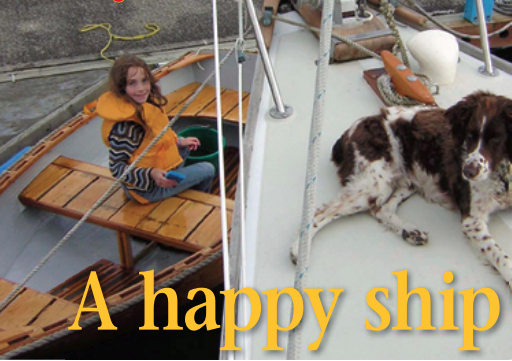
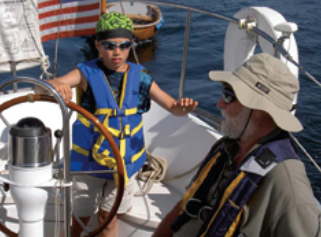
My 9-year-old granddaughter, Piper, escaping the tedium of grown-ups talking about boring things, was burrowed deeply into Kuma’s fo’c’s’le with her stash of favorite books. Later in the afternoon, to everyone’s surprise, she climbed out, grabbed a life jacket and began bailing the dinghy. She worked with a sponge and small plastic bucket, scrubbing hard, scraping at seagull droppings and hardened seaweed with a sharp stick. More than content, she was downright pleased with herself. Further buoyed by praise from the captain for a job well done, she went on to swab down the decks of the mother ship, cleaning off muddy paw prints left by the ship’s dog, Scout (who watched her intently), and cleaning out cockpit detritus. She’d never been so happy on the boat.
The next day, during the long haul home, her brother, Nick, whose patience had become depleted along with the batteries in his menagerie of electronic devices, relieved the skipper and discovered that he could sail to windward like a witch. It was cold and raining hard but he stood fast, ignoring the weather-weary groans of those lubbers huddled down below. He held to a difficult compass course with grim determination and the semblance of a smile.
Playing an important role
I think the boat intercepted the everyday lives of these two and did what boats are meant to do. Piper and Nick discovered something — not just about bailing dinghies and steering the boat, but something else. They found that they were a vital part of something larger than themselves. And if adventure, as has been said, is a disaster that turns out all right, they found that too. It was a kind of happiness, unique to the occasion and borne of what the world required of them, not just what they required of it.
One day, I hope they’ll discover the joy of pushing off — of watching someone along the docks watching them and waving and smiling at the sight of their small boat, well-handled and bound for islands. I hope they’ll notice the sails harden and draw well, telltales streaming back almost perfectly. And I hope they’ll look back to see a well-scrubbed dinghy following along, marking speed with every tug on the painter and every foamy whisper.
Happiness on a small boat takes many forms. It happens unpredictably and when least expected. It’s often a personal thing and cannot be shared. It comes as the satisfaction of finding a good anchorage and setting the hook well and of sitting in the cockpit watching a mast line up against a flagpole, hard evidence that the boat’s not dragging . . . little things like that.
It’s hard to beat waking up to settled weather on an August morning, wiping dew off varnish before anyone’s up, and looking forward to another day at the same anchorage . . . unless it’s feeling a cold wet fog roll in through the companionway, building a fire in the woodstove, and looking forward to another day at the same anchorage.
I’m always happy sailing under the Tacoma Narrows Bridge in the current that sweeps Kuma into the southern reaches of Puget Sound at around 16 knots. Almost every year it happens and every year it’s like the first: rushing under the great bridge with the seals and the small fishing boats, thinking about those huge cephalopods on the bottom, watching the herring gulls wheeling against the sun. And if there’s a buoy available at Eagle Island and I can row among seals at sunrise, contemplating the next couple of weeks, I’m happy.
Happiness, of course, is the other side of the coin from something else, without which we cannot hope to know it. It’s been said that the difference between powerboaters and sailors is that the former expect, as we do with cars, that everything will work. Sailors, on the other hand, tend to expect something to fail at any time and that they’ll have to fix it themselves. We’re used to it and it keeps us from getting too giddy when things go well. Getting through failures of equipment (and nerve) produces its own kind of happiness, a kind of happiness the skipper may share with few others.
Satisfaction not guaranteed
Be that as it may, the captain must bear some responsibility for keeping his passengers and crew in good spirits. It’s a popular misconception that a day on a pleasure boat is some guarantee of pleasure. In fact, happiness afloat is illusive, unavailable to many, and certainly nothing to be taken lightly or for granted.
It doesn’t matter how safe, comfortable, and convenient things are made on deck or down below or how much good humor is brought to the situation. It doesn’t matter how many cold drinks and sandwiches are ready or what hidden joys the destination may hold; sometimes people can find better things to do than shuffle about on a shiny plastic bench in a tangle of ropes and dangerous-looking objects. You can’t find a boat big enough, fast enough, new enough, or enough like home to please everyone.
Even old Scout shakes most of the time when we’re under way and lives only to get ashore. I have an idea that fear is the basis of his discontent. It’s not boredom, as we once thought; it’s fright. We’ve deprived him of every- thing that makes sense to a dog — smells and taste (he won’t eat or drink when we’re under way), the chattering of squirrels, and even a few trees and shrubs to rub his back against. He’s jostled about with no grip on the slick seats, strapped into a pet harness and life jacket or wooly sweater when it’s cold enough, and when the temperature gets into the 80s and 90s he gets doused with buckets of seawater.
If he gets within smelling distance of another boat he perks up until he loses the scent, but thereafter his misery knows no bounds until he rides the dinghy, his only friend, to shore. Happiness when we sail has come to be, for old Scout, the Viking Kennel. Sailing isn’t for everyone, man or beast, and there’s no reason to think that it is.
I think some people feel a bit like Scout — alien and lost in a foreign country and fearful. There is not only the fear of wind and deep water and the creatures that live there but also the fear of the unfamiliar. There is a fear of not knowing what you should do on a boat that obviously requires that all sorts of things must be done. Some good people are afraid of appearing to be clumsy in the use of a new language. Pretending to be bored is a shield against this fear of the unknown.
No shouting
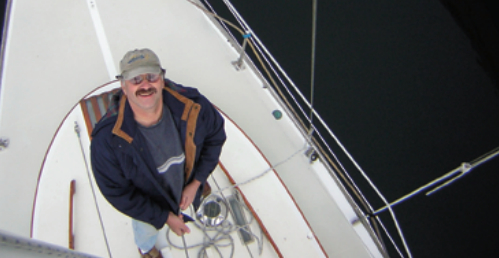
People become unhappy on a small boat when they are held responsible for things they don’t know. It helps if the skipper is a good teacher — if he or she knows the lesson plan and has devised a simple method that’s well within the capability of the crew. The legendary shouting matches that can precede the abandonment of sailing happily together are often a result of not thinking ahead. There is sometimes a tendency for the inexperienced skipper to expect his crew to compensate for his own lack of knowing how to do something, especially when things begin to unravel.
A case in point: letting go the anchor. The engine is running, making communication difficult at best. The crew goes forward to make ready the anchor but he or she can’t seem to unbend the lashing holding it in place. It’s taking too long to satisfy the helmsman who shouts,
“WHAT’S GOING ON UP THERE?”
“WHAT?”
And louder, “I SAY, WHAT’S GOING ON UP THERE?”
This is entirely lost in the wind but what is not lost is the skipper’s obvious dissatisfaction with what’s happening or not happening on the bow. The foredeck hand, trying to free the anchor from its lashing, throws more words against the wind.
“WHAT?”
Another reply is lost to the sounds of a roaring engine.
The skipper moves forward and when he’s about halfway there, he sees the nylon cable slipping below the waves and moving toward the stern. He rushes back to the helm and backs down. There’s a tad too much throttle or not enough, the rudder is hard over from a forgotten maneuver, the current grabs the bow, pushing the boat toward rocks, and so on and so forth.
Thinking ahead is important to happiness as well as good seamanship. A few carefully worked out hand signals can take the place of shouting; a clearer sense of what’s happening, for everyone concerned, is as important as a division of labor. Smiles all ’round is a good start, too, but the captain is responsible. That’s what skippers are for.
Happiness in small numbers
Happiness on a small boat may well be inversely proportional to the waterline length but small boats with more hands on board are definitely not the merrier. Some small boats are almost entirely taken up with berths. I counted five in one 18-footer at a recent boat show. The salesman said that two more could sleep on the ample cockpit seats.
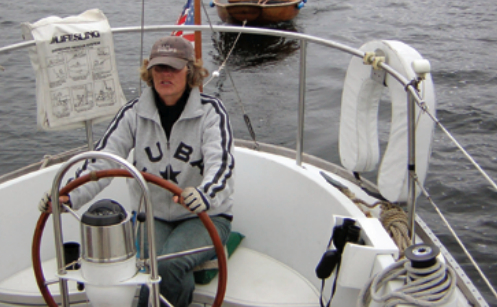
My feeling is that just one shipmate at a time works best. Maybe two, but one good one is hard enough to find. I’ve also shared a happy ship with two good friends but more than that and talk inexorably moves to second mortgages and the Academy Awards, children, Paris Hilton, and lawn fertilizers.
The casual and impromptu thrill of being a part of the outdoors and the here and now and the uniqueness of being on a small boat gets lost. You can miss an eagle being mobbed by crows or scooping up a salmon. The pterodactyl-like cries of a lumbering great blue heron are easily drowned out by cockpit speakers. The gathering cat’s-paws that call for alertness at the helm go unnoticed along with dolphins and seals. Before you know it, the special pleasure of being where you are is gone.
A rendezvous at a good picnic spot close to the water’s edge can produce happier times for those who’d rather talk than watch. Row the dinghy ashore to a gathering of friends on the beach. You’ll be surprised at the amount of attention the little dink garners from otherwise water-challenged people. Before long, bored adolescents will put aside their iPods and vie for a go at the oars. They can get away from the rest of the crew and become masters of their own ships. Dinghies, like puppies and small children, have a way of bringing smiles, uncontrollably, to the faces of the otherwise disgruntled.
But failing in the pursuit of happiness with others, there is a great deal to be said for the joys of singlehanded cruising and for learning how to keep oneself happy at sea when there’s no one else to entertain or look after. Sailing alone not only instructs in boat handling techniques otherwise not acquired, but it also gets us closer to the essence of what led us to sailing in the first place: freedom and independence, self-sufficiency, and a renewed acquaintance with our better angels.
Richard Smith is a contributing editor with Good Old Boat. He has built, restored, and maintained a wide variety of boats and sailed them in Michigan lakes and Oregon reservoirs, and from harbors and mud berths in the Irish Sea. He and his wife, Beth, currently sail Kuma, an Ericson Cruising 31, in the Pacific Northwest.
Thank you to Sailrite Enterprises, Inc., for providing free access to back issues of Good Old Boat through intellectual property rights. Sailrite.com