Four fateful words that spelled six years of work
Issue 65 : Mar/Apr 2009
Something must have blinded me to the first words in the Findings and Recommendations section of our boat’s pre-purchase survey: “Major deck repair needed.” The language was very clear. I know what all those words mean. “Major” doesn’t usually mean insignificant, right? So then, why is it that I bought the boat anyway that January, had it trucked 800 miles in a blizzard, and paid for a marina slip for the coming spring?
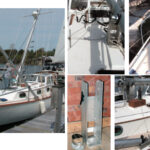
The boat, a 1964 Alberg 35 sloop that I found online, listed with a broker in Maryland, seemed to be the perfect boat for us. And the price seemed too good to be true. Two months and two visits later, the Maryland boatyard chipped away the ice, hauled the boat, and loaded it onto a truck bound for Wisconsin. Several days later, I took delivery of a major deck project.
At this point my memory gets kind of cloudy. I think that if I had had the good sense to be psychoanalyzed at the time I would have heard terms like “pathologically optimistic” or perhaps “reality deprived.” I do, unfortunately, remember plopping down $2,500 for the slip and arranging to double my boatyard fees by moving into a shed.
I won’t bore you with the details of the six years between then and now, like the time the shed blew away in a storm, exposing my newly laid balsa core to the elements. Or the two sons I’ve had since buying the boat. (One son equals half as much time to work on the boat. Two: forget it.) I won’t discuss the cost of six years of indoor storage or even the expense of 13 gallons of epoxy. And I don’t want to talk about the health benefits of grinding and sanding epoxy, polyester, and fiberglass.
I do want to share what I have learned over the course of this experience. If you do anything long enough you are bound to learn a few things. For those who are not familiar with the process of re-coring balsa-cored boat decks, a few methods are available.
Work with gravity
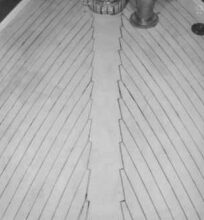
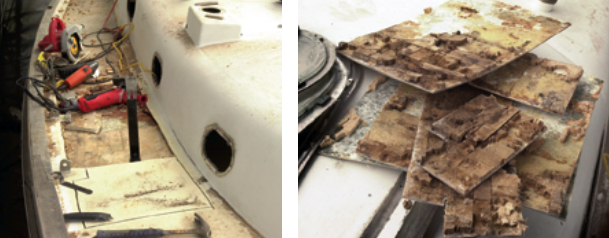
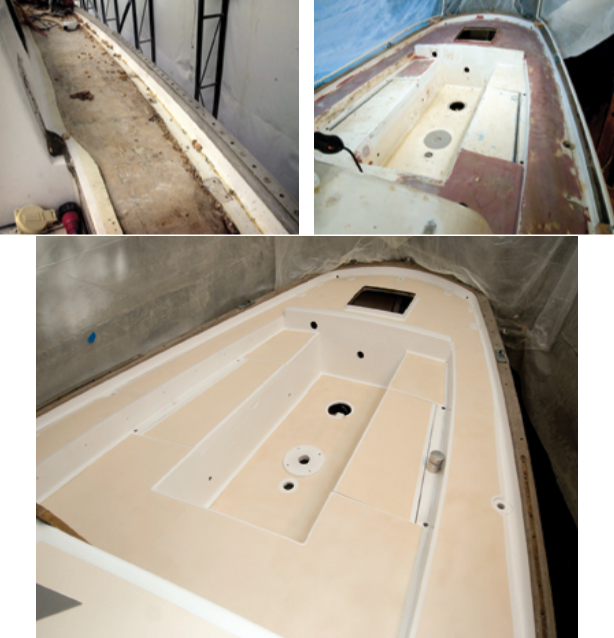
The one I opted for involved making a shallow cut from the top of the deck and removing the top skin. I then scraped out the wet or rotted balsa core, replaced it with new balsa, and replaced the top skin. In many places, where the top skin was in bad shape from repair attempts by previous owners, I had to re-laminate it using fiberglass materials and epoxy.
Many people choose to do the work from underneath to preserve their molded non-skid. My opinion is that this job is hard enough without gravity working against you.
Applying hindsight, the biggest and most obvious mistake I made was not giving enough weight to the survey. I blame this in part on my own evaluation of the conditions of the deck. In January, sodden balsa-cored decks can feel pretty firm underfoot. Ice is structural until it melts. The second biggest mistake I made was underestimating the length of the project. Anyone who has ever tackled a boat project knows that it always takes longer than you think it will. I knew that, but I still underestimated by six years.
Along the way I made many, maybe thousands, of mistakes with the workhorse power tool of choice for the deck re-corer, the angle grinder. It’s surprising how comfortable a guy can get hacking, sawing, and drilling into his boat. All told, I spent weeks filling errant grinder marks in gelcoat. However, by the end, I gained a proficiency that I had only dreamed of in the beginning. I was able to tackle new areas with surgical precision. Now that I have attained a mastery of the craft, I hope to never use those skills again.
Wrong again
When I began the project, I believed I was well equipped with the necessary tools for the job. Oh no, not so! When you set out to do battle, you had better be properly armed. This proved not to be a job for cheap tools. The hardness of fiberglass-reinforced materials is not to be underestimated. Terms like “carbide-tipped” and “industrial-grade” entered my vocabulary. Later, once the cutting is done and things are rebuilt, everything needs to be sanded fair. I now own, literally, a boatload of sanding tools.
An unanticipated benefit to working on the same project for the better part of a decade is that, in addition to growing older and wiser and grayer and poorer, you have a lot of time to contemplate what you ultimately would like your boat to be at the end of it. I wanted my boat to be a Hinckley. Of course, I fell short of this goal, but I was able to incorporate some of the deck features of my favorite boats. I ultimately ended up with a bulletproof deck with some nice design improvements and a decreased likelihood of experiencing future deck leaks.
For those of us who like older boats or can’t afford a newer boat, soft spots on deck are an unavoidable reality. They offer a strong bargaining point for a potential buyer and great deals can be found on boats that need deck repairs. Boatyards are thrilled to do the work for you. For a 35-foot boat with substantial core issues, you can expect a repair quote in the $10,000 to $20,000 range.
Be realistic
Does this mean I think you should avoid these boats? Not always but, before taking one on, you should be realistic about your economic and/or time commitment to the project. If, like me, you like power tools and toxic materials, this is definitely your dream project. If you don’t, make sure you don’t pay more for repairs than the boat is worth.
The other day a young guy was looking longingly at a 35-foot sailboat berthed next to mine at the boatyard. I asked him if he was thinking about buying the boat. He was.
He had already agreed on a price but was a little concerned about what the broker described as very soft decks. I saw in his eyes that same blind love for the boat that I had six years ago for mine. I presented a thoroughly desperate tale of my deck project, fraught with every conceivable mishap and regret. Despite my best efforts to dissuade him, I know he will buy the boat. That’s all right. I’ll have company as I move on to my next projects: grinding off bottom paint, and repowering, and re-rigging, and replumbing, and . . .
Joe Picciolo is a cinematographer when he isn’t working on his Alberg 35, Calliope. With his wife and two sons, he also sails Gakika, an Alberg-designed Bristol Corinthian, on Lake Michigan.
Thank you to Sailrite Enterprises, Inc., for providing free access to back issues of Good Old Boat through intellectual property rights. Sailrite.com