Advice from one of America’s best-known cruising authors
Issue 66 : May/Jun 2009
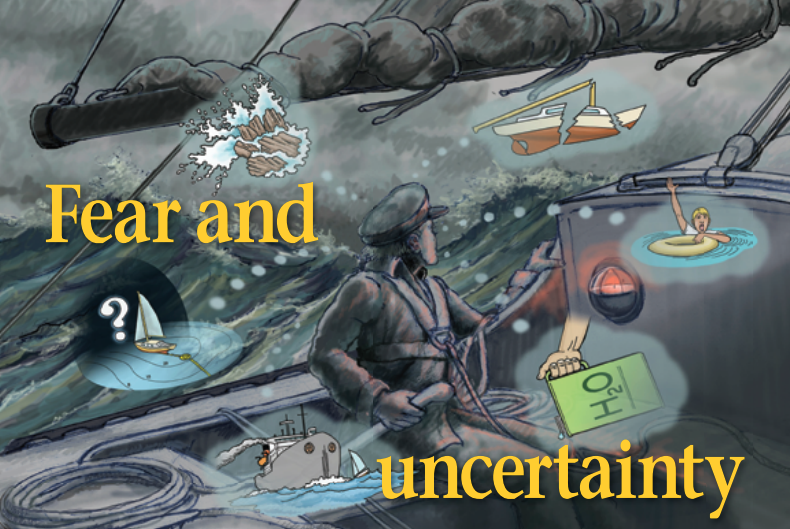
When I’m way out on the water in a small boat and a storm swoops down and the yacht starts hopping around, all sorts of crazy things flash through my mind. Will the hull crack open? Will the bulkheads give way? Will the mast come down? And what about the rudder? Oh dear, there are so many things that could go wrong.
Yet in my heart of hearts, I know the hull is strong, the bulkheads are firmly in place, and the mast and rigging are in good order. I’m aware that the boat was properly designed and built, and I’ve tried hard to keep her in good condition. Certainly the boat has come through lots of storms during her career. No doubt there will be more. She won’t sink. The crew won’t be lost.
Yet sometimes I have funny little feelings . . .
My dictionary defines fear as a state of agitation and anxiety caused by the presence of danger. Everybody knows that when you’re far out at sea and a fierce storm is raging, it’s a nervous time. It’s the moment when you hope the yacht will survive and that you’ve taken the best and most sensible measures against the wind and seas.
We all know that the worst time for a new sailor is when he (or she) faces the first storm. The shiny world suddenly becomes dark and gray. The boat makes novel and unexpected sounds and motions. Our new sailor soon discovers that he has to hang on when he moves around the boat and that his steps must be small and cautious. Because of this, a degree of uncertainty and a measure of slowness creep into everything.
Experience is key
For the people on board, experience is everything. After dealing with a dozen Force 8 to 10 problems at sea, the skipper simply accepts storms as part of the game. He uses the most suitable storm tactics, knows about ample sea room, keeps a safe distance from shipping lanes, and shows a bright light at night. Some sailors use illegal strobe lights because a high-intensity flashing light is more easily seen. Dinghies and loose gear on deck are doubly tied down to keep them quiet.
If the yacht is in reasonable order below, the first thing is to rest and be quiet. If the boat is essentially stopped, or running off before the storm, there’s certainly no need for everyone to stay awake. Or to be bleating over the radio about the perilous state of affairs.
A storm may last for three days. On the first you may think you’re going to die. On the second, you realize that the yacht hasn’t yet capsized and the bilge is dry. The mast is still up and maybe the boat will make it. On the third, you’re standing at the stove trying to concoct something good to eat. On the fourth day, the easy winds are back, you’re on course, sunning yourself in the cockpit, and thinking about the sailing life and how good it is.
A tale of two cruises
A few years back, Margaret and I were at the Kettenberg boatyard on Shelter Island in San Diego preparing for a Pacific trip. While a welder was repairing our stern pulpit, we were putting on stores, checking that we had the right charts, and dealing with a dozen small jobs.
We met a number of boatowners who were headed to Mexico and points south. In fact, two sailboats were leaving the next day. Both were 38-footers with couples as crew, and both were headed to the Marquesas Islands in French Polynesia, almost 3,000 miles to the southwest. On the afternoon before they left, we all had a little party at the boatyard, and we hoisted signal flags that spelled out, “I wish you a pleasant voyage.”
The two boats set off next morning, in light winds. Someone in the yard kept in radio contact and told us that on the second day the two yachts still had trifling winds. After three days, one boat had logged only 190 miles, the other 235.
The 190-mile couple was feeling the blues, and their radio messages were filled with gloom and doom. “We’re so discouraged,” they said, “We’ll never get there.” The next day it was, “Little wind and a big swell.” Then the slower boat said, “At this rate we may run out of food.” Apparently they were not pushing their boat very hard. Meanwhile, the faster boat had picked up the northeast trade wind and was zipping along at 140 miles per day. Soon their radio signals began to get faint and crackly.
After eight days at sea, the couple on the slower boat still had not found the trade wind. The two sailors lost their nerve. They returned to San Diego, avoided their sailing friends, and quietly put their boat up for sale.
The second boat arrived in French Polynesia after a 28-day voyage and sent back a series of glorious postcards.
What was the difference between the two boats? The crew of the slower boat was simply scared. The couple had lost all their self-confidence. It was fear and uncertainty on every side.
“The wind will never come,” they said. “Nobody’s around to help us. What if one of us gets sick?” The intrepid sailors that we had met two weeks earlier had become pathetic whiners. The gray world of fear had triumphed.
Self-imposed danger
I like to think myself a hero, but I’ve had my moments. During one of my east-about solo trips round the world, I stopped at East Falkland Island off the coast of Argentina. I wanted to fill my water tanks, which were empty because of a stupid plumbing mistake I had made. It was just after the Falklands War when all the lighthouses had been darkened and the navigational buoys removed. I went into a complicated little bay on the north side of Choiseul Sound on the east coast where the British Army had a dock and a small base. The military people kindly filled my water tanks and gave me a paper sack with three or four loaves of fresh bread.
It was already late in the day and I began to worry about sailing before dark. There was a trifling northwest wind, so I put up the mainsail and cast off. I had sailed half a mile or so when a launch with four or five men came alongside. I stopped my boat by heading into the wind and letting the mainsheet run out and asked for instructions for making my way out to sea. The officer in charge talked on and on. Finally we traded salutes and the launch sped away.
I sailed south from the bay into Choiseul Sound and turned east toward the Atlantic. By now it was dark; there was no moon. I knew there were lots of dangerous, kelp-covered rocks in the area. I should have gone back to the army base and anchored until morning, but when I looked behind me I could no longer see the entrance to the bay.
Suddenly I felt the yacht slow as we glided into a heavy field of kelp that swished along the sides of the hull. I knew that kelp will grow upward from rocks 60 feet deep or as little as 3 feet. My keel needed a little over 8 feet.
Though the weather was cold and I was wearing a heavy three-layer Musto outfit, I could feel sweat running down my back. I was scared — terrified — that I had turned east too soon and that I would pile up on rocks I couldn’t see. I eased a little south from the compass course I had laid out. I was absolutely scared to death and afraid that, by my bumbling, I had jeopardized the entire voyage and maybe my life.
The bottom was too rocky and uneven to anchor so I kept going slowly with just the mainsail up. Never was I so relieved when an hour later, the depth sounder moved from 4 fathoms to depths off the scale. The land was behind me. I was safe at sea.
Why had I been scared? Why was I a victim of fear? By my stupidity and lack of sensible action, I had allowed myself to become locked into a quicksand of darkness and danger, a situation I should have predicted and avoided.
Reasons for fear
Fear can be brought on by a fierce storm or by more quiet and subtle things. Desperation because of too little or no wind. Fear of the unknown. By a nasty navigational problem. By sickness or an accident on board. Something wrong with the boat. A crewman who has become irrational. A dozen reasons.
When you feel the pain of fear, what can you do? Each of us is different, of course, and it depends on the problem and your reactions. Maybe the weather is stormy and you’ve decided to stop the boat. After a careful look in all directions, at the sails and their furling, a check of the water depth, and wind and sea conditions, you go below, leaving a lookout if necessary. As soon as you’re in the cabin, you or someone in the crew notes the ship’s position on the chart and the time and conditions in the logbook. By now your oilskins are partially or fully off and you may think about a light feeding. The thought of food may be revolting. Yet you know you should eat and drink a little something to keep up your strength. My favorite is dry crackers with a little chicken or tuna from a small can (6 oz.) packed in spring water, not oil.
Safety lies below
During severe weather, the best place for everyone except the lookout or helmsman is below in the cabin. During the days before leaving the harbor, you, one of the crew, or yard workers, presumably screwed down all the floorboards. There are restraints (fiddles or strings) on all the shelves, and the pots and pans and loose things in the galley are tucked away after each meal. Each drawer should have a generous toggle or strong hardware to keep it closed, and under-seat lockers should have their toggles in place. Even the chart table lid should have a positive closing latch of some kind. In a storm, the motion can be severe, and it’s not the time to upset the crew with flying books, a toppled potful of hot soup, or missiles launched from the tool drawer.
A quiet, untroubled cabin can mean peace of mind — just what the captain and crew need when they’re upset and a bit nervous from the antics of a violent storm.
Except for perhaps a lookout on deck, I’ve learned that during a severe storm the best place for everyone is in his bunk — safe and dry — behind a strong leecloth. Speaking for myself, I try to relax in a narrow world that seems secure and less noisy, a private place where I can rest and collect my thoughts. I find that if my hair is on fire with worry, it’s a good time to sort things out. When I’m relaxed and at ease, fear and tension tend to disappear. If I can doze or sleep a little, all the better. If I’m slept out, I read a thriller (The Day of the Jackal) or try an easy crossword puzzle.
A survival state of mind
Let’s talk about the mental aspects of fear. Naval experts have long known that a sailor’s state of mind in a survival situation is vital. During the early days of World War II, German submarines sank hundreds of British ships in the North Atlantic. The crews had to take to the lifeboats, often in appalling conditions. It was amazing how some sailors died almost at once while others resolutely clung to life for weeks and were rescued. Survival wasn’t tied to body size or age, because many big, husky young men died the first or second day. Survival seemed more related to pluck, spirit, stoutheartedness, determination, and the will not to give up.
In other words, fight fear with resolve and determination. As Don Whilldin writes: “Enforce a positive attitude, avoid despair like the plague, and don’t allow doubt and resignation to set into your crew. Not even for one second.”
Fear is not cowardice. Fear has more to do with uncertainty and irresoluteness, which are based on unknowns and the lack of knowledge of a situation. Part of fear is anxiety and being afraid. The remedy for the sickness caused by these close- knit words is to find out what you’re afraid of and try to remedy it.
Is the boat going to sink? No, I trust her. Are you going to be run down by a giant merchant ship? Stick your head out of the main hatch and look around. If you see no ships, you can cross that one off for the moment. Is the vessel going to be swamped by big seas? Not if you’ve selected the best storm plan. Are you going to run into rocks? No, because your position shows that you’re 112 miles from land. And so on.
Stay busy, stay positive
I believe if you knew that the storm was going to last for 14 more hours, that you would have to go out on deck twice during that time to deal with a loose sail, and that tomorrow the wind and seas would be down, you could go to sleep without worry. I’m convinced that if you know all sides of a situation, you can handle it.
So when you’re at sea and nervous about the weather and other problems, pull your self together. Try not to think about how awful things are. Think positively. Give yourself projects and busy work. Sharpen your knife. Polish the brass barometer. Mend the rip in your shirt. Read about your next port in the pilot book. Measure the length of each piece of spare running rigging and label the coils . . .
If you have a crewman who is terrified of standing watch at night, don’t mock him or tell him how cowardly he is. This will only further embarrass and isolate him from you and the others in the crew. Put him on watch during the day or ask him to peel the potatoes for dinner.
Remember that, if you weren’t worried before, you shouldn’t be worried now. According to statistics from the U.K. Department of Transport, it’s 10 times safer to travel by sea than to cross the road.
A rational view
When I was a boy of 10 or 11 in our house in Cleveland, my grandfather would sometimes send me down to the basement on cold winter nights. I was told to turn down the gas flame under the hot-water tank and to put a few shovelfuls of small lumps of coal (“slack”) on the fire and reduce the draft to bank the furnace for the night.
I did as I was told but I was terrified by the darkness of the dimly-lit basement, particularly the coal bin, which I was certain was full of hidden horrors. I was so scared I felt sure my bones were rattling.
I told my grandfather about this, so he took my hand and together we went down the steps to the basement. There he turned a powerful flashlight into all the dark corners, including the coal bin. Under the clear, bright light, all I saw were concrete walls, the laundry tubs, and the workbench.
“Have you seen anything bad or spooky?” asked my grandfather.
“No, nothing at all.”
“Do you feel safe now?”
“Yes, grandfather.”
“Will you be able to handle these jobs at night on your own?”
“Yes, grandfather.”
Together we turned down the flame under the water heater and banked the furnace. My grandfather had taught me that the cure for dread and fear is to shine a clear, bright light across the cobwebs in your head. I was never scared to do my little jobs in the basement again.
Postscript
In four decades of sailing, Hal Roth cruised around the world with his wife, Margaret, twice raced around it in the singlehanded BOC Challenge, and wrote several books about their adventures. The material in this article was extracted with permission from his final book: Handling Storms at Sea: The Five Secrets of Heavy Weather Sailing, published earlier this year by International Marine. Good Old Boat ran a profile of Hal and Margaret Roth, an extraordinary cruising couple, in May Hal lost his battle with lung cancer in October 2008. We all miss him.
Thank you to Sailrite Enterprises, Inc., for providing free access to back issues of Good Old Boat through intellectual property rights. Sailrite.com