A flexible joint accommodates different expansion rates
Issue 68 : Sept/Oct 2009
Leaks and cracks are all too common when Plexiglas is fastened to a wooden hatch frame with screws. They are largely a result of the differences in thermal expansion between the two materials.
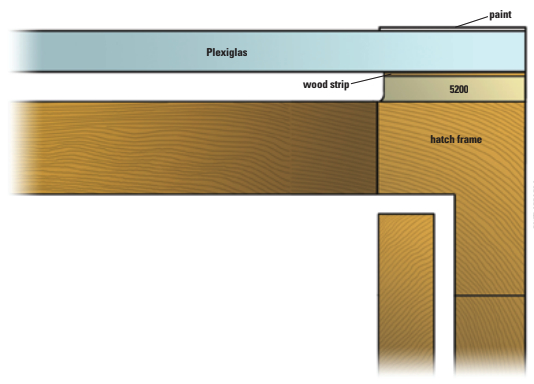
Several years ago, when I made a new hatch cover, I conceived the idea of attaching the Plexiglas to the wooden frame with nothing more than a thick layer of 3M 5200. I reasoned that, because of its remarkable adhesive and elastic properties, 5200 would be ideal for bonding the two materials, and that the thick, elastic layer would allow relative movement of the Plexiglas and wood.
This joint worked perfectly in that it didn’t leak or crack, but it fell apart after a couple of months because the 5200 separated from the Plexiglas.
To avoid this problem when I reassembled the hatch cover, I cemented very thin strips of wood to the Plexiglas, with epoxy cement, in the areas where it would be in contact with the 5200.
After the epoxy had cured, I set the Plexiglas in place, with the attached wooden strips laying on a very thick layer of 5200, and allowed the assembly to cure indoors at a constant temperature.
This hatch has been in place in my boat for three years of Florida sun and rain with no sign of leaks or cracks in the Plexiglas or of failure in the joint.
The strips of wood must be very thin so they will expand and contract with the Plexiglas. I made them of cypress, but any close-grained wood should be satisfactory. I cut them on a table saw, about 1⁄32-inch thick.
I made the layer of 5200 about 1⁄4-inch thick, but I suspect it would work as well if it were considerably thinner. (Note: Alternatives to 5200 include 3M’s 4200, UltraGlaze by GE, and Life Seal by BoatLife. –Eds.)
To protect the epoxy-wood-Plexiglas joint from damage by sunlight, I painted the outer surface in that region.
Three years is not long enough to determine the durability of this joint, but I feel confident that it will last for many years to come.
Paul Campbell has sailed several boats in New England and Florida, including a 25-foot Hinckley, a Cheoy Lee Robb 35, a Krogen 38 cutter, and a 25-foot Beachcomber.
Thank you to Sailrite Enterprises, Inc., for providing free access to back issues of Good Old Boat through intellectual property rights. Sailrite.com