To wash, or not to wash? Aye, there’s the rub
Issue 67: July/Aug 2009
Awhile ago, I took a Saturday-morning rope-splicing class at a chandlery. As we were working away, someone asked about splicing old rope. The instructor said old rope has been stretched and is usually too hard to work with. I spoke up, saying that we’ve had good success washing rope in our home washing machine and, with a little fabric softener, the rope usually comes out almost as soft as new. Let me say this grabbed our instructor’s attention.
According to him, washing rope is the worst thing you can do to it. Fabric softener is a chemical that breaks down the tiny fibers inside the rope, causing it to lose strength without warning, he said. The agitation of the washing machine causes the inner braid to break through the outer braid of the rope. In fact, he said, he sells a lot of double-braided docklines. People often bring them back with the rope’s core poking through and ask for a refund. When he sees this, he asks them if they washed the line in a washing machine . . . and they always have. Eventually, he calmed down and we went back to our splices.
This information surprised me. I’ve washed bushels of old rope and never had a problem like that. Being the curious sort, I started to wonder just what does happen when you wash rope.
The reasons to wash rope are to clean it and possibly to make it softer and more pliable. In some fi elds, such as mountain climbing and emergency services, washing rope is standard operating procedure. In those applications, however, ropes are dragged through mud and sand that penetrate the rope and act as abrasives, slowly grinding away at the rope’s fibers. In that case, washing, even if it might damage the rope, is far better than leaving the grit in it.
Sailing lines aren’t normally dragged through mud. Seawater can leave salt crystals behind as it dries, but fresh-water rinses will dissolve this without the need for washing the rope. So, if by washing it we end up with cleaner and softer rope, are we paying dearly for it in terms of reduced strength?
As it turns out, the three tools necessary to answer this question were at hand. First, my latest good old boat, a 1973 Grampian 34 project boat, still had its original running rigging. The 1/2-inch polyester double-braided main halyard, which had reached the ripe old age of 34, could be sacrificed to the cause. Second, after an intensive training program, my dear wife certified me as competent to operate the Domestic Laundry Apparatus (aka, “the washer”). Finally, I teach mechanical engineering and have access to testing machines that can very carefully break things with quite substantial forces.
Testing to destruction
I wondered how we can tell if washing damages a rope and decided that one way would be to measure its tensile strength. The more damage, the weaker the rope becomes.
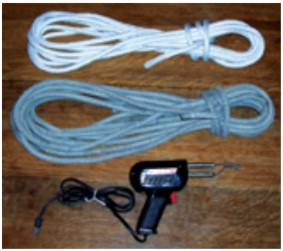
My old halyard was wire-and-rope. The rope portion thus likely didn’t see great loads during its life. As far as I can tell, my boat spent her life on Chesapeake Bay. She was left rigged year-round, and this halyard was run outside of the mast. The rope was badly weathered and dirty. Cutting it open showed that it had started life as a white rope with blue flecks. In addition to being sun bleached, it was stiff and hard on the hands. I used an electric soldering gun, with the tip hammered flat, as a hot knife to cut the test samples.
The old halyard could help me answer the question regarding how washing affects the strength of old rope, but I also wondered what happens to new rope? To answer this question, I purchased a hank of new 1/2-inch Bridgeline Ropes polyester double-braid so I could put it through the same tests as the old rope.
I cut both ropes into pieces about 3 feet long. I used the soldering-gun hot knife to cut and seal the ends of the ropes and to keep the inner and outer braids from sliding past each other. The table below gives the list of test cases.
I cut five pieces for each case on the old halyard, alternating along the rope. That is, starting at one end, I cut pieces for cases A-B-C-A-B-C . . . I also used the hot knife to score Roman numerals on the pieces to indicate their original locations on the halyard. Since the new rope should be very uniform, I cut only three pieces for each test case: D, E, and F. I didn’t number these.
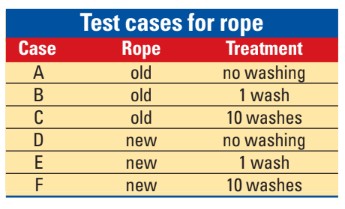
The test cases would be: no washing, to get a baseline on rope strength; 1 wash, to see if washing decreases the strength of a rope; and 10 washes, which is probably more than any rope could reasonably expect to see in its life.
I did the washing in our home machine using the smallest load setting (since this was a very small load) and an amount of Tide liquid detergent roughly in proportion to the small load. Since a fair amount of soap was left in the rope at the end of a wash cycle, I added a second rinse at the end of each load. I added Ultra Snuggle liquid fabric softener to the washer’s fabric-softener dispenser in a quantity appropriate for the small load. As things sometimes turn out, the actual testing occurred six months after the washing, so if there are long-term effects of detergent and softening chemicals, they probably would be seen in these tests.
The first thing I learned is that the core really does pop through the cover when you wash new rope. This happened to two of three pieces after one wash. Old rope, however, doesn’t experience this. So my splicing instructor and I are both right: washing does or doesn’t cause the core to pop on rope, depending whether it’s new or used.
I figured I’d inadvertently discovered a rope-manufacturing secret. Each braid is a hollow tube. When double-braided rope is made, first an inner braid is woven. This is followed by the outer braid woven over the top. The machine that does this apparently puts more tension on the outer braid as the second weaving takes place. The inner braid is being compressed along its length while the outer is being stretched. I expect this is done so that, once the rope is loaded and the spaces between the strands are worked out, the inner and outer braids end up at the same length so each will carry half the load on the rope. This tightening-up of the rope, no doubt, is what makes it hard to splice used rope.
Until a rope undergoes that tightening-up process under use, however, the inner braid is longer than the outer braid. The agitation in the washer allows gaps to open in the outer braid, and out pops the inner braid.
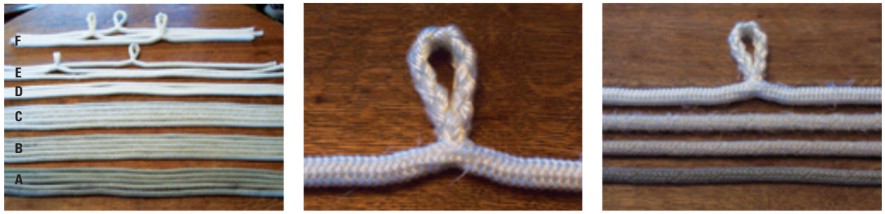
Fortunately, this is not fatal for the rope. If you see this happen, grab the rope from one end with one hand, squeeze the rope with your other hand, and slide that second hand toward the pop. This stretches the outer braid, “milking it” and causing the inner braid to be pulled back into the rope. You’ll have to repeat from the other end and keep milking until the rope is back together. I know this because that is what I did to all the popped samples before testing them. I marked the locations of the pops on those ropes.
The old rope obviously got cleaner with washing, but it also became very fuzzy as washing continued through multiple cycles. Even the new rope fuzzed up when washed, although not nearly as badly. Given how much UV damage must have occurred in 34 years of continuous exposure, it’s not too surprising that so many of the little polyester fibers broke to create this fuzz.
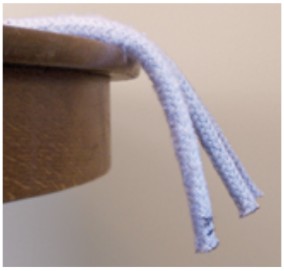
An early observation is that the old rope became considerably softer to the touch after one wash, and a little softer yet after 10 washes. In a “droop test” for stiffness, I set an equal length of each sample over the edge of a table. With a sheet of cardboard, I lifted the ends of the ropes level with the tabletop, then slid the cardboard away, allowing the ends to droop. The unwashed rope drooped the least. The once-washed rope was less stiff and drooped a little more, while the rope washed 10 times drooped consider-ably more, showing that more washes did make the rope less stiff.
Pulling strings
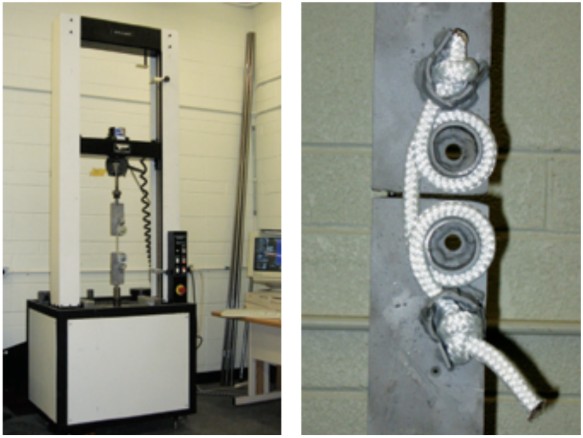
So on to the fun part: breaking things. For this, I used a laboratory tensile-test machine that can push or pull up to 30,000 pounds under very fine control.
Measuring the strength of a rope turns out to be something of a challenge. If the rope is bent sharply, as it is in a knot, its strength is considerably reduced by the sharp bend. Clamping a rope in metal grips also greatly reduces its strength where it is crushed. Ideally, the rope should be wrapped several turns around a large drum to gradually load the rope by the surface friction between the rope and drum, just as is done with a sheet on a winch. Unfortunately, it takes quite a bit of rope to make up a single test sample this way.
For this experiment, I used a pair of “capstan grips”. In these, the rope is wrapped around a 1 1/2-inch diameter cylinder before being led through a hole in the grip and knotted. The cylinder allows the load on the rope to be gradually applied by the friction along the surface, rather than being applied abruptly. In this arrangement, about two-thirds of the load was applied to the rope by the cylinder, and the remaining third was carried by the knot at the end.
Ideally, the cylinder would have been considerably larger in diameter to reduce the stress concentration caused by bending the rope. This was a trade-off against how much rope was available for tests: a bigger diameter means each sample must be longer. This means I could have conducted fewer tests given the available rope. As a result, the ropes broke at somewhat less than their true tensile strength but, since all samples were tested in the same grips, we can see the relative differences in strength between ropes.
Figures 1 and 2 show the load vs. displacement recorded by the test machine for new and old ropes. On this machine, we controlled the displacement (how much the rope is stretched) and measured how much load the rope applied to the machine. When the grips begin to separate, they first pull slack out of the rope and it takes a while for the load to build up. As the new rope is pulled more and more (Figure 1), it stretches considerably and goes through an interesting process: it creeps a little around the cylinder on one grip, then a little around the other cylinder, giving out a little “snap” noise each time. This constant creeping is why the load plot seems to be vibrating up and down.
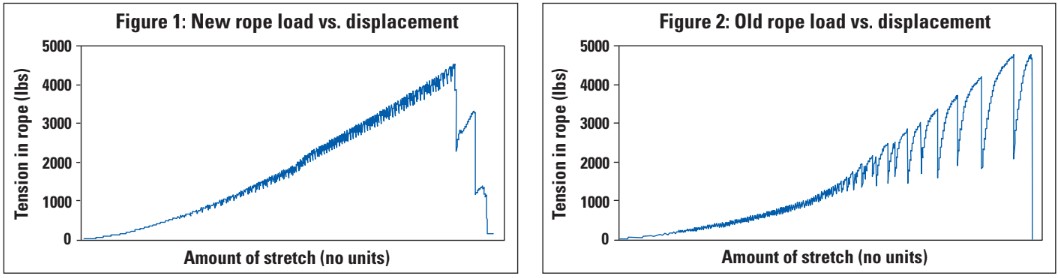
Figure 2: Load vs. displacement of an old rope sample in the test machine. Note the sudden failure at the right of the plot.
The old rope, on the other hand, didn’t slide nearly as well over the cylinders. In this case, tension would build up until it finally overcame friction, resulting in a loud “Snap!” Each time the rope slid like this, the force (Figure 2) dropped quite a bit but quickly built back up.
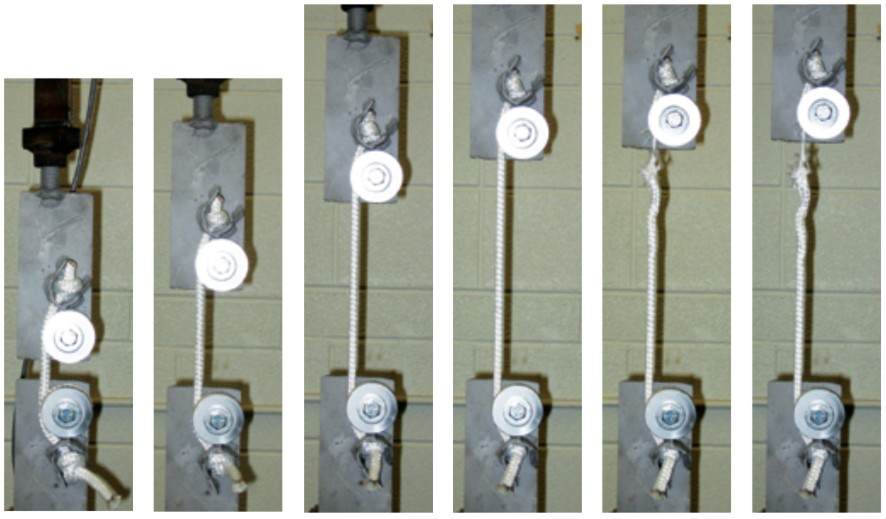
Eventually, each rope arrived at its breaking point. Here again, there was a major difference between the old and the new. The new rope went through a breaking process in which groups of strands reached their limit and broke with a “crack” noise similar to what you hear when breaking a stick. Usually there were several of these minor breaks before the rope gave out, each one causing the load supported by the rope to drop and leading to the downward steps at the end of the plot. This machine pulled the rope at a rate of about 1 inch per minute, and it took up to 30 seconds for a new rope to go though the breaking process from first “crack” to complete failure. When this rope finally did break, the load was fairly low and there wasn’t much drama. (This isn’t usually the case in a rope break, however. See the Whiplash sidebar, below).
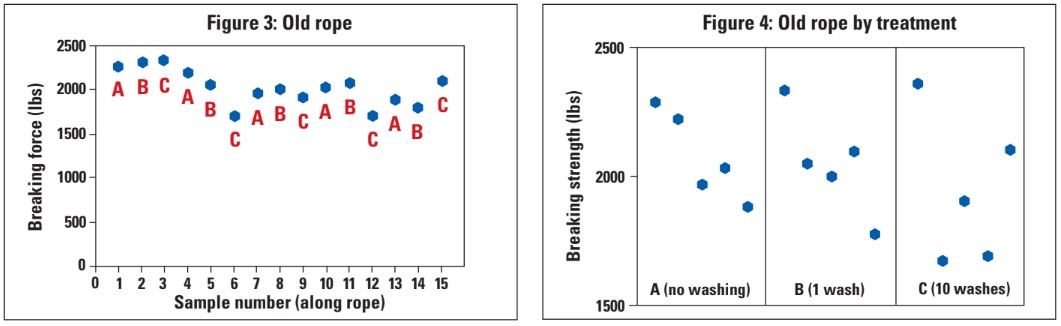
Figure 4: Strength of old rope samples by amount of washing. These results suggest that washing had little effect on the strength of the old rope.
In contrast, the old rope, once the breaking load was reached, gave up suddenly. Each ended very quickly with a “tink-tink-BANG!” Fortunately, the ends of the ropes were still held by the grips, so they didn’t go very far, although each failure gave the test machine quite a shake.
In all cases, the ropes broke as they were coming off the cylinder in either the top or bottom grip. Because the diameter was smaller than ideal, this point would be a stress concentration in the rope, so it was the point that reached its breaking point first. The new rope samples that had experienced the core popout during washing had these locations on the ropes marked. Two of the samples had the pop locations between the grips during testing but neither was a point of failure.
Results
Figure 3 gives the breaking strength of each old rope sample along the original halyard (sample #1 was the bitter end). The letters “A,” “B,” and “C” below each point indicate the test case of that sample. The bitter end of the halyard seems to have been stronger, but no other pattern is obvious. This strength difference could have been due to having been exposed to less weathering or less loading during its life. The results are sorted by test case in Figure 4. While the 10-washes case has the two lowest points, it also has the highest. The bottom line: it doesn’t appear as if washing the old rope has made any difference to its strength.
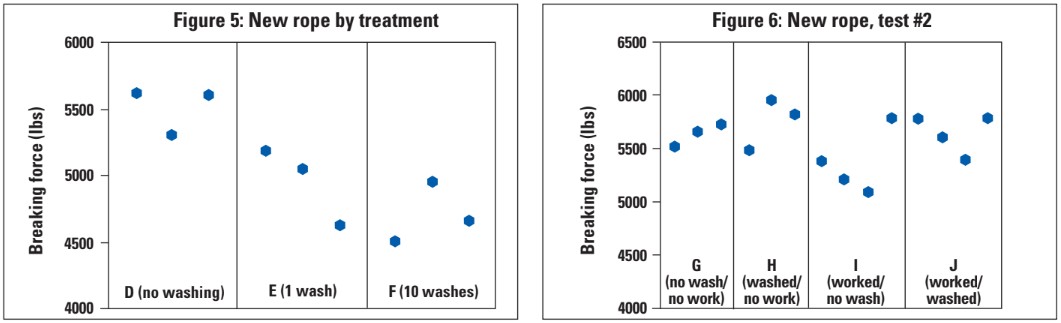
Figure 6: Effects on strength of washing (no detergent) and working.
The results for new rope (Figure 5) show two things. First, notice that the breaking strengths are far higher (5,000 vs. 2,000 pounds) than those of the old rope. Granted, there may have been chemistry and manufacturing improvements in ropemaking in the last 30 years, but there is no doubt that the old rope has lost a considerable portion of its original strength.
Second, it certainly does appear that washing has reduced the strength of the new rope. The strength values after the first wash have dropped by about 10 percent, with perhaps a few more percent lost by the 10th washing.
This is puzzling. While washing had no effect on old rope, it reduced the strength of new rope.
Further research
This presented an opportunity for a follow-up test. Washing does three things: it wets the rope, it adds chemicals (detergent and softener), and it agitates the rope. It would seem safe to assume that getting polyester sailboat rope wet shouldn’t cause it to deteriorate. So did chemicals or agitation cause the rope to lose strength?
The idea that mechanical agitation might affect the rope ties in with the fact that most riggers won’t splice “old” rope, where they define “old” as having been used once. Working a rope (putting it under tension and bending it around sheaves in blocks and so forth) causes the fibers to tighten up, making the rope hard to splice. The agitation in a washer might also cause the fibers to move around, possibly leading to a change in strength.
To investigate these ideas, I performed a new test. I used only new rope since I had already used up the old halyard. To see if the agitation in washing had an effect on strength, I compared washed rope against unwashed rope. This time, the washed rope was rinsed twice to remove residual soap and softener before starting and some rope samples were washed in plain water with no added detergent or fabric softener.
I also incorporated “worked” rope in this test. The worked samples were run 10 passes while being turned through 180 degrees over a 2 1/2-inch diameter sheave under a tension of 500 pounds. This represents a working load of about 1⁄12 the strength of the rope, probably a reasonable maximum load value for non-racing sailors. I also tested these worked samples in the washed and non-washed states. The complete set of test cases is given in the table below.
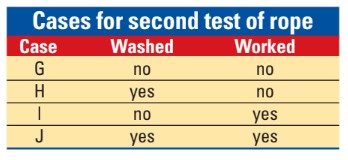
Figure 6 is a plot of the results. Comparing the first two cases, non-worked rope that was not washed (case G) to rope that was washed (case H), shows the strength is about the same. Two of the three washed samples had strengths higher than the three unwashed samples, but then one of the three had a lower strength than all the unwashed samples. Comparing these results to cases D and E in Figure 5, where washing did drop the strength, suggests that the detergent and/or fabric softener did cause the rope’s strength to decrease.
Comparing cases G and I — the unworked rope to the worked rope — shows there probably was a drop in strength of about 5 percent on average. Comparing the worked rope before and after washing (cases I and J), however, shows that the strength went back up to that of the original rope. So here, washing (without detergent) caused the rope’s strength to increase!
And in cases A, B, and C (old rope) we saw that washing had no effect at all on strength. If detergent and softener were chemically damaging the rope fibers, the fibers in the old rope should be damaged, just like in new rope. Since the old rope didn’t lose strength, detergent and/or softener must not be damaging to rope.
So what gives? Let me offer a couple of theories. First, working the rope samples for cases I and J was done by running the rope under tension around a sheave 10 times. Each pass caused the rope to bend, then straighten. It’s likely this bending caused the strands in the rope to redistribute themselves so they were tighter on one side of the rope and looser on the other. Putting such a rope into a tension test led to the tighter strands reaching their breaking point earlier, so the strength of the whole rope dropped a little.
A trip through the washing machine would have let the strands slide back to their original positions, so the tighter ones could loosen and vice-versa. The strands in this washed rope would then be loaded more evenly in the tensile test and the rope’s strength returned to the original value.
A theory that might wash
Second, as for washing new rope with detergent and softener reducing its strength, while washing new rope in plain water or washing old rope with detergent have no effect, let me propose the following theory.
Double-braided rope is made from tiny polyester fibers. When the fibers are manufactured, they are coated with a material called “spin finish” before they are made into yarns that are braided into rope. The purpose of this spin finish is to eliminate static electricity and to reduce the friction of fibers sliding over fibers, and fibers sliding over metal parts on the processing machinery. This is done so subsequent processing (spinning, weaving, and braiding) of the fibers is made much easier.
When we tension our rope, the fibers and strands slide past each other as the rope tightens up. The more easily the fibers can slide past each other, the more equally they will distribute overall load and the greater the total load the rope will carry. On the other hand, if fibers can’t easily slide past each other, some will be tighter and some looser as the rope is loaded. In that case, the tighter fibers will tend to break first, reducing the total capacity of the rope.
When a rope is new, it has this spin finish material on the fibers. Washing with detergent probably takes it off. Washing in plain water may not take it off (at least perhaps not with a single wash). No doubt it wears off over time with exposure to the elements, so older ropes won’t have any left. Hence, we see new rope lose some strength when washed with detergent, but not when washed in plain water, and we don’t see any change with old rope.
We could test these theories with more experiments, but they sound reasonable (to me, at least) and I’m sure we’d all rather go sailing.
Take-away points
What have we learned? Let me offer the following:
- Washing doesn’t seem to make any difference to the strength of old rope.
- New rope did lose some strength after being washed in detergent. This loss, however, is most likely due to the “spin finish” coating being removed from the rope’s fibers, rather than from deterioration of the rope itself. Since this “spin finish” will wear away over time anyway, washing won’t have any additional effect on strength.
- Washing a dirty rope once will make it considerably softer and less stiff. There was limited improvement with additional washings. So there’s no benefit to washing a rope if it’s not dirty and stiff.
- If you machine-wash new rope before it has been worked enough to tighten it up, expect the core to pop through the outer braid. If you have dirty “new” rope to clean, try soaking it in a tub and hand-washing to avoid this.
- If the core does pop out, “milk” the rope from the ends to pull it back in. Its strength doesn’t seem to be affected.
- Old, weathered rope is probably drastically weaker than new rope. This is something to keep in mind when deciding which rope should be assigned to which job on (or off) the boat.
Laundering tips
Throw a basketful of rope into the washing machine, turn it on and, when it’s done, you’ll have a great big ball of completely entangled rope. (Don’t ask me how I know.)
One way to avoid this is to tidy up each rope with the chain sennit knot (daisy chain and chain stitch are other common names). While you can make tight loops, there’s no benefit, and smaller loops means you need to make a lot more of them. Once washing is done and the rope dried, the end knot can be removed and one tug will cause the sennit loops to fall right out.
Shackles and other potentially damaging hardware should be wrapped up in rags that can be tied off with nylon wire ties. The rags will protect the inside of the washtub. This step may be very important for domestic harmony.
Whiplash
Something to keep in mind when looking at Figure 1 is that sailors don’t apply stretch to ropes; we apply loads. As the load increases, the rope will stretch more and more. Once we hit that peak in the curve, the rope won’t carry any more load. Each fiber that breaks passes its load onto its neighbors, causing some of them to break and shed their load. This causes other fibers to break, and so on. This chain reaction occurs very fast.
What does this mean in practice? As you load and stretch a rope, it behaves like a big rubber band storing energy. When a rope breaks, all that energy is released in an instant. How much energy? If our sample 1⁄2 -inch rope was acting as a jibsheet with 6 feet of rope under tension, it would release 3,600 foot-pounds of energy. In contrast, a bullet exiting the muzzle of Dirty Harry’s .44 Magnum, “the most powerful handgun in the world,” has 1,300 foot-pounds of kinetic energy. Granted, the energy in the bullet is a lot more concentrated, but I still wouldn’t want to be in the path of a broken sheet. Chafed, elderly, damaged, and undersized lines put you that much closer to what might be a memorable event.
Tim Nye teaches mechanical engineering and in his spare time drags home and resurrects derelict machinery. After meeting and marrying Elizabeth, a sailor, he now drags home and resurrects good old sailboats. Their current boat is a 1976 Grampian 34, Sea Rose, mostly complete and sailed out of Hamilton, Ontario.
Thank you to Sailrite Enterprises, Inc., for providing free access to back issues of Good Old Boat through intellectual property rights. Sailrite.com