The metamorphosis of a beat-up bargain boat
Issue 69 : Nov/Dec 2009
Small-boat sailing on the Severn River and Chesapeake Bay was a part of my life growing up in Maryland in the 1960s and ’70s. I never owned a sailboat of my own but had always longed to do so. Fast forward 35 years. When we moved to Rockport, Maine, I was immediately drawn to the romance of sailing these magnifi cent waters on my own 40-foot Hinckley . . . but supposed I would settle for something, say, about 25 to 30 feet in length and maybe 95-percent less expensive.
One day, while reading the Camden Herald, my eyes darted to an ad about the 2005 Penobscot Bay YMCA Boat Auction. The local YMCA raises money each year by auctioning boats that have been donated. About 12 boats apparently did not sell at the annual auction and were still available to the highest bidder.
Not really being in a position to acquire a boat, I had not attended the auction in previous years. But I was drawn to the picture of a 1978 Catalina 27 left over following the auction held in 2005. I remembered the Catalina was a popular boat on the Chesapeake, one known to be a very good sailing craft. “Everything works . . . great boat for little money,” the ad stated.
I decided to have a look and invited my good friend and neighbor, Frank, to join me. Frank is a true Mainer, an amazing sailor, and one of those rare people who seem able to fix or build anything.
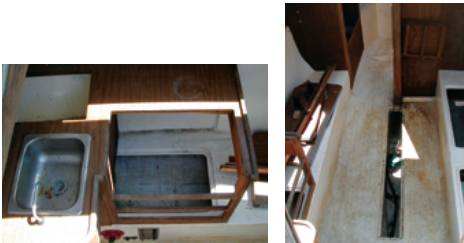
We climbed the ladder and looked in the cabin. Yuck! The water down below was at least 8 inches deep. Cushions were floating in the smelly mess. We grabbed some high waders from my trunk and climbed in. We opened the engine access panel to find what appeared to be a rusted pile of junk. “I wouldn’t take this bucket of bolts if it was given to me,” Frank stated matter-of-factly.
I made an offer. At $900, the offer was so low it was embarrassing. The man at the Y said, “We can’t accept that.”
“Of course,” I said. “I understand.” But I told him I would wait patiently in the hope that, if the YMCA received no other offers, perhaps they’d reconsider. Three weeks later, I brought Blue Moon home.
What had I done?
This sort of project means work, money, and an understanding wife. I scored two out of the three criteria. Money was my only challenge. I started the restoration fund by selling extra sails from the Catalina along with odds and ends no longer needed around the house. As the fund grew, I began work.
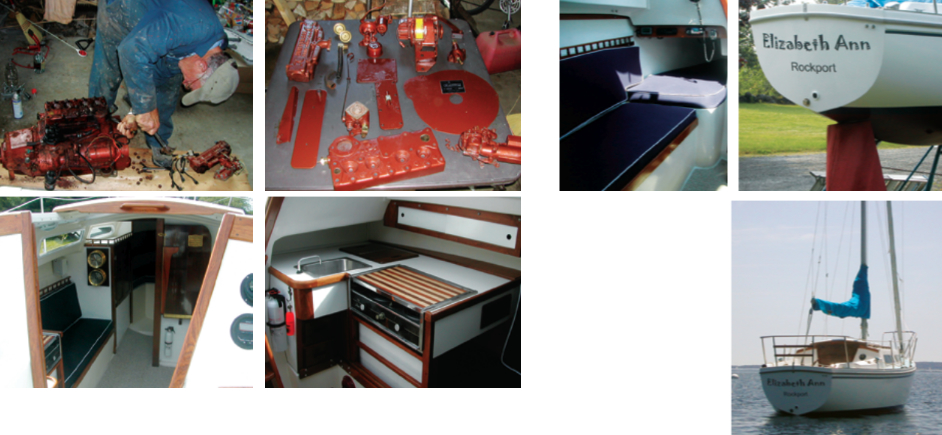
My daughter, Elizabeth Ann, loves sailing and, while college takes up most of her time, she jumped in to help me gut the boat and begin the restoration process. We began by pulling everything out and removing every part we could unscrew or unbolt. We removed all the brightwork inside and out. We took that and most of the galley to my basement for restoration over the winter. We also removed the old head and the Atomic 4. A neighbor’s backhoe lifted the Atomic 4 and galley out of the boat. At that point, we were left with a grubby, stinky, moldy cabin. After I performed a thorough inspection, Elizabeth Ann and I began to scrub and prepare Blue Moon for repairs and paint.
The Atomic 4 challenge
We began to dismantle the Atomic 4. It was obvious the engine had not been run for several years. As it was a straight saltwater-cooled rig (no heat exchanger), I wondered whether it was worth rebuilding. Might it have a cracked block, head, or manifold? Perhaps it had seized?
Frank and I began removing parts, slugging away with chisels, heat, and enthusiasm. The head looked good, the pistons appeared to be virtually unused and moved freely. But the exhaust manifold was toast; we noted a large crack. Somehow it had overheated. Frank drizzled acid through all the water channels, and we reamed out each passageway.
I began to make a list of parts that would be required to restore the Atomic 4. The major part was the exhaust manifold. I’m a fan of eBay, and discovered and purchased a used Atomic 4 exhaust manifold in excellent condition. The list continued: gaskets, bolts, plugs, plug wires, distributor, and so on. I found the remainder of the parts through Moyer Marine and my local auto parts store.
We ground and seated the valves and, following a thorough cleaning inside and out, the engine was ready for paint.
The following spring, we completed the engine rebuild and the backhoe lifted it back into the boat. Remarkably, it cranked up immediately and ran cool and beautifully smooth. After just a few fine-tuning adjustments, it was “water worthy.” What an amazing engine.
Ongoing beautification
The beautification program continued. Odds and ends in need of replacement included the head, plumbing hoses, and water hoses. I installed new cabin lights, rewired the panel, and installed a new bilge pump.
What was Catalina thinking, using that awful, cheap-looking, fake wood on the bulkheads, doors, galley top, and folding table? I took a page out of the Herreshoff design book and felt I could contrast the teak and other beautiful hardwoods with white. I began by replacing the galley laminate with white laminate. I trimmed the bulkheads and doors with white paint. I created a replacement table out of walnut from the leaves of an old table I found in a yard sale and crafted its leg from mahogany retrieved from a junk pile behind a local boatbuilder’s shop. I fashioned a mahogany plaque to display the clock and barometer I snagged on eBay and crafted a dashboard for the radios and XM tuner using leftover lumber from the walnut table. This was fun.
My wife, Carolyn, is an amazing craftsperson and, most of all, she is generous. She set aside her passion for gardening while she created new cushions for the Catalina. We purchased new foam and fabric at half price from a local fabric store that was going out of business. Carolyn suggested that we use navy blue fabric with white piping. The cushions are beautiful.
I made a template out of paper for the cabin sole. I purchased outdoor carpet at Home Depot and took the template and carpet to a local carpet store to have it cut to size and the edges bound.
Bottom and topsides
Years of built-up bottom paint had to be removed. A sharp scraper worked best. Once all the paint was removed, I lightly sanded the bottom with 60-grit paper. The keel required a minor repair using a little fiberglass and Bondo. I taped the bootstripe and painted the bottom.
The hull itself was oxidized and in need of fresh paint. I had been talked into painting the topsides myself using the roll-and-tip method. I acquired Old Salem paint, along with brushes and rollers, on sale at Hamilton Marine. I sanded the hull lightly using 220-grit. Josh, my next-door-neighbor, was kind enough to help with this step. Josh rolled while I followed up tipping. After a few passes, it was clear that something was not working. Our brush strokes were visible and the paint was drying too fast. We decided to regroup and start over.
I sanded off our first pass and then consulted with an old salt and paint expert at Hamilton Marine. When I described my problem, he said, “That will never work. You need brushing thinner, this brush, and these rollers. I’ve been painting boats for more than 40 years. If you follow my advice, your boat will look like glass. Thin the paint so it’s almost like water. Tip with the brush at a 45-degree angle. Move fast, but smoothly.”
Our second pass did the trick. The paint looked terrific. I applied a navy-blue bootstripe and she was completed.
A new name
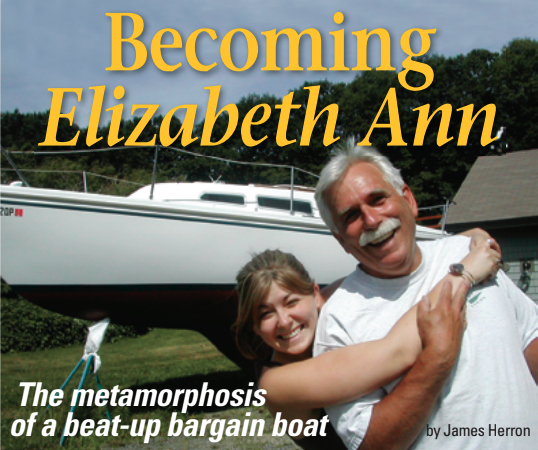
Now she was restored, we decided to rename the boat. We chose Elizabeth Ann. The name acknowledges our daughter, my mother-in-law, and my sister . . . all wonderful women.
When my sailing friends learned that a name change was imminent, they impressed the fear of God upon me. “Don’t launch her without the proper renaming ceremony,” they warned. The needed ritual to ensure smooth sailing involved champagne and mumbo jumbo. Somehow, I think the champagne was the underlying reason for the celebration. Nonetheless, we duly carried out the renaming ceremony and successfully launched her in July 2008.
Elizabeth Ann looks terrific, and she sails like a dream.
James Herron is a voice actor who grew up in Maryland and, together with his wife, Carolyn, has made New England his home.
Thank you to Sailrite Enterprises, Inc., for providing free access to back issues of Good Old Boat through intellectual property rights. Sailrite.com