Self-adhesive Velcro offers improvement
Issue 73 : Jul/Aug 2010
I was surprised to see the article about Velcro turnbuckle locks in the March 2010 issue. Perhaps, in the rough waters of Erie off Presque Isle, sailors naturally think alike. It’s probable that I have waved to author Joe Orinko in passing. His boat’s name, Unicorn, rings a bell. And yet I independently developed a similar solution to a similar problem.
During a Lake Erie crossing in July 2007 that was filled with lessons, I noticed that the shroud turnbuckles had wiggled dangerously loose on my O’Day 25, Huguenot. After a harrowing experience tightening them in 5- to 6-foot waves, I resolved to find a way to prevent that problem from recurring. In my work, I use a fair amount of self-adhesive Velcro, so that material came to mind.
Since I have to remove Huguenot’s rig every winter, I wind up making multiple adjustments to the turnbuckles during the sailing season (trying to finally “get it just right”). Because of my ongoing tweaks, cotter pins and rigging tape seemed wasteful and awkward. My solution offers some advantages over Joe’s.
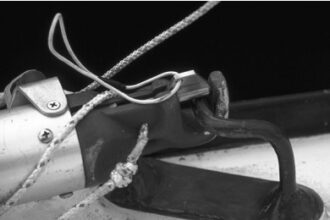
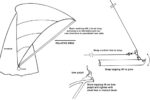
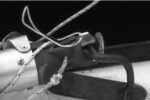
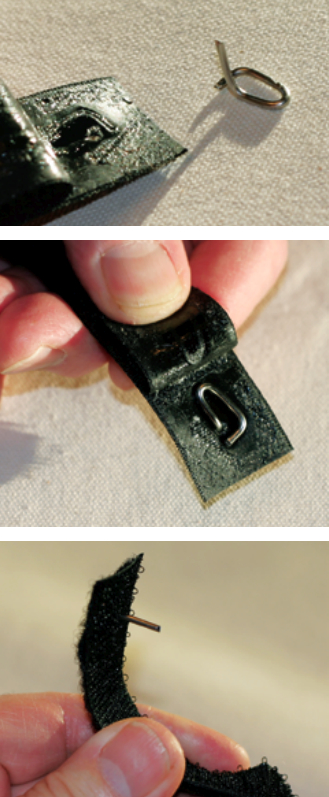
My idea was to bend a rod of 1⁄16-inch stainless-steel (308L) welding filler rod to serve as a backing structure and keeper pin to poke into the hole in the turnbuckle screw. To join it to the Velcro, I poked this keeper pin through from the adhesive side of a strip of “hooked” Velcro to the hooked side and embedded the pin’s backing structure in the adhesive. I then bonded the adhesive side of that Velcro strip to the adhesive side of a strip of “fuzzy” Velcro, sandwiching the backing structure of the pin between the two adhesive strips.
The final product is very similar to Joe’s, with the added advantages that there is no cotter pin stub to spread apart, no glue or epoxy to deal with, and little risk of the pin separating from the Velcro (by pulling through or breaking off).
The key to bending the stainless-steel filler rod is to bend the backing structure with needle-nosed pliers, making use of the curved outside of the jaws to help form the shape of the filler rod. Once the backing structure is done, a 90-degree bend is easy to make by holding the newly made base with the pliers and bending along the side of the pliers’ jaw. It’s easy to cut the pin to the exact length desired.
Devin Ross sailed his O’Day 25, Huguenot, on Lake Erie for three years before moving her to Lake Arthur in Moraine State Park, Pennsylvania, to allow for easy day trips (and many more sailing days). Huguenot is the current boat in a progression: a Hobie 16, an Erie 17, and a South Coast 22.
Thank you to Sailrite Enterprises, Inc., for providing free access to back issues of Good Old Boat through intellectual property rights. Sailrite.com