Advanced methods enhance options, safety, and fun
Issue 102 : May/Jun 2015
The art and science of making a boat stay put in an anchorage is vast and interesting. In part 1 of this series, in the March 2015 issue, I described the conventional way of anchoring (with some twists) by heading upwind for the drop. In this article, I explain a couple of techniques that work well under sail, particularly for the solo sailor, who can only be in one place on board at a time. These articles only scratch the surface of the topic of anchoring, but many good references are available. It’s hard to beat Earl Hinz’s The Complete Book of Anchoring and Mooring for its thoroughness and variety on the subject.
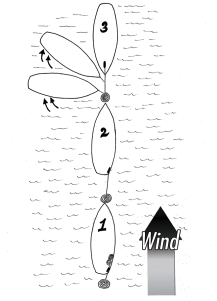
1. Pass at slow speed over the drop spot and lower the anchor.
2. Snub the anchor periodically, softly at first and then more firmly as it digs in.
3. Transfer the anchor rode from the stern to the bow.
The flying moor
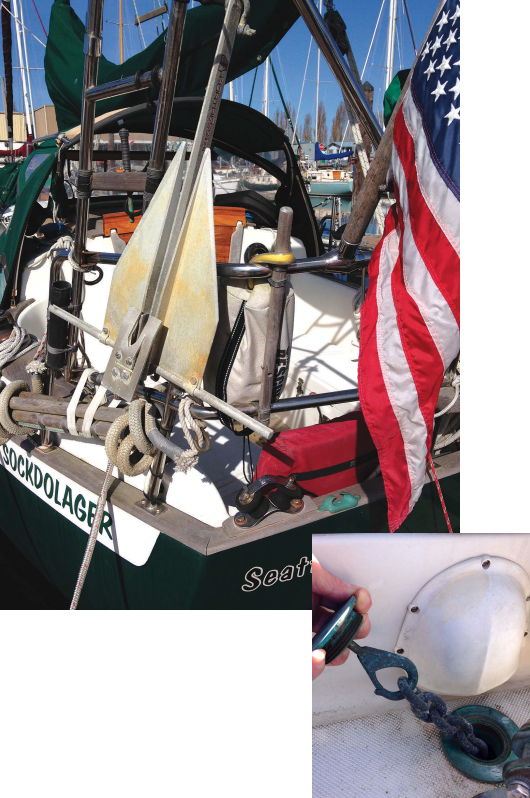
Whether solo or not, I like the “flying moor,” in which you drop the anchor while sailing slowly downwind. It’s fun once you get the hang of it, and lets you know immediately if the anchor bites and how well. There is some risk of fouling the prop with the anchor rode if you drop the hook off the bow, so you have to steer away from it after dropping it. Better yet, drop the anchor from the stern.
Have the anchor ready at the stern with the rode faked down in the cockpit. A good approach speed is 1 1⁄2 to 2 1⁄2 knots. When you’re over the drop spot you’ve selected, tip the anchor off the stern, let the rode feed out, and snub it gradually and softly, as explained in “Anchoring When Solo, Part 1.” When the anchor sets, transfer the rode to the bow so you’ll ride to the wind normally. Whether you anchor from the bow or stern, be sure your chocks and cleats are through-bolted with backing plates and strong enough to stop the full force of your moving boat.
If you drop anchor off the bow, it’s more complicated and is best done where you have lots of room. Anchoring in this manner is easier on a small boat with a sturdy bowsprit. The forces created by large boats on their gear may be too much for this technique.
First, center the helm as you near the drop spot. Your anchor should be ready to go and the rode, if it’s rope, faked on deck ready to stream out. Whether you’re under power or sail, approach the drop spot at an angle approximately halfway between dead downwind and a broad reach, keeping the wind on the same side of the boat as your bow anchor is rigged. The angled approach allows the rode to stream off the bow away from, rather than underneath, the boat. If you practice this with two people, the person at the helm should be able to tell that the rode is not streaming under the boat. The reason for keeping the wind on the same side as your anchor is so that, when the anchor catches, the boat will turn smartly upwind toward the anchor, rather than away from it when it might pull the rode under the keel. If your main bow anchor is rigged on the port side, you’ll want to approach your drop spot with the wind on your port quarter.
Flying moor under power
If you’re motoring, put the engine in neutral, center the helm with a bungee cord and walk forward. Using a bungee cord avoids stressing the rudder when the boat rounds up. With a displacement boat that carries her way, you should be going about 2 knots as you pass over the drop spot. The boat will usually behave long enough for you to set the anchor. Drop the hook from the bow, let the faked rode feed out, and don’t snub it until you are ready to have the boat round up.
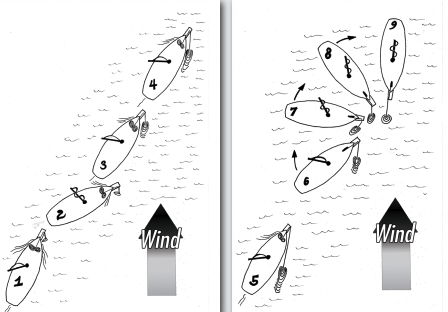
1. Approach the drop spot on a very broad reach with the anchor rode faked on the foredeck and the anchor ready to deploy.
2. To slow down, ease the mainsail, head up a little, raise the topping lift, partially lower the mainsail, or any combination of these. About 2 1⁄2 knots is ideal.
3. At the drop spot, let go the anchor and allow the rode to run out.
4. Stay on course, letting the rode feed out. Do not snub it.
5. Let the boat come to where you want her to lay at anchor, and snub the rode around a cleat or bitt.
6. The boat will lose way as it begins to round up. You will feel the tug as the anchor digs in. If it does not, the boat will not round up.
7, 8, 9. The boat rounds up and comes to rest.
Flying moor under sail
Done properly, a flying moor under sail is an absolute blast of focused excitement and fun, but it’s a challenge. Practicing in an uncrowded harbor is advised. You can sail down to the drop spot on just a roller-furling jib, rolling it in and out to adjust speed, but the problem with using only the jib is that if your anchor doesn’t set, you either have to get the main up quickly or start the engine. Either sail works fine for this technique, but keeping the mainsail up preserves the option of sailing to windward if you need to.
Sailing downwind toward your drop spot, try to have the main boom out on the opposite side of the boat from where your anchor is positioned. In other words, if your anchor is stored on the starboard side of the bow, have the main boom out to port, which means you’ll be on starboard tack and thus will round up to starboard. As before, put the boat on an angle between dead downwind and a broad reach. Control boat speed with the mainsail; don’t be going much faster than 2 1⁄2 knots when you drop the anchor.
To reduce speed using the main, you can do several things. You can let the boom all the way out and then adjust course a bit to slipstream the wind past it, crabbing like pilots do to slow down light aircraft when landing; you can scandalize the sail; you can lower it in stages to spill more wind; or you can do a combination of all three. Of course, the maneuver works best when all the sail’s control lines are within reach of the helm and the mainsail track allows the sail to drop smoothly. This is multitasking on steroids.
As you reach the drop spot, fix the helm with a bungee cord so the boat does not wander downwind. Quickly top up the boom and walk forward. Lay out the anchor as before, keeping in mind that, since your sail is still driving you, you should not do any light snubs on the rode or the boat will turn upwind prematurely. (It’s going to start turning anyway from the friction of the anchor and chain on the bottom.) Just keep the rode running out smoothly and be ready for a big pull when you do snub it. Let the boat proceed downwind until near where she’ll lie to her anchor, and when you’re ready to stop her, wrap the rode around a cleat or bitt and let it slip as you snub it. Don’t try to stop the boat without using a cleat, because the pull will be too strong.
If the holding is good, the boat will swing rapidly around, her momentum setting the anchor. This is the closest thing to boat brakes I know of. Lower and furl the scandalized main once you’re sure the anchor’s holding. If the anchor doesn’t bite, you’ll know it immediately because the boat will stay sideways to the wind and the scenery will pass by.
A second anchor
Occasionally, you’ll need to put out a second anchor, either to limit the boat’s swinging room in an anchorage with changing currents or to supplement the holding power of the first anchor. A second anchor set 45 degrees off the bow will take some of the load off the primary anchor and steady the boat in a blow. You can set the second anchor from the boat or, if your dinghy is ready, from the dinghy.
Normally it takes two people to row out an anchor — one in the dinghy and the other on the foredeck tending the rode and pointing in the direction to row. Solo, you have two choices. One is to fake the rode on deck, then hang the anchor off the stern of the dinghy (secured with a slipknot or with a fluke hooked over the transom) and row it out. Or you can fake the rode into the dinghy and row or power the whole mess out. (If you’re using an outboard, backing the dinghy to windward and hanging the anchor off the bow elimi nates tangling the rode in the prop.) In both cases, first secure the bitter end of the rode to the boat.
To set a second anchor from the boat rather than from a dinghy, first run a heavy weight (called a kellet) on a checkline down the primary rode to sink it straight to the bottom. Scuba weights on a shackle work fine. Once the kellet is on the bottom, keep its checkline taut so it doesn’t drift around and snag anything. This technique works best on smooth sand or mud bottoms and helps keep the primary rode hanging vertically from the bow, away from your prop and rudder.
Now prepare your second anchor to drop. Using the direction in which your primary anchor is laying as a bearing, slowly motor forward at a 45-degree angle to it. If you don’t use a kellet (for example, if the bottom is uneven enough to snag or wrap your primary rode around a rock), take in the extra slack on the primary anchor rode as you move forward, faking it on deck so that later it can run smoothly out unattended. This means either fixing the helm, so the boat will move forward in the direction you want because you’ll be busy on the foredeck, or leading the anchor rodes aft to the cockpit so you can stay at the helm.
At the new drop point, stop the boat, center the helm, release the anchor, and let the rode lay out. Try to avoid using reverse engine until you’ve dropped back to your original position, then back down on the second rode to set it. Retrieve the kellet if you want, adjust the tension on the two anchor rodes, and put chafe gear on both. Old fire hose makes good chafe gear, and a kellet sent down the rode on a checkline can reduce the vertical component in the boat’s pull, thus increasing the apparent scope.
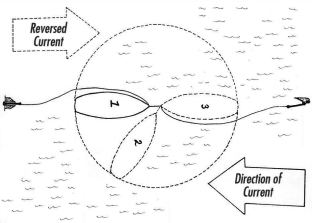
1. The boat lies to her main anchor, oriented to the direction of the current. A stern anchor has been set and is ready to be put to work when the tide changes.
2. When the current goes slack and begins to change, the boat swings around.
3. The boat lies to the reversed current a little more than a boat length away from her original position.
Bahamian moor
If swinging room is limited, use a Bahamian moor — two anchors set from the bow in a straight line with the boat in the middle. Set a bow anchor and drop back on it downcurrent, letting out twice the rode you need, then drop the second anchor from the bow and pull the boat back on the first rode until the rodes are of equal length.
The advantage of a Bahamian moor is that the swinging radius is reduced to a little more than the boat’s length, as limited by her two opposing anchors. Sometimes this is the only way to safely anchor in a spot with restricted room. To keep the anchor rodes from tangling as the current reverses at the change of tide, it’s wise to rig a swivel or a heavy-duty snatch block.
You can do a flying Bahamian moor by dropping the bow anchor while sailing downcurrent. Again, pay out twice the normal rode, snub it, and let the boat swing around to a stop. Then drop a stern anchor and pull the boat forward on the bow rode as you pay out the stern rode.
If your anchor drags
Anchors drag for all kinds of reasons, and even seasoned sailors can be surprised. A single shell on the tip of a plow can prevent it from setting; kelp is notoriously tricky; and wind shifts or other boats’ anchors can upset your previously buried anchor. Being methodical and visualizing your responses in advance will serve you well in the event your anchor drags, or if you need to pull it up quickly and leave your spot because of bad weather.
For example, let’s say you’ve already fixed your anchored position visually using landmarks (maybe you’ve set an anchor-drag alarm on the GPS), you’ve plotted a reverse bearing to get out of the harbor in darkness, and you’re alert to changes in the boat’s motion that could signal the anchor’s dragging (usually the boat goes crosswind in the troughs of waves). Look around to see how much sea room you have left. If there’s enough and you’re not in danger of hitting another boat, let out some more rode to give the anchor a chance to reset. Don’t snub too much until you’re ready to test it. If you get to a scope of 10-to-1 and the anchor still doesn’t bite, it’s likely not going to. If you haven’t gone too far and there’s still room behind you, this would be a good time to drop your second anchor.
Getting an anchor up quickly when solo is sometimes neither easy nor fast. In case you have to escape being pinned on a lee shore, be prepared with a sharp knife to sever the rode, perhaps buoying its end with a fender for retrieval later.
Weighing anchor
Whether you have a windlass or not, weighing anchor can be a challenge for the singlehander. It’s easy to end up with a tangle of rode on the foredeck and the boat drifting down on rocks or the boat behind you, so plan ahead. In Alaska, I sometimes had to anchor in 60 to 100 feet of water. With no windlass, it meant taking a few breaks to rest and stow the mess of rode already up on deck, powering forward if necessary to reposition the boat. As a small woman, I could never stand up to pull such loads with my back and shoulders. I did all my pulling in a straight-backed, fore-and-aft kneeling position, with most of the strain on my hips and legs. I rigged up two simple, small come-alongs with chain hooks and clove hitches. When one was secured under load, I would retie the other for a new grip, sort of a slow mechanical hand-over-hand affair. (We now have a windlass aboard our Dana 24, Sockdolager.)
With your engine idling, or perhaps in very slow forward, center the helm, walk to the bow, and pull in enough slack to have less than a 2-to-1 scope. Secure the rode to a cleat and put the engine in neutral. The remaining rode should hang almost straight down from the bow. Keeping an eye on your position relative to other boats, stow the on-deck rode. Now pull in the rest until it’s straight up and down and taut. Cleat and stow that while you let the boat do the work of breaking out the anchor. At such short scope, it usually takes only a few minutes for the boat to break it out, and it saves your back. The boat will swing sideways to the wind when the anchor breaks out, so haul it in and hang it in the water to wash off the mud. When you’re ready, move the boat to a spot where you have room to tidy and stow the foredeck and secure the anchor before getting under way.
Experiment with these anchoring techniques to see what works best for you and your boat. Enjoy challenging yourself in incremental steps.
Karen Sullivan sailed with her partner, Jim Heumann, from Port Townsend, Washington, to New Zealand in their Dana 24 from 2011 to 2013. Before that she cruised in Alaska’s Prince William Sound and soloed down the Inside Passage in her previous Dana. A long time ago she sailed between Maine and the Caribbean in various boats. She is at work on a book about their recent Pacific crossing. Read more at: http://karenandjimsexcellentadventure.blogspot.com.
Thank you to Sailrite Enterprises, Inc., for providing free access to back issues of Good Old Boat through intellectual property rights. Sailrite.com