A raw-water seacock that screams to be opened
Issue 102 : May/Jun 2015
We all know the importance of opening the engine’s raw-water seacock before starting the engine and that forgetting to open it can result in serious engine damage. Even though I know this very well, I admit I have forgotten more than once. The mistake normally occurs after I have shut the seacock to open the strainer and clean out the basket. After screwing the top back down, I feel I have finished the job, forgetting that I still have to open the seacock. I am surely not the only one who has made this mistake.
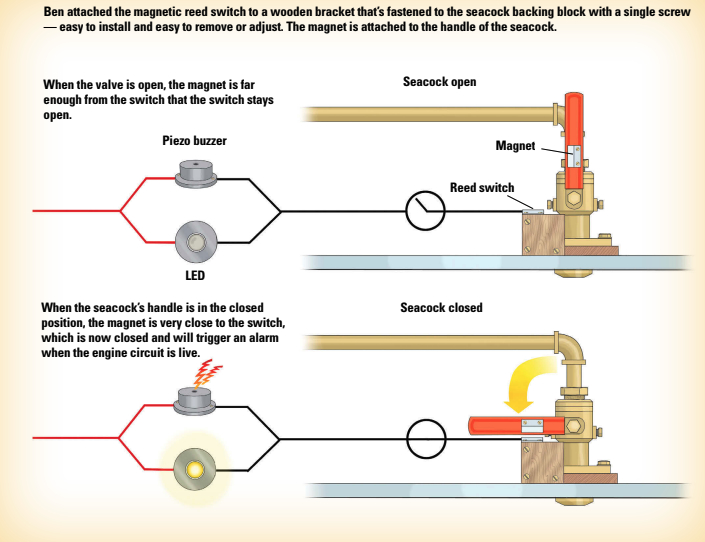
Not long ago, I developed an alarm to warn me if I forget to open the seacock. The key component in the system is a magnetic reed switch. This type of switch has two contacts inside a sealed tube and is often used for house alarm systems to monitor if a window has been opened. When a magnet comes close to the magnetic reed (less than an inch), the contacts close and electricity passes through. When the magnet is moved farther away (more than an inch) the contacts open and no electricity passes.
A simple installation
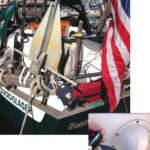
I made a wooden bracket that I screwed to the backing block of the raw-water intake through-hull and fastened the magnetic reed switch onto the wooden bracket so that the seacock handle comes close to the switch when the valve is closed. I tested the system by taping the magnet to the seacock handle so that when the handle was up, the magnet was far enough away from the switch for the switch to remain open, and when the handle was down, the magnet was close enough to the magnetic reed switch to close it and turn on the alarm.
For the alarm, I used a noisemaker (a Radio Shack piezo) and a blue LED bulb. Both devices draw very little electricity. When I turned the engine switch and heard the alarm, I knew immediately that the seacock was closed and I should not start the engine.
The system passed its test. When the boat was next hauled, I took off the seacock handle, drilled and tapped two small holes, and mounted the magnet properly on the handle with machine screws.
Wiring the alarm is straightforward. All it needs is a wire that is energized when the engine is turned on. On my Yanmar, I have to turn on a switch to provide electricity for the engine before the engine can start, so this is an ideal source of power.
In other installations, an oil-pressure switch might automatically turn on engine-related circuits (including the alternator, engine instruments, electric fuel pump, and so on). Tap into what-ever circuit is “on” when the engine is ready to start or is already running. Connect the circuit to a light and/or a buzzer, run it through the magnetic reed switch, and ground the end of the system. Then, anytime that circuit is energized, the alarm will alert you if the seacock handle is closed
This type of circuit can be adapted to make other alarms. A surface-mounted temperature switch on the exhaust muffler can signal overheating. A float properly mounted in the bilge can trigger a high-bilge-water alarm.
Ben Stavis has been the “maintenance guy” on his family’s Rhodes Reliant, Astarte, since she was new 45 years ago. He is constantly devising ways to make maintenance easier and service intervals longer. He spends his sailing season in southern New England and northern Chesapeake Bay. Astarte spends the long maintenance season on the hard in Delran, New Jersey.
Thank you to Sailrite Enterprises, Inc., for providing free access to back issues of Good Old Boat through intellectual property rights. Sailrite.com