A former tightwad reflects on shoestring budgets
Issue 108: May/June 2016
The pastime of sailing has often been compared to standing in a cold shower while tearing up 20-dollar bills. Yacht ownership is not generally thought of as being an inexpensive hobby. These days a new Sunfish will run you $4,000 or $5,000. Yet some people living on the fringes of the middle class on hamburger budgets and driving fully depreciated cars nonetheless manage somehow to own and sail yachts. Many do so by owning odd old or small yachts they consider perhaps more accurately to be “boats” than yachts. Many are also practitioners of the DIY ethic, that pioneering spirit of self-reliance that made America great and that this publication espouses with such practicality and eloquence.
In my younger years, I considered myself a Master Tightwad of Sailing. I was sailing leaky, elderly, biodegradable boats. Now, I’m owned by a 48-year-old 32-foot plastic sloop, a 50-year-old 22-foot plastic trailer-sailer, and a composite-construction 60-year-old schooner. While my outlook has broadened since my solo sailing days, old habits die hard. Like my brother who straightens and saves rusty nails, I still can’t bear to throw away odds and ends like a perfectly good sliver of hardwood scrap or a piece of line, even if it is only 2 feet long. Some of those old sails in the attic can be recycled as winter boat covers. If I wrap canvas around that worn out trailer tire, it will make a dandy dock fender. Someday I’ll try to make a batch of baggywrinkle for our little gaffer out of that heap of old docklines. Throw something away? Never!
A central tenet of tightwaddery is fixing it yourself. At a wooden boat festival, I once saw a well-used pickup truck with a bumper sticker that read: “Oh no, another learning experience!” DIY repairs all too often become an adventure and challenge in problem-solving for those of us who measure twice and cut four times. But after 30-odd years of DIY, I’ve acquired a bit of equanimity as I contemplate the loss of yet another screwdriver (nut, bolt, ratchet handle, or whatever) after it has fallen into the black hole beneath the engine oil pan. As I fish for it with the old stereo speaker magnet on a string, the secret is to pretend it’s all part of the great grand game of life.
The beauty of small
I teach beginning sailing to help support my yachting addiction and students often ask about boating costs. A lot of my students, like their instructor, are on modest budgets, so I give the classic advice of “go simple and go small” as offered by the legendary circumnavigators Lin and Larry Pardey. Size does matter. Little boats can be stored in your yard, transported on trailers behind a friend’s SUV or farm tractor, or perhaps moved with a rental truck. You don’t need a $50,000 piece of equipment to step the mast. Smaller boats mean smaller outlays of cash for everything from bottom paint to a new mainsheet.
Sharing the overhead
If you simply must have standing headroom, one way to get around the yard fees and storage costs is to spread the load among several incomes. I’ve written previously in this publication (May 1999) about our first ill-fated “boat co-op.” (See additional partnership articles in September 2003 and January 2011.)
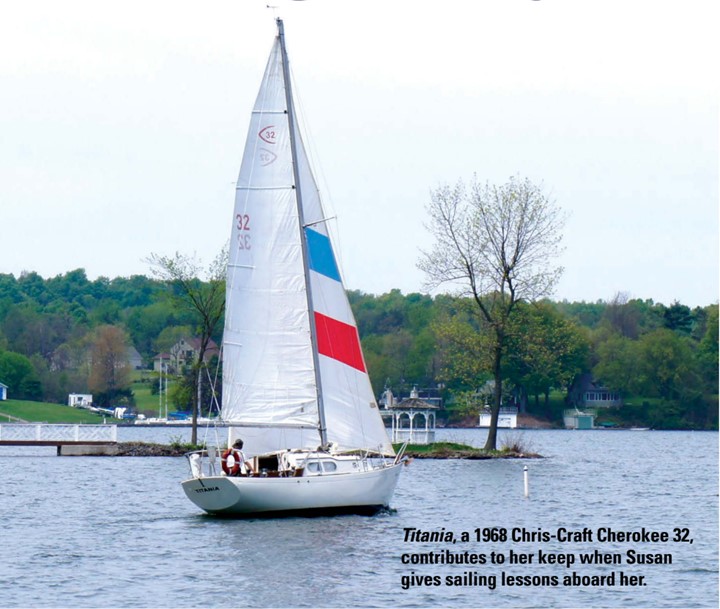
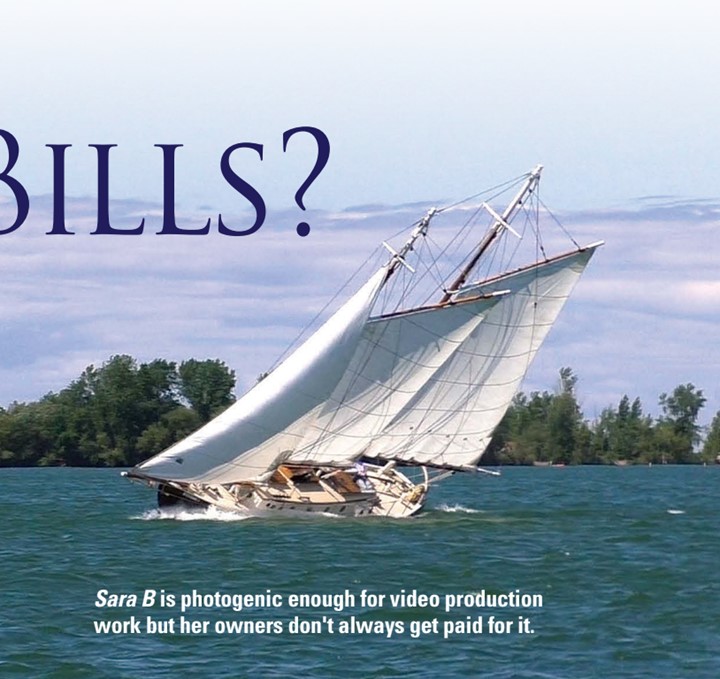
Back in 1997, three of us purchased and then shared a 32-foot Chris-Craft Cherokee sloop for one summer before the trio broke up amiably. Ten years later, my eternally optimistic husband formed another co-op to support a Tancook schooner named Sara B. That experiment in boat sharing has lasted nine seasons. It has survived an extensive unconventional and very sticky two-year refit of the wooden 47-footer involving 2 barrels of resin, several rolls of glass fiber mat and roving, 6,000 stainless-steel 1-inch staples, and at least 3 gallons of fairing compound and auto-body filler. We hope to carry on co-operatively with maintenance and sailing for at least one more season.
The Sara B LLC is a budget version of the fractional ownership setups that began gaining popularity a few years ago. Usually those deals involve new or nearly new boats with six-figure prices and cost each owner/LLC member considerably more each year than we originally spent to buy our little schooner. But there’s no reason why such a deal couldn’t be done with a good old fiberglass boat. A drawback with sharing is that you lose some flexibility in scheduling and control over the boat. Even as I enjoy sharing Sara B with others, I also enjoy having a smaller boat under my exclusive command to sail solo on short notice when that splendid weekday afternoon westerly wind ruffles the bay.
Cooperative arrangements are certainly not for everyone, but ours has worked well for a boat that’s big enough to easily soak up a half dozen people for a Sunday sail. With her two masts, eight halyards, and abundance of other gear to keep track of, Sara B can be sailed solo in a pinch or with two people familiar with the boat, but having a third person along makes sailing (and docking) a whole lot easier.
The champion tightwad boat share that I’ve encountered to date was that of three women who went in on a $200 sailing dinghy they kept on a mooring in front of a friend’s waterfront cottage. Now that’s penny pinching of the highest order in my book.
Studio, muse, or workshop
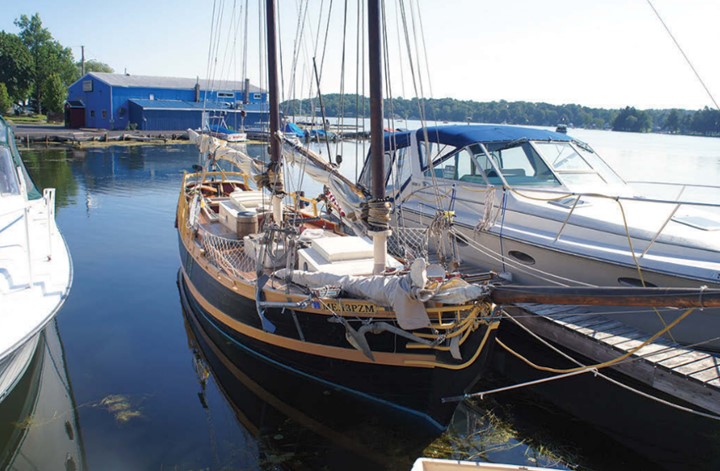
Some budget boaters find ways to generate income from their sailing hobby so the boat pays part of her expenses. I’ve crossed tacks with several sailors who transported compact art studios along on their cruises. Once they arrived at a scenic anchorage, they would haul their easels and paints ashore to create some en plein air artwork that they could sell for cash or barter. I know one sailor who does boat surveys. I’ve sailed with another who sometimes works as a delivery captain.
A time-honored way to help out with yachting expenses is to write about the boat and the adventures of her ship’s company. Some scribes are a lot better at it than others. The sales of my sailing memoir about Sara B our eBay boat, Living On The Edge With Sara B, are never going to come close to the success of Canadian author Farley Mowat’s book about his little schooner as portrayed in The Boat Who Wouldn’t Float. Still, I did launch a modest self-publishing venture based on the first book I printed about traveling Lake Ontario aboard a 23-foot woodie, the good little ship Ariel. After that title sold out, I printed three more works based on my sailing experiences . . . all of which turned at least a small profit.
Other sailors, far more creative than I, have drawn inspiration from their hobby to write and sell many books, magazine articles, musical works, or photography. As readers of this magazine surely have inferred, combining photography and words often enhances the odds of getting into print.
If you have a lot more hustle and are a better sailor than I am, you may even be able to leverage your writing to get on the speaking circuit. Last year, I saw a boat-show workshop on how to sell stories to boating magazines. Another workshop I almost signed up for was about reducing the anxiety of boating. (One way to do that is not to get too deeply in debt!) Reducing anxiety would seem to be a rich source for stories about sailing. You might not get rich off the lecture circuit, though, unless you also have some sort of service or product (or book!) to sell.
Talk like a pirate
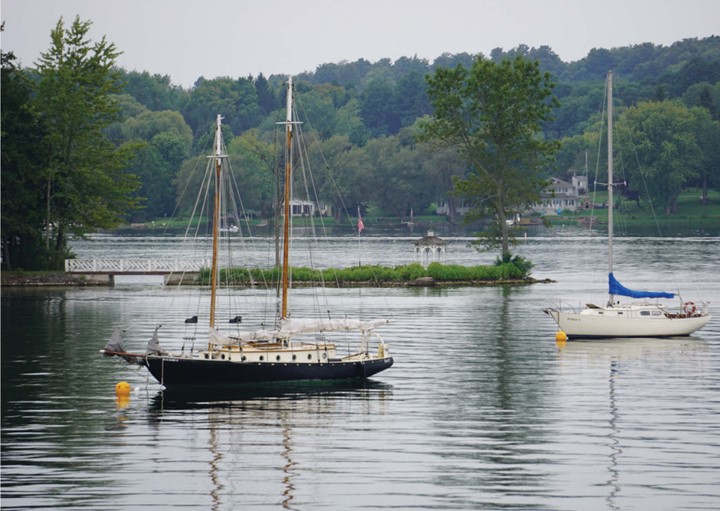
Last summer, I encountered two vessels with skippers who had ventured into the historic reenactment business. One, a Cal 25 the owner acquired for free, had been converted into a remarkably convincing tiny pirate ship. Her free-spirited skipper has traveled between the lower Great Lakes and Florida for several years attending pirate fests and other semi-theatrical gigs and being paid for his appearances.
Another such yacht stopped in my home port on Lake Ontario last summer en route to the coast of Maine. She was a 30-foot schooner, built of wood about 20 years ago, and was an exact half-scale replica of a Revolutionary War-era vessel. Her new owner, whose day job involved operating oil field service vessels in the Gulf of Mexico, planned to work the tall ship gatherings and pirate gigs of the New England and mid-Atlantic coast.
If your boat is really photogenic, you might even be able to make a bit of money by renting her out as a movie prop. A fellow schooner owner in the Toronto area managed to score a few hundred dollars from a production company for a day or two of filming with his little two-master.
An extreme example of making money with a boat was one that stopped in at a nearby port on Lake Ontario last summer. The Amara Zee is a steel-hulled knockoff of a Dutch sailing barge and currently owned by a theater company. The actors and gymnasts stage their shows on deck and aloft in her rigging. We watched a performance of “Hacked . . . The Treasure of the Empire” with a plot that has been aptly described by reviewers as “indescribable.” Still, as sailors, we greatly admired the ingenuity and rigging skills of the thespians as they climbed, zipped, swung, hauled on tackles, and manned the capstan bars to present the show.
Charters and tours
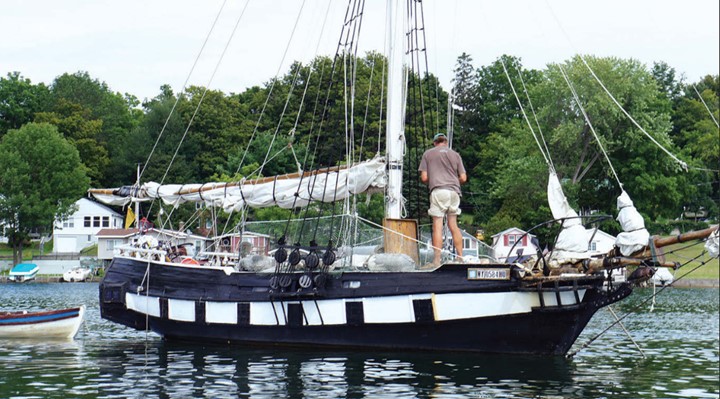
One of the most common ways to make your boat pay her way is to put her to work in the sailing excursion trade as a UPV (uninspected passenger vessel). To do this you need to get your merchant mariner credential (MMC), more commonly known by six-pack operators as a Coast Guard captain’s license. This involves a physical, a test of your seafaring knowledge and rules of the road, a hefty pack of paperwork, and some fees. Some people pay a four-figure tuition to attend a school that guarantees a passing grade on the test. Tightwads study at home and then drive to the nearest test site to take the exam.
I did this back in 1997, and subsequently offered day trips and sailing lessons on inland waters for a number of years. There are some legal requirements, including enrollment in an approved drug-test program and documentation of the vessel if she is over 5 net tons, but if you carry six or fewer passengers, the trade is far less regulated than that involving so called COI (certificate of inspection) vessels like the windjammers and big cats that haul crowds around on harbor cruises and sunset sails.
Not all marinas allow commercial activity on their docks, however. We were fortunate to find a waterfront business that welcomed the idea of sailing charters as a complement to its own offerings. I’ve also encountered a sailing charter operator who teamed up with waterfront restaurants or taverns to offer sunset cruises.
If you operate a charter business for very long, you will almost certainly meet some very interesting passengers. Running a small passenger vessel is not a job for the faint-hearted. Perhaps you will be asked if the family can bring their dog. Or their very large macaw. You will almost certainly have to deal with infants and toddlers. It’s difficult for someone like me, who has never had a child, to comprehend how quickly a 6-year-old can pull the free end of the halyard up to the top of the mast and through the halyard block. But some kids are an utter delight to have aboard. I remember a brother and sister team who spent most of the charter making the beds, swabbing the floor, wiping down the countertops, and otherwise putting things in order below-decks in their child-sized home.
You may well have to deal with frail people dreaming of taking the first (and last) sail of their lives. If that happens, I suspect you will never forget the light in their eyes and the smiles on their faces as they watched a fleet of racers crossing the starting line leaning to a sweet summer wind as they charged along.
Buy, sell, and trade
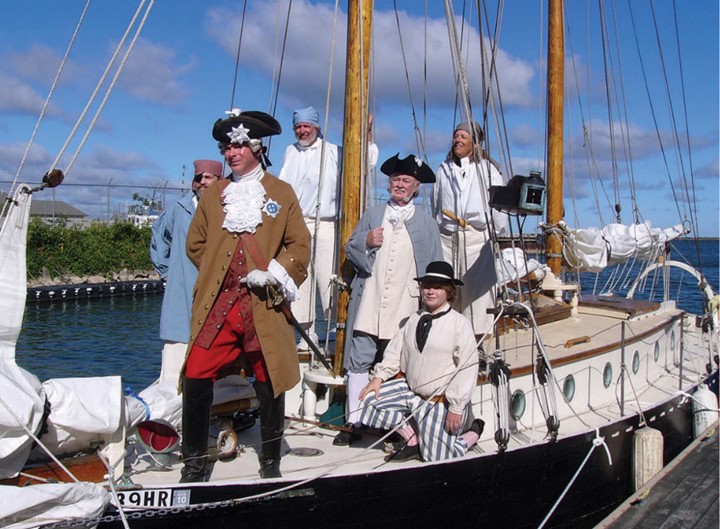
It goes without saying that if you are a true-blooded budget boater, you will buy low and sell high when it’s time to change boats. Although this is something I have not yet managed to do, I have met a few wheeler-dealers who acquired cheap boats, kept them for a few years, and sold them at a profit. My marina neighbor fixed up a Catalina 30, then swapped it for a 41-foot Morgan Out Island with its comfy amidships cockpit and more room than the entire upstairs of our house. Another friend swapped a 22-footer with a freshly done paint job for a sweet-lined Irwin 27. When I last saw him, he was in the process of swapping that boat for a 40-footer he planned to take south as a liveaboard vessel.
I am ashamed to confess that I have the ability to buy cheap boats nobody else wants. This is, after all, why I could afford them. The problem is they are still unwanted when I try to sell them. On three occasions, I have sold these worthy vessels for the price of the trailer upon which they sat. But two of those boats had paid their way for years. They didn’t owe me a thing. Quite the contrary. They enriched my life with an abundance of learning experiences that to this day make for great conversation on winter days when sailors gather to swap yarns. The third boat had been purchased as an act of charity from a non-profit organization, so I didn’t feel too bad about letting her go for the cost of the car carrier she sat on.
I agree with everyone else that yachting is not a cheap hobby, but it’s only money . . . and you can’t take it with you. The older I get, the more I realize it is the memories, experiences, and friendships associated with sailing that are priceless.
Susan Peterson Gateley lives and writes among the poison ivy and multiflora thickets of a woodlot within earshot of Lake Ontario on a rough day. She learned to sail and cruise on biodegradable boats using the “discovery method” and — after several offshore bluewater trips on other people’s boats and ships — decided she prefers “green water” coastal cruising. Her mission is to make the climb up the learning curve a little easier for wannabe sailors. Her books are available from her websites, www.silverwaters.com and www.susanpgateley.com. She still hopes to get one of her boats on this magazine’s cover!
Thank you to Sailrite Enterprises, Inc., for providing free access to back issues of Good Old Boat through intellectual property rights. Sailrite.com