A faithful and forgiving foul-weather friend
Issue 106 : Jan/Feb 2016
Ellen is on top of me! Our legs are entwined! We are lying against the starboard wall of our cockpit footwell. It is horizontal, parallel with the sea, and seawater is pouring over us from the lee side cockpit coaming. Without any warning, Entr’acte has been knocked down by a ferocious gust of wind and is on her beam ends, mast and spreaders in the water. To reach the mainsheet is now a vertical climb against gravity and the wind. Finally, one of us manages to let the sheet fly but the line jams. By this time, like a panicked tightrope walker, I am crawling forward through the water along the starboard lifelines, all the while praying for the mainsail to “please blow out” and end this thing. Does anyone actually wish for a sail to blow out? Well, it’s not every day that a sailor gets to see his cabintop rising vertically from the sea.
I reach the mast, the reefed mainsail a white leaking roof above me, and release the halyard. Climbing out of the lee against the wind and around to the windward side of the still horizontal mast, I lie flat along it and manage to claw the sail down toward me. Then several things happen simultaneously. Entr’acte rights herself instantly, the wind seems to stop completely, and torrential rain begins . . . rain like no one has seen since Noah’s flood, not even in the movies.
We drifted under a waterfall, laughing hysterically, just a half mile from the marina and our date with the travel lift. Neither one of us was hurt. We saw no damage, until we looked below. Entr’acte was dry and all was absolutely perfect except for an incredible mess in the galley where the sink drain had regurgitated the morning’s offerings.
“I guess we should have used the trysail,” I said.
Ellen looked horrified. “The last time I saw it, it was rolled up in the bag next to the handhold. Is it still on board?”
I assured her that it was quite safe and dry below . . . ready for storage.
We had broken one of our cardinal rules and paid for it. In my defense, this was our final sail for the season and I had washed and dried our trysail carefully for long-term storage. The wind was a steady 20 knots, but we were sailing in the trade winds in the lee behind Fiji’s Big Island, Viti Levu,and through sheltered, flat, shallow
water. I reasoned that for such a short trip a double-reefed mainsail was quite adequate. After all, it was only 13 miles!
Mystery sail
Flashback to the winter of 1973 when, Thanks to the Arab oil embargo, I was spending the longest winter of my life sitting at home awaiting the delivery of my first boat. Throughout that winter I devoured every sailing yarn I could find: Chichester, Moitessier, Knox-Johnston, Pigeon, and more. The stories were delightful and I absorbed all the lore. But one term constantly eluded me. They all spoke of “the storm trysail.” Everyone mentioned it but never explained what it was.
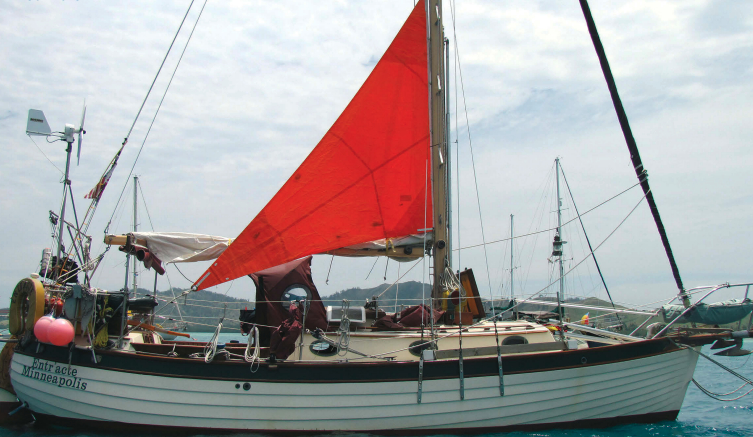
When we built Entr’acte, our full-keeled Nor’Sea 27, we still had not unraveled this mystery, but decided that — even though we did not know what a trysail was — if Sir Francis and all the lads carried one, we should have one as well. How we would use it was still unknown. The trysail is still somewhat of a mystery to many sailors.
The trysail is a small storm sail hoisted during heavy weather in place of the normal mainsail. It can be flown by itself or in conjunction with a partially unfurled headsail, a dedicated storm jib, or a staysail. When it’s needed, you lower the mainsail and raise the trysail to either carry on or to heave-to while you “go below and smoke your pipe.” At least, that’s what Captain Voss did.
When I talk about trysails, other sailors say, “I have reefs in my mainsail. A trysail is complicated and not worth the expense and space on board.”
Yes, I agree, a reefed mainsail is fine, up to a point. But look at the mainsail and all we typically ask of it.
The multitasking mainsail
The mainsail is first a light-air sail that spends endless hours slatting and banging in calms while waiting for wind (see Ed’s article on the light-air Mainster, January 2010 –Eds.). As the wind fills in, the main becomes a working sail as it begins to pull and drive the boat. The wind increases and we take a reef, then two, and then maybe a third. By now the wind is really howling. The waves are slamming into the boat, the lower shrouds are now working under greater load, and hard water is actually hitting that exposed bit of what has now become a storm sail.
When the wind finally increases another notch we heave-to under the deep-reefed mainsail and, while we are down below praying, a mere corner of the entire mainsail is taking the full force of that wind and sea. It seems unfair and somewhat unrealistic to ask so much of one piece of gear.
Think for a bit about reefing a mainsail. As reefs become deeper, the shape gradually changes and the
mainsail loses efficiency, just when it’s needed the most. The very upper part of a mainsail was never meant to be a storm sail. Lin and Larry Pardey’s Storm Tactics Handbook covers this topic quite well.
No matter which reefing system you employ, reefing is a process and is not automatic. To tuck a reef into a mainsail when it’s blowing 12 to 15 knots is rather easy and good sport. You feel like a real sailor! Between 15 and 20 knots, it can be a bit of a challenge and now you feel like a hero, especially if you are Mrs. America doing the reefing while Mr. America is asleep down below. Beyond 25 knots, that third reef can be a real bear in the seas and wild motion that accompany such wind. It isn’t fun anymore; what was once good sport is now downright dangerous, particularly at night. On my watch, I can have the trysail raised and drawing and be into a cup of coffee far faster than I can set up a third reef in the mainsail.
Be Walter Mitty for a moment and imagine setting that deep reef in 30 knots and above. In 30- to 40-knot winds I would never ever have the mainsail raised — no matter how many reefs — especially if the wind is aft.
Enter the trysail
The trysail offers several distinct advantages over a deeply reefed mainsail.
First – It is a simple solution and fast. Down main. Up try. Done! This is an over-simplification to be sure, but if you have the proper setup and are proactive, it really is simple. Designed specifically as a heavy-wind sail, it is well up to the task and saves your precious mainsail and rig from needless extreme wear and tear.
Second – The mainsail’s vast amount of wet sailcloth is rolled up tight and lashed to the boom. Securely out of the way, it does not collect water that could destabilize the boat.
Third – It removes the boom from the equation. This makes it very different from a “Swedish mainsail,” which is basically a storm mainsail that looks like a regular mainsail but is much smaller, has no battens, is cut to have some draft, and needs the boom to function properly.
Fourth – The trysail provides a safe option of setting a substitute mainsail without the constant fear of an accidental gybe that can dismast your boat.
Fifth – With the trysail set, you can carry on with much less worry. If you desire to heave-to, just furl your headsail, put down the helm, and allow the boat to settle in.
Trysail construction
The Sailrite book, Stormsails: Their Design & Construction, states that because the trysail is so small, it need not be made out of inordinately heavy cloth. It recommends using the same weight cloth as your mainsail. It is a very simple sail, basically a small triangle cut flat with very little draft; a bit more reinforcement at the head, tack, and clew; and extra tabling along the luff, leech, and foot. You could easily make a trysail yourself if you have a machine capable of sewing multiple layers of sailcloth.
The shape of the triangle is what is unique. The odd shape is designed to keep the center of effort low and close to the mast to reduce heel and not induce excessive weather helm. With no belly in the sail, in very strong gusts the wind just slides off the sides of the sail, lessening the chance of a knockdown. Entr’acte’s first trysail was 7.5-ounce cloth and served admirably for years.
Upon replacing it, we took the advice of the Pardeys and had the new one made from storm-orange material for better visibility in large seas. This was a great move. However, storm orange comes only in 9-ounce and 12-ounce weights. Thus, Entr’acte’s new 9-ounce trysail is quite heavy relative to the size of the boat. When new, it was quite stiff and repacking it after use was like wrestling with sheet metal. Eventually, as it softened, it became more compliant.
I have heard discussions about incorporating reef points in the trysail. On the surface it seems like a good idea, but I cannot imagine going to the mast in terrific storm conditions, lowering the sail, tying in a reef, and hoisting the sail again. The moment that sail comes down you immediately lose whatever benefit and safety it provides. If you are hove-to under trysail, the moment you lower the sail to reef it, you will no longer be hove-to but lying a-hull, absolutely the most dangerous position to be in under those conditions. I say that if your trysail is sized properly to your boat, there should be no need to reduce sail further.
Trysail track
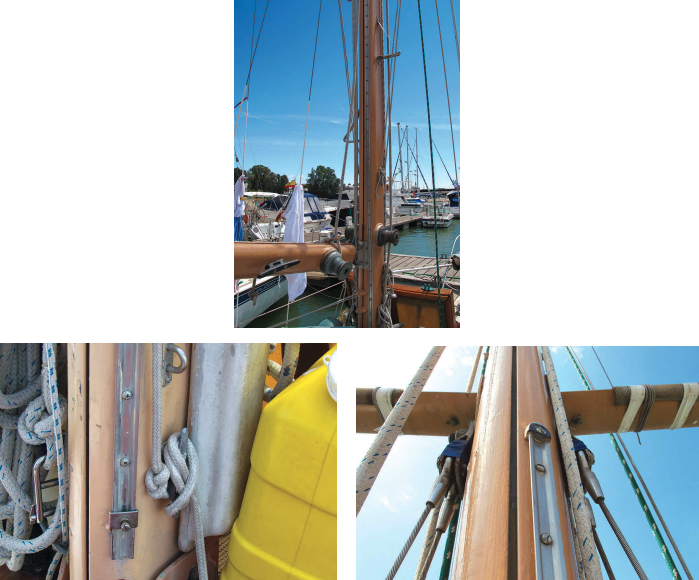
The trysail must have its own dedicated sail track and sheets. Period. Having to remove the mainsail slugs from the track and feed trysail slugs into that same track in heavy weather is a needless complication. The sail should live on deck in an easy-to-open bag, its slides attached to its own track, and ready to hoist directly from the bag, like a parachute. We have violated this rule twice over the years and both times we have paid the price.
Sail track is sold in 6-foot lengths. It is absolutely vital that these sections meet perfectly to eliminate any possibility of snags when hoisting the trysail. This is difficult to achieve and especially so when installing the track from a bosun’s chair. To ensure a fair run, the sections should be welded together, all the joints ground smooth and polished off site, and the track installed as one continuous length.
The trysail track runs parallel to the mainsail track and is typically fastened to the mast with either stainless-steel pop rivets or tapped machine screws. The track should begin about a foot above the coachroof and extend to a point just below the spreaders. The track and fastenings should be installed with appropriate bedding compound.
Be advised that the standard pop-rivet tool is hopelessly inadequate for the installation of even one stain-less-steel rivet! The appropriate tool can be rented cheaply from most tool rental companies. Avoid aluminum rivets as they will eventually corrode and fail — at an inopportune time. If using machine screws, make certain that the screw heads do not jam against the sail slides.
Sheeting arrangements
When we first took delivery of our trysail, I asked the sailmaker how to lead the sheets. He replied, “. . . attach the clew to the boom and use your mainsheet or . . .” (I love this one!) “. . . just tie the sheet to a handrail someplace.” I pictured our beautiful newly cut teak handrails, through-bolted as they were, being mercilessly jerked and attacked by a wildly flailing sheet. Even with my lack of experience at the time, I knew better than that.
We tried the clew-to-the-boom idea and it almost cost me my life. One dark night in a Gulf Stream squall, we hove-to under trysail and for safety lashed the boom down into the gallows. All seemed well enough until a ferocious gust hit, knocking Entr’acte well past 50 degrees. The sudden force of the wind against the sail caused the boom to stretch the lashings, leap from the gallows, and travel just far enough to slam me on the side of the head, driving me down to leeward.
It was one of those “movie moments.” She reached for me, I reached for her. Our fingers brushed just out of reach and, as the lightening flashed, our eyes locked and I was gone! The starboard lifelines saved me, but it was a drop of 4 feet to those lines and an extremely painful experience. I had two cracked ribs, but remained on board.
The trysail should never be attached to the boom. In these conditions, the boom should never be under load.
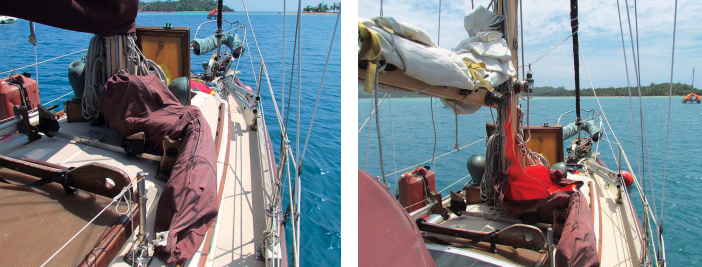
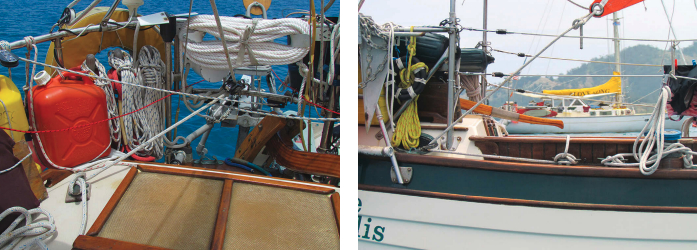
On Entr’acte we employ two sheeting arrangements, depending on our heading and conditions: one at the centerline and another on either quarter. Centerline sheeting requires only a single sheet and allows the boat to be sailed on either tack. Sheeting to the quarter requires one sheet for each tack but offers better sail control when far off the wind. For heaving-to, we have used both, depending on conditions and how Entr’acte was behaving at the time.
We added an extra cleat on the cabintop and coaming dedicated to the trysail sheet. The sail lives in the bag, hanked on. The sheet is stowed on a pinrail at the stern pushpit next to a permanently mounted block. To raise the try, we lead the sheet through the block and cleat it at a pre-marked position. We then carry the other end up to the bag, unzip the bag, and attach the sheet to the clew with a bowline, drop the main, switch the halyard from the mainsail to the try (the most difficult part), and hoist the try. Because it has already been “pretrimmed,” there is no flogging. We make all final trim and course adjustments from the safety of the cockpit.
Flying a trysail
Experience has led us to conclude that a trysail is not a “survival sail.” Rather, it is, or should be, a fundamental part of a cruising boat’s sail system. We employ it regularly as an alternative to deep reefing. It is not at all unusual to see Entr’acte sailing along between thunder squalls under trysail and full genoa. When the next squall approaches we simply roll in the genoa, scoot along under trysail and, when the big wind has passed, unfurl the genoa and carry on until the next go-round. It looks kind of dumb, but it works. If we had used this procedure that day in Fiji, we would never have been knocked down and thus would have had no opening paragraph for this article.
Where does the trysail fit into our reefing program? Entr’acte’s mainsail carries three sets of reef points and they are used as follows:
The first reef – We tie this in when the wind gets to 12 knots to keep the steering gear happy. If we are hand-steering, we wait until 15 knots.
The second reef – This usually goes in at 20 knots. Whenever the second reef is tied in, we watch the conditions carefully. If all seems stable, we leave well enough alone. If we are thinking about this reef and night is approaching, however, or we think we might want a further sail reduction, up goes the trysail and that’s that. That day in Fiji was at the end of the season and the trip was short. We let down our guard and paid for it. Lesson learned.
The third reef – This is our emergency get-home reef in case, say, an upper shroud let go, the mast broke above the spreaders, and we need a mainsail to make safe harbor. We have also used this reef when running dead downwind wing-and-wing in the trades.
The trysail can be easily hoisted in any wind, on any point of sail, and in any conditions — but you must be proactive. Remember the old adage on reefing: “If you are thinking about reefing, it is past the time to do it.”
Hoisting a trysail is easy. Getting the mainsail down in heavy wind is the problem, especially if you’re running dead downwind and the sail has full-length battens. Wait too long and you have a tough, sometimes dangerous, fight. Hoist your trysail as part of a sailing plan, not as a matter of survival. Ellen and I are “set it and forget it” people. We like to implement a solution early and relax knowing that the hard work is done. We save the heroics for when we must perform them.
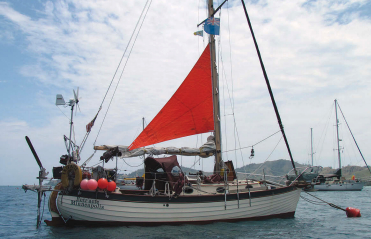
We are not racers. We are “mom and pop” trying to sail our little plastic boat to the best of our abilities. We like to have Entr’acte sail well and to make smart passages, but the safety of the vessel and the crew comes first, comfort of the crew comes next. Our goal is to arrive, to arrive safely, and to arrive well-rested — ready to party! All other considerations and tactics are subordinated to these goals.
The name of the game is plan ahead. Anticipate conditions and set up for them in advance. If employed properly, the trysail takes a tremendous load off of your mainsail, your rig, and you.
Ed Zacko is a Good Old Boat contributing editor. He and Ellen met while playing in the orchestra of a Broadway musical. They built their Nor’Sea 27, Entr’acte, from a bare hull and since 1980 have made four transatlantic and one transpacific crossing. Entr’acte is now based in Seville, Spain, where Ellen and Ed are happily sailing in and around the Mediterranean and playing in the jazz clubs of Spain, France, and Morocco. When not on board Entr’acte, they heave-to in Phoenix, Arizona, where they maintain a busy concert schedule throughout the Southwest U.S. Follow them on www.enezacko.com.
Thank you to Sailrite Enterprises, Inc., for providing free access to back issues of Good Old Boat through intellectual property rights. Sailrite.com