. . . when properly mounted and maintained
Issue 107 : Mar/Apr 2016
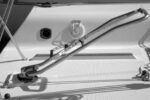
When planning to buy a good old boat, most sailors typically look carefully at the design, the propulsion, the hull, the sails, and many other aspects of the boat, but we tend to take fittings like winches for granted and seldom evaluate them carefully. I know this to be true for me, anyway, because when I bought my most recent boat, a 1967 Pearson Commander, I noted that it had winches in place as well as holders for the winch handles. They were the old-style winches that require a flat crank handle. After completing the sale, I went aboard the boat to look for the winch handles. What a surprise when no one knew where they were!
I knew the winches were probably going to have to be replaced at some point in the future, but I hadn’t figured that extra cost into the price of the boat. The purchase of several old-style handles suddenly became a priority. I searched the nautical consignment shops and eBay to no avail. It was soon obvious that I would have to move ahead with my plan to replace the winches.
It is for a reason that, in some circles, winches are referred to as “nautical jewels.” On occasion, their cost can exceed the price of the boat. When shopping for used winches, the trick is to find winches of the correct size (that can be operated with conventional handles), in good condition, and for a reasonable amount of money.
Because of their cost, the winches installed on a newly built boat are often the minimum size that is practicable, unless the first owner chose larger winches as an option at the time of purchase. That newly built boat with the somewhat too-small winches will eventually become a good old boat. There will come a time in the life of that boat when owner number two, or three, or four will want larger winches.
I once owned a Pearson Ariel that had been raced and refitted with size 40 winches. My newest good old boat, the Pearson Commander, is the same size as the Ariel. When I bought it, however, those original winches were size 6. My replacement winches are size 8 and will fit the same base. When you are looking at replacing your winches with larger ones, make sure you have room for the bases.
Used winches are a bargain
If you ask around your local marinas and boatyards, you will often find someone in the process of upgrading, or who has recently upgraded, to new winches and is ready to get rid of the old ones for a reasonable amount of money. Winches are very close to indestructible, and used ones can be economically rebuilt if most of the parts are still there. Look around and explore your sources. You may find some good winches available at a bargain price from consignment stores or from sailors you know.
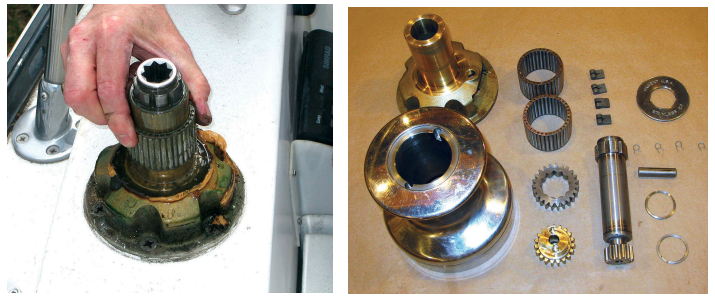
I was lucky. One of my slipmates had upgraded his winches and offered me the old, size 8, ones. Used winches can be rebuilt, cleaned, greased, and made operable by any do-it-yourselfer. The local boatyard quoted more to rebuild my winches than the cost of a new winch. I decided to do it myself.
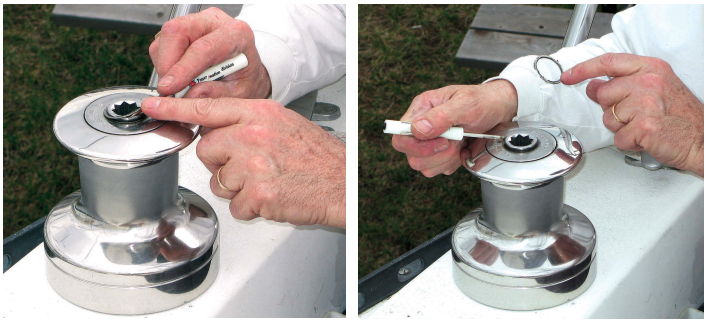
Most winch manufacturers provide online instruction books to direct you in the disassembly and reassembly of their winches. Lewmar, the manufacturer of the used genoa winches I obtained, provides a detailed instruction book on its winches. New Lewmars are very easy to dismantle, but the older ones have a locking ring, or circlip, that is a little tricky to remove and can be damaged if you are not gentle.
Once inside the winches, I found that they had all the pawls necessary for operation but none of the springs that the pawls needed to function. Lewmar was most cooperative and quick to supply me with a complete set of springs for my winches for just $10. After I had cleaned, greased, and reassembled the winches, they performed as new. One caveat: do not clog the pawls with grease as they will stick over time. Lubricate them lightly with light oil. Check the winch manual or ask the manufacturer regarding the amount of lubrication.
A well-made winch should last a very long time, particularly if it is serviced when needed.
Bill Sandifer, who was for many years a Good Old Boat contributing editor, has been involved with boats and the water since the age of 12 when he “borrowed” anchored rowboats for “rides” while never leaving the mooring. (He just paddled around with a “found oar.”) Since that time, he has been a launch operator, sailing instructor, founder of a scuba company, and owner of a boatbuilding company. He currently cruises the U.S. Gulf Coast with his family in a 50-year-old Pearson Commander.
Thank you to Sailrite Enterprises, Inc., for providing free access to back issues of Good Old Boat through intellectual property rights. Sailrite.com