A shocking danger is ever imminent
Issue 114: May/June 2017
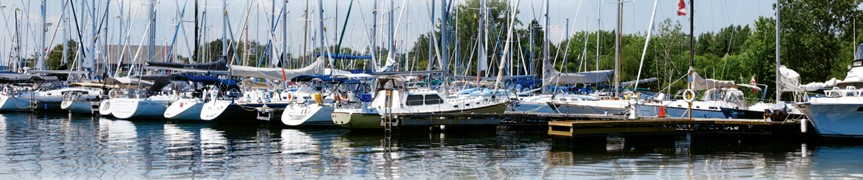
Marinas are usually situated in places that offer good protection from storms. During the summer months, those locations can shield marinas from cooling breezes, leaving the air still and sultry. Meanwhile, the boats in the marinas are surrounded by cool water, and the idea of taking a refreshing dip can be very tempting — to anyone who is not aware of how dangerous that dip can be. Three hazards in particular should make everyone think twice about swimming in a marina.
Underwater objects
Old pilings are not always removed when replaced with new pilings and might be left to slowly rot away, and their remains may eventually be hidden beneath the water. The older a marina, the more likely it is that long-forgotten pilings are present. Jumping into the water on top of a hidden piling can lead to serious injury or death. Razor-sharp barnacles that grow on submerged objects can lacerate swimmers brushing up against them.
Other underwater hazards include rope, fishing line, and objects blown off docks by high winds, such as chairs, tables, and sun umbrellas. These, too, can injure or entangle swimmers.
Vessel traffic
Marinas are built for boats. Boat operators maneuvering in tight spaces have difficulty enough without having to be on the lookout for swimmers. Few states require any training or license to operate a boat, and many operators don’t have the skill or reflexes to react safely in an unexpected situation. I have seen the driver of a motorboat speed forward when his intention was to reverse. I’ll never forget the resulting crunching sound. It’s fortunate that nobody was in the water at the time.
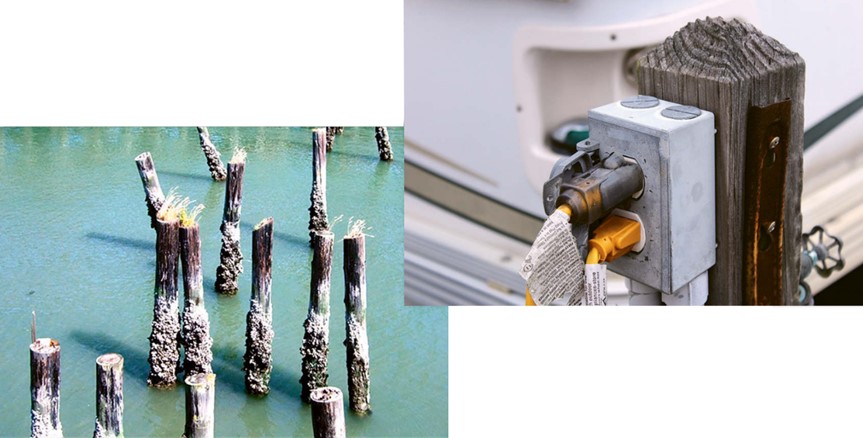
Electric shock drowning
Perhaps the most frightening — and least visible — hazard is electric shock drowning (ESD). Few people are even aware of it.
I learned of ESD in the spring of 2016 on reading a news story about two girls who jumped into an Alabama lake from a dock. One of the girls didn’t resurface. When her father and brother jumped in to help, the father felt an electric shock. He called to his wife to cut the power, but it was too late for his daughter.
As I read the story, I started thinking about my marina and other freshwater marinas I visit. I sometimes see adults and children swimming, especially around the houseboat communities. Surveying power supplies on the docks at some marinas, I saw receptacles, conduit, and breaker boxes that showed signs of age and poor maintenance. Some electrical outlets were not even equipped with ground-fault protection. Could electricity find a path to these marina waters? Absolutely.
According to Capt. David Rifkin of the Electric Shock Drowning Prevention Association (ESDPA), 60 deaths were attributed to ESD between September 30, 2000, and July 3, 2016. He and other experts believe the actual number of deaths due to ESD during that period is much higher, because many are mistakenly reported simply as drownings.
ESD appears to be a threat only in bodies of fresh or brackish water where there is the possibility of a source of AC power making contact with the water. This includes not only freshwater lakes and rivers but also areas like the upper Chesapeake Bay, where salinity varies by season and with rainfall. In these places, it’s safest to regard the water as fresh. Private docks with electrical connections can present as great a hazard as marinas.
The reason ESD is a danger in fresh or brackish water is because the saline concentration in our bodies makes us better conductors of electricity than fresh water. For electrical current seeking a path to ground, a human body provides a better path than fresh water. Salt water, on the other hand, is a much better conductor of electricity than the human body, to the extent that any stray current will flow around a human body in salt water. No saltwater drownings have been attributed to ESD.
Electrical current in marina waters can be measured, and alarms are available that trigger when current is detected in the water near a dock. However, that current can appear in an instant, as a result of someone working on a boat’s electrical system, a visiting boat with a ground fault plugging into the marina’s electrical system, or someone dropping a live power cord into the water. When an alarm sounds, it is likely too late for anybody in the water. The only way to avoid ESD is to never swim in or near a freshwater marina, or in a freshwater body anywhere near an electrical source, such as a private dock.
Some marina managers, aware of the risk, schedule “maintenance windows” when they shut off electricity to their docks so that divers contracted to clean boat bottoms or perform other underwater work have an opportunity to do so without risk of ESD.
Do not be tempted to swim at your marina. The dangers might be greater than you realize. Stay safe.
Resources
To learn more about electric shock drowning, visit the ESDPA website: www.electricshockdrowning.org.
Jerry Thompson is an information systems professional who works and lives in eastern North Carolina. He learned to sail more than 25 years ago at the Armed Forces Recreation Center, Lake Chiemsee, Germany. North Carolina’s milder winters keep Jerry on the water year round.
Thank you to Sailrite Enterprises, Inc., for providing free access to back issues of Good Old Boat through intellectual property rights. Sailrite.com