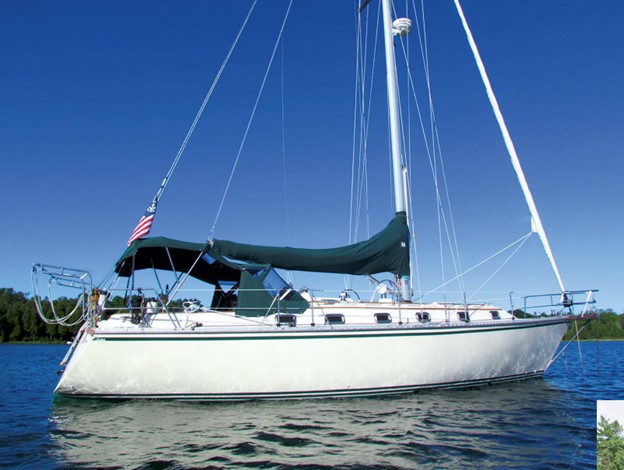
A cannibalized cockpit enclosure provides versatile shelter
Issue 116: Sept/Oct 2017
How much shelter from the weather does a sailing crew need? Some sailors look at their bare unprotected cockpits and add a dodger, then a bimini, and then the whole caboodle, as Dale Bagnell described in the July 2016 issue of Good Old Boat (see “Cockpit Canvas One Kit at a Time”).
We did the opposite. We subtracted.
When we bought our Caliber 38, Catamount, 12 years ago, it came with a dodger and full cockpit enclosure. We are not full-enclosure sailors. We like to see our sails, feel the wind on our faces, and anticipate the waves, and we don’t mind donning rain gear when necessary. We feel cramped and confined in a full enclosure and, apart from that, we don’t like what it does to the lines of a sailboat, so we dismantled it. While we discarded much of the stainless-steel framing that cluttered the cockpit area, ever frugal, we kept many of the other parts. As we used the boat and discovered how different weather conditions affected our comfort in the cockpit, those parts came in useful for making adaptations to suit a variety of situations.
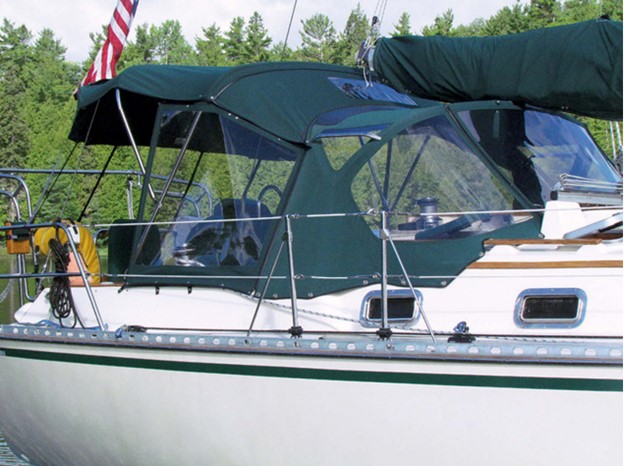
Rain fly – Our first obvious need was for a rain fly. We’d kept the awning that zipped onto the aft end of the dodger and served well in most rainy conditions. We also had enough of the original stainless-steel tubing to support it.
For the aft end of the fly, we fitted a bar (made of the tubing) horizontally between the boat’s twin backstays. The forward end is supported by a hoop that hinges on the cockpit coaming, and we added a third overhead bar across the middle section. We altered the aft ends of the awning to accommodate these new supports. So we could dismantle the apparatus and stow it on board, we cut all three overhead tubes in half. Dowels fitted into one cut end of each tube allow us to reconnect them.
Ventilator – Variation two evolved on a particularly hot day. Motorsailing in searing heat, we realized we could unzip the front portion of the awning from the dodger, flip that section back on itself, and attach the flipped-back ends with snaps to the side support bars. We secured the leading edge of the bimini to the handles on the outside of the dodger with webbing. The result? We were still shaded, but enjoyed a breeze and a better view of the sails and our surroundings.
Rain shield – Variation three was born after a hard rain while at anchor. The awning alone was not keeping us dry when rain blew in from the sides. Where were those original rain windows anyway? We’d luckily saved two of them, the ones that connect to the zippers on either side of the dodger.
We discovered that, when those two windows were up, we could still make good use of the cockpit during a rainstorm. At anchor, the bow faces into the wind and the protection the windows afforded was enough for us. The three overhead tubing pieces are bowed, so the awning sheds rainwater and does not allow puddles to form. And those windows also keep us warmer on cold days at anchor. When we don’t need them, they unzip easily and stow well in our forward shower.
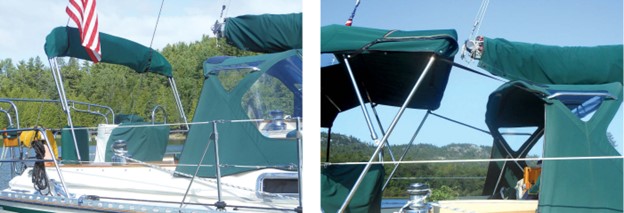
Open air – Variation four allows us to quickly adapt to warm days. Because the awning’s main supports are attached to the cockpit coaming with a hinged fitting, we discovered we could flip the whole thing aft and secure it to the horizontal bar attached to the backstays. At first we tied it with ugly bungees. That arrangement soon gave way to a new Sunbrella cover we designed that secures the canvas and its supports to the backstays. We can fold it all back or reassemble it in a few minutes while under way.
Shade from the side – The impetus for variation five was the really hot days when the late-afternoon sun poured into one side of the cockpit. A roll of brightly striped Sunbrella made a great separate sun awning that zips into the existing zippers on the edges of the original awning. Two straps secure it outside the lifelines and down to the toerail. It zips to either side, so we find ourselves using it often to keep the cockpit cool.
Screens – And mosquitoes? Wanting to stay outside in the evening despite those pesky critters, we came up with variation six. Having kept all the extra zippers from the full enclosure we had rejected all those years ago, mates to the zippers still on the original awning, we were able to sew netting to them and enclose the entire cockpit. We added a zippered door so we could get out to check the anchor or reach the barbecue. Secure and unbitten inside, we find it delightful to sit out on a full-moon evening and count the mosquitoes buzzing on the outside of our screens. The whole netting arrangement fits into one small bag, dismantles in minutes, and stows easily below.

Six shelters from one
So, over 12 years, our original cockpit enclosure has now morphed into six different flexible variations: rain awning, bimini, rain-window protection, extra sunshade for either side, mosquito protection, or an open cockpit with the whole awning apparatus secure against the backstays. Our subtraction evolved into addition after all.
We appreciate the high quality of the original materials and the skill used in making the full enclosure, and are glad we were able to render all our variations easy to convert and store. We sail most often with the awning secured aft so we can see our sails, feel the wind on our faces, and enjoy sailing the old-fashioned way.
Jennifer Bagley and her husband, Fred, live in Vermont but sail the Upper Great Lakes out of Cheboygan, Michigan, near the Mackinac Bridge. They primarily cruise Georgian Bay, the North Channel, and Lake Superior on their Caliber 38, Catamount.
Thank you to Sailrite Enterprises, Inc., for providing free access to back issues of Good Old Boat through intellectual property rights. Sailrite.com