Good planning, instinct, careful observation, or luck?
Issue 122: Sept/Oct 2018
In Good Old Boat there is an entertaining trope, or recurring narrative pattern, that shapes many Learning Experience stories: let’s call it Calamity Overcome. It’s a sailing story where the writer messed up and lived to tell us about it. It goes like this. A series of simple mistakes leads to a buckled foredeck, sagging shrouds, and a threatened dismasting. Or heavier than expected weather leads to severe pitching that clogs the fuel line during a Lake Michigan storm. More recently (“Between a Bridge and a Hard Place,” May 2018), backing up against moderate seas without a firm hand on the wheel leads to a jammed rudder and a Mayday call. Once the calamity occurs, the narrative tension revolves around the skipper’s efforts to resolve the dire situation. Sometimes, after the first couple of paragraphs in these stories, I fairly scream: “Don’t make forced errors!” I want to explore an alternative narrative pattern, let’s call it Calamity Avoided. I think it contains an important moral about our responsibilities as mariners and members of the sailing community.
A wilderness and cold water
It’s mid-June and, despite the long midsummer days, Lake Superior’s surface is 38 degrees. Singlehanding on Superior for the summer months, I am mindful that anyone falling in lasts around 15 minutes, loses consciousness, and then dies of hypothermia. All 29 crew members of the Edmund Fitzgerald, memorialized by Gordon Lightfoot’s 1976 hit song, went down and never came back up because the water was too cold . . . “The lake, it is said, never gives up her dead,” echoes in my mind.
I’m approaching my first true wilderness anchorage, Susie Island. To say the least, it’s pretty, but foremost in my mind right now is the desire for a ladder of about six feet or so to keep me above the deathly cold water. Despite what my paper chart and depth finder are telling me, the GPS screen spells certain doom. In my mind a terrible grinding and gnashing sound echoes across the still water. Somehow, Sunyata, my S-2 9.2A, drawing 5 feet, continues more or less straight into the deep inlet in Susie Island. I picture her fiberglass keel leaving behind a hideous sitzmark on the rock bottom.
The ladder in my mind comes from a childhood story where a boy is watching a painter high up a ladder leaning against a barn roof. The boy sees the ladder slide off the roof, but instead of the painter suffering serious injury or even death, the falling ladder fades away and a second ladder, seemingly real, stays safely in place. The protected painter is entirely unaware. The boy believes benevolent magic was at work. I wonder: do sailors have such magic ladders?
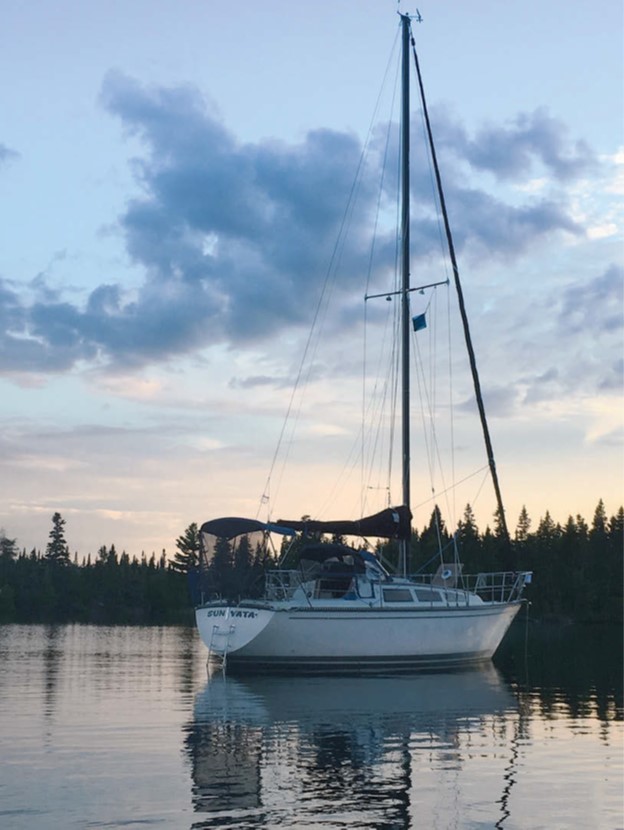
If so, the magic ladder for mariners is less a supernatural phenomenon, and I think it’s not even purely blind luck. It’s knowing when to trust your senses and see the outlines of tall trees far up above the fog to avoid an island’s shoreline, or when to “hit” the shore of Susie Island because that’s actually where the water is deep enough to safely anchor. Calamity Avoided is often a matter of attentive chart work, an accurate depth finder, and wideopen eyes and ears.
The Susie Island episode echoes the many more stored in the GPS. In two and a half months on Lake Superior that summer, I had the good fortune to “hit” bottom more than a dozen times. Once, when Sunyata was tied up safely at Malone Dock, the screen showed her 150 feet inland.
A couple of weeks later, I’m sailing out of Thunder Bay and the water has warmed to around 40 degrees. Hypothermia had recently claimed three boaters (including two NFL players) in 68-degree water off Florida when their vessel capsized during a posted small-craft advisory.
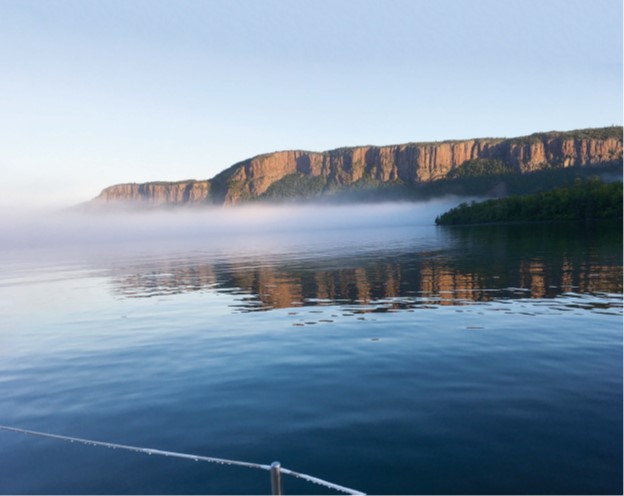
In Canada, banks of fog sometimes clear off midday, revealing the stunning shoreline of rocky precipices and narrow passages between headlands and islands of all sizes. But then the fog bank descends and I am alone in an inland sea of gray. One evening, the downbound freighter Federal Seto — I can feel the rumble of its deep-throated engines but cannot possibly pinpoint its direction — sends out sécurité advisories; its radioman warns “visibility zero” off Passage Island. But the next morning it’s the distinct thrill of heavy seas whipped up by strong northeast winds with a long fetch. The 1,000-foot-high bluff of Thunder Cape’s Sleeping Giant blocks the two Canadian weather channels, so the only weather forecast I have comes from the far-distant Keweenaw Peninsula, and they must have it all wrong. Anyway, perhaps only sissies pay attention to predictions of 10-foot seas on Lake Superior.
It’s easy to imagine how this scenario might unfold. We know from the Calamity Overcome stories in Good Old Boat and elsewhere that heavy seas have a way of clogging fuel filters, disabling engines, cracking windows, flooding lockers, breaking hatches, snapping sail hems, bending booms, and stretching shrouds, stays, or halyards to the breaking point. Although I’ve installed jacklines fashioned from sturdy climbing webbing and secure carabiners, all that protective gear is a hassle to use, and perhaps I’ll be tempted to tie down a loose anchor on the pitching bow. The 30-minute clock that ticks when you’re alone in the frigid water might start for a variety of reasons, most of them avoidable.
Saved again
My longest passage of 55 nautical miles across open water led to the summer season’s only expensive mistake. By late August, it was time to be heading home to Pikes Bay in the Apostles, and my dutiful attention to bad weather meant that I was running a bit late. Strong winds and heavy seas kept me at Isle Royale’s idyllic Chippewa Harbor, where the well-protected inner basin is a fine place to hole up in heavy weather. By then, I’d abandoned my original hope to circle the far side of the Keweenaw Peninsula then motor up the Keweenaw Waterway, and instead I was headed from Isle Royale to the “wicked rock shoals” at the entrance to Copper Harbor.
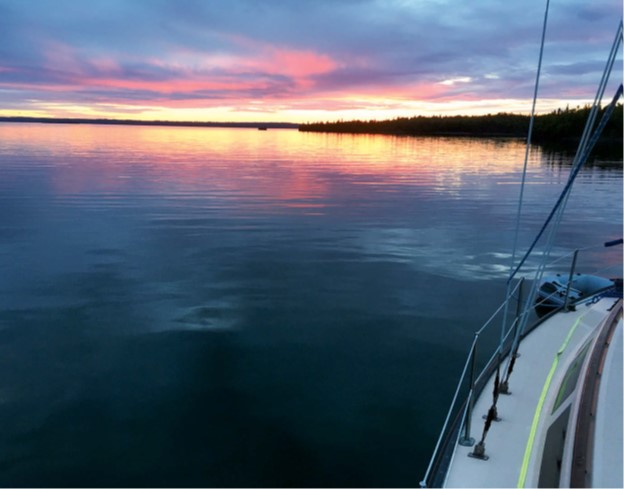
Halfway through the open-lake passage, a west wind came up, freshened to 20 knots, and kicked up 3- to 4-foot waves that made my 135 genoa far too much sail. For most of an hour, I tried to coax it in, but the wind and waves were too strong. “If you’re thinking about reefing . . .” I might have clipped in to my lifelines but, strangely, I did not. Finally, I took a leaf from the storm-tossed Pardeys and executed a “heave-to.” That stopped my wild ride, but the genoa did one extra round of flapping in the wind and twisted itself around the year-old headstay. (It didn’t see a second summer and my pocketbook is the lighter.) Suitably shortening up the genoa to what Bayfield sailing captain Beth Cozzi calls a “bikini jib,” I proceeded onward to Copper Harbor.
After this excitement it was early evening, and the wave-tossed 11-hour passage had evidently worn me down. The sailing directions from Bonnie Dahl’s Superior Way, the NOAA chart, and even my handheld GPS all agree that the entrance to Copper Harbor is clearly marked by range markers for a course of 190 degrees. I needed only to line up the red/orange markers and slip into the long and west-wind-protected bay. Unaccountably, I saw bright lights something like the red-laser range marker I’d passed through three times in Canada’s Nipigon Strait, only these lights — if I’d followed the dangerous mirage — would have sent Sunyata straight on to the “wicked rock shoals” and certain damage. I might then have written about Calamity Overcome.
But, just then, a magic ladder did its thing and gave me a second chance. I looked again, carefully this time, and finally saw the pair of small orange/red blazes, lined them up, and ran in to Copper Harbor.
A network of ladders
I believe magic ladders come in several forms. One is careful, even obsessive, preparation. Defense in depth is necessary for singlehanded wilderness sailing. Stout jacklines, reserve diesel, fuel stabilizer, radar reflectors, extra food supplies, spare nylon propeller, heavy anchor and stout rode, tools enough to overhaul everything on board — I deliberately planned and prepared all these. My boating brother, aboard for two weeks in Canada, was often posted at the bow, and in the vaguely charted Slate Islands threaded us through narrow shallows.
Simple luck is a magic ladder of sorts. There was my botched Bahamian moor in tiny McNab Harbor, where a release line fouled the second anchor. (Bahamian moors in place for three other overnight wind shifts kept Sunyata off nearby shores.) Luck led to the satisfying end to an exquisite 40-mile sailing day from Little Lake Harbor across Nipigon Bay and down Nipigon Strait, along those laser range markers, with a sail-in anchorage at Moss Island — a quarter hour before severe north winds raised impressive whitecaps. Shallow Nipigon Bay kicks up a 4- to 6-foot wind chop at the drop of a hat, but we’d long passed that danger point. Or perhaps the magic ladder had worked its wonders and let us proceed safely into a protected anchorage.
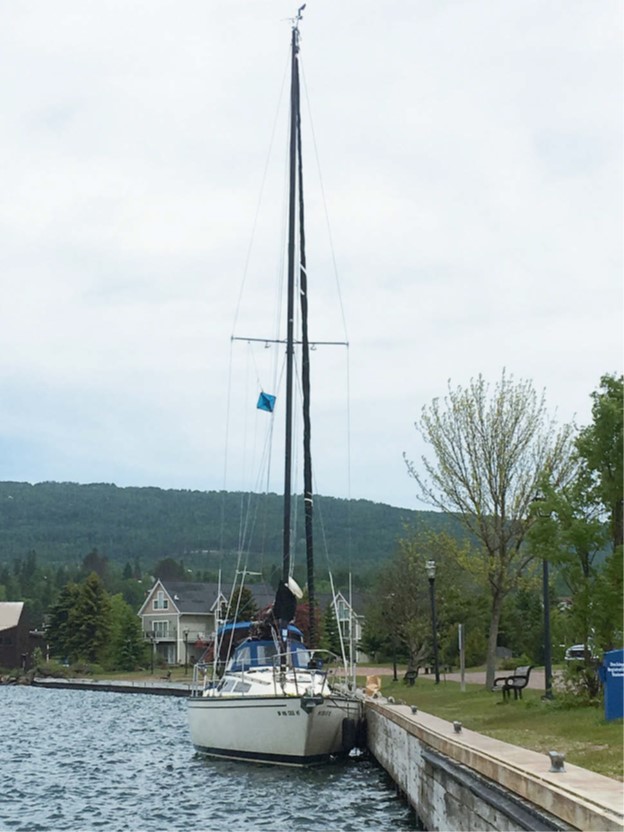
The sailing community itself forms a magic ladder too. That summer, I had a dozen or more instances of Calamity Avoided. The singlehanding captain of Peregrine warned me off a shallow approach at Grand Marais. A vintage-Chris-Craft restorer caught me at Red Rock, Ontario, before my bow pulpit could shear off the dock’s electricity and water pedestal. Larry and Judy on Allegro pointed out Otter Cove as a valuable hurricane hole. I am grateful for this protective community and thankful for its portable wisdom. I am even thinking more positively about the sharp radio message one day in heavy fog, fairly shouted over channel 16: “Loon: you are on the wrong side of the buoys! Keep the bell to the left!” Loon was negotiating a tricky entrance to Siskiwit Bay, I think, and the wrong side of a bell buoy would have meant a hard grounding and a chapter of Calamity Overcome. Instead, the alertness of a sailor-colleague brought about Calamity Avoided. It’s in our power to do the same.
Thomas J. Misa, a native of Port Angeles, Washington, attended schools on the East Coast, then taught the history of science and technology for three decades in the Midwest. His website is tjmisa.com. Recently, he and his spouse, along with Sunyata, relocated to Lopez Island in Washington’s San Juan Islands. So now, Sunyata sails in the Salish Sea.
Thank you to Sailrite Enterprises, Inc., for providing free access to back issues of Good Old Boat through intellectual property rights. Sailrite.com