Sailing other people’s boats is a good way to find the right size
Issue 122: Sept/Oct 2018
The essence of cruising by sailboat is not about crossing vast oceans, but about living by sail. My husband, Tom, and I lived this way for 10 years, traveling aboard our Peterson 44. When we returned to the United States, I had visions of reinventing micro cruising.
Since the 1990s, when I first set out on a 34-foot sailboat, the size of boat considered ideal for cruising has crept up; in 2015, the average boat sailing in the Atlantic Rally for Cruisers (ARC) was a little more than 48 feet, with anything under 40 feet considered small. We were ready for small, so we sold the Peterson and bought a Cape Dory 25.
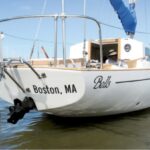
Cruising on a 25-foot boat seems a bit masochistic (how do you even have a reasonable galley?), but I knew that the joy of smaller gear and less stuff could be its own reward. Unfortunately, it seems we overdid our leap downward in displacement and length, as the Cape Dory proved way too small for us, at least for the Maine island-hopping we enjoy. When friends invited us out for a daysail, we jumped at the chance to try on their Pearson Triton 28, Ajaja, for size.
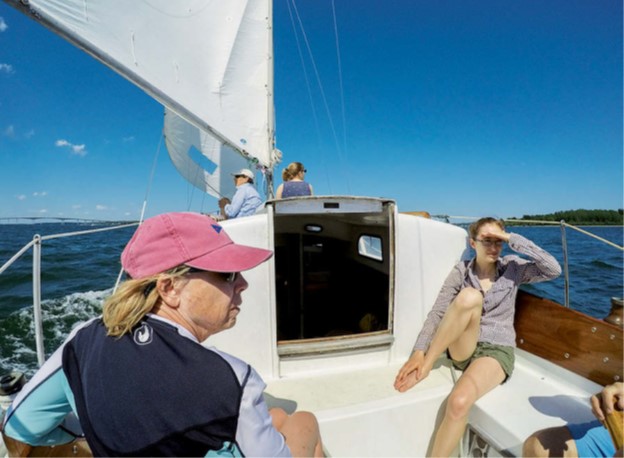
Entering Narragansett Bay’s West Passage from Wickford Harbor, we headed south. Though I was itching to take the tiller, this was the first family sail for Tom and Celia and their two daughters and so I hung back, enjoying my own first daysail of the year.
It was an early summer afternoon reminiscent of Sundays on Long Island Sound — less traffic but the same sense of determined holidaying with small boats in packs crossing in apparently aimless directions. Missing were only the tugboats, barges in tow, trying to thread the flocks, signaling at boats to get out of the way. The East Passage of Narragansett Bay, on the other side of Jamestown Island, is much more crowded with big yachts out of Newport and commercial vessels from Providence.
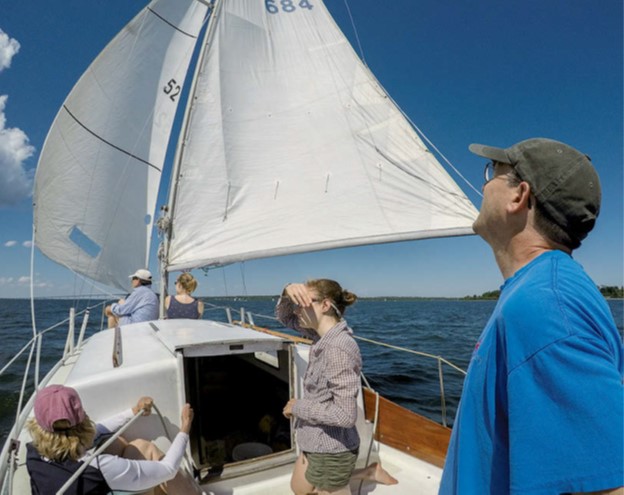
Ajaja ran along easily in 8 to 10 knots of wind. Her long keel with its 4-foot 3-inch draft tracked nicely, but the cutaway forefoot and shortened keel make her more maneuverable than boats with longer full keels. I marveled at how much more deck space there is on the Triton compared to our Cape Dory — three feet matter. Her pop-up cabin top provided full headroom below, but did hinder the view forward from the cockpit.
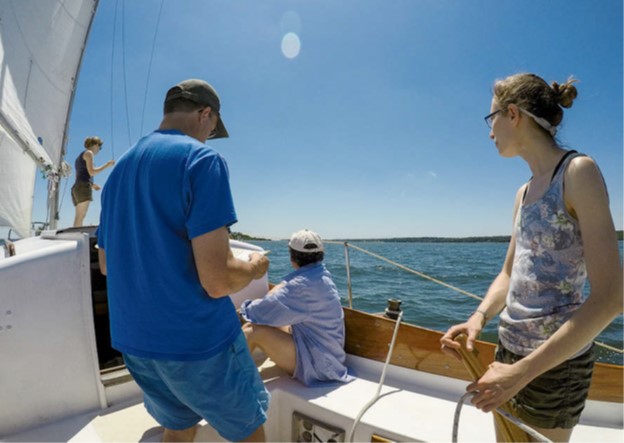
Carl Alberg designed the Pearson Triton 28 and the boats were built in nearby Bristol during the 1960s. It’s one of the first fiberglass production cruising boats, and one of the first to have its deck cored with balsa to reduce the weight of the structure. Clearly designed with the 1960s Cruising Club of America (CCA) Rule in mind, it has a fractional rig with jumper stays.
Tom and Celia’s youngest daughter, who’d just completed her freshman year at college and was working on engineering projects at the Naval War College in Newport, sailed us out of Wickford and down the bay to the new Jamestown Bridge. She’s a fierce helmswoman. She had covered her slender body in sunscreen to make up for the fact that she was exposing most of it to the summer sun. Her elder sister, a graduate student in medieval studies, sought a combination of sun, shade, and quiet on the foredeck, where she read James Michener’s Chesapeake and occasionally fired back comments to the cockpit.
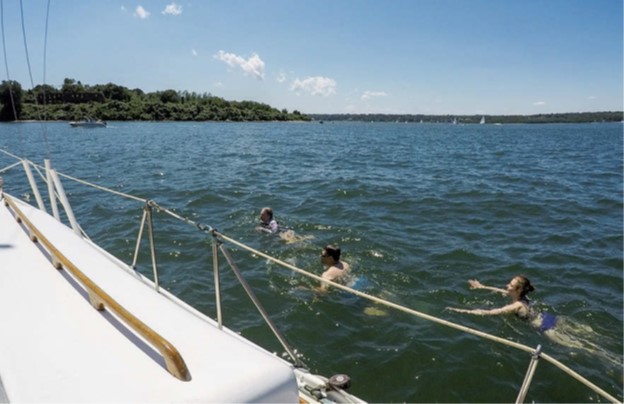
Our goal for the day was the north end of Dutch Island, which had been fortified various times since the Civil War and is now an uninhabited wildlife preserve where camping had been allowed before the state closed it to the public. North of Dutch Island is an open roadstead in the lee of the afternoon wind, which by 1:00 p.m. was rising steadily from offshore Rhode Island Sound. As we passed under the Jamestown Bridge, we noticed a field of small boats anchored or drifting gently while their occupants fished. We had no depth sounder, but Tom and Celia used their local knowledge to nose in as close to shore as they dared, and I helped Celia lower the anchor.
After a swim, we unpacked lunch and ate crackers, fruit, cheese, and canned mussels. It was just about idyllic, and we watched light powerboats bobble in each others’ wakes while Ajaja lay placidly bow to the wind. All agreed that a bimini would help to cut down on the regular bouts of sunscreen slathering and the gradual donning of layers. (How did we do this in the days before we became so concerned about sunburn?)
While we were anchored off Dutch Island, I asked our hosts what their Triton, Ajaja, meant to them. For Celia, Ajaja is a front porch from which she can enjoy the ocean and to which she can kayak from her home. For Tom, the Triton is more complex; a mixture of present desires and “the possible realization of a small fraction of old fantasies.” A realm where small repairs are more consequential than in the towering pile of their house.
I recalled with Tom the voyages of the most well-known Triton 28, Atom, sailed by James Baldwin and named after a Tahiti ketch sailed by Jean Gau in the 1950s and ’60s. Baldwin made two circumnavigations later in the 20th century, starting out in his early twenties using an Aries windvane and graduating from no engine to an outboard motor. He wrote of the Triton’s capabilities in this passage on crossing the Indian Ocean for the first time:
My joy at finally reaching the open waters of the Indian Ocean was soon muted by the realization that the trade winds blow at their strongest here, often at gale force for several days at a time. We made fast passages between the widely spaced islands, running with deeply reefed sails at an average speed of 130 miles a day. Not bad for a boat with a twenty-two-foot waterline length in heavy seas using a self-steering gear. Atom would even try to do 150 miles a day here, and I sometimes let her. But that kind of speed threatened to unravel her old sails or even bring down the mast if caught back-winded in an unintended jibe.
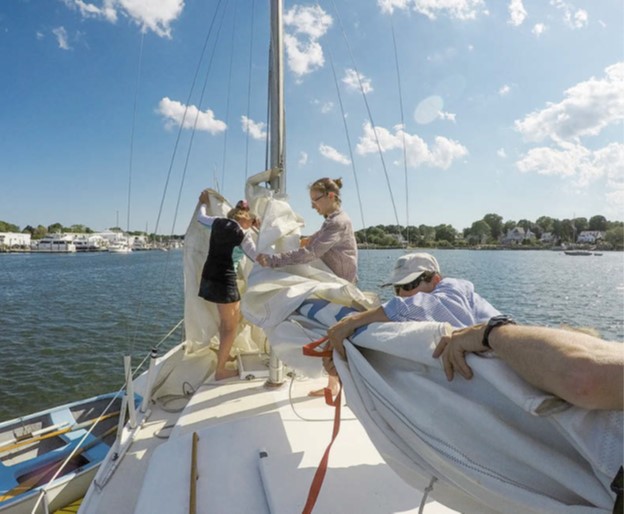
But the virtues of this small, easily managed sailboat showed up as we ended the Narragansett Bay day with a reach back up the bay on the 15-knot sea breeze. With everyone else occupied, I got a turn at the tiller. I tugged Ajaja up the channel to Wickford, first holding my own, then drawing away from a Catalina 34 motorsailing on the same narrow track. As we approached the neck from which a submerged seawall extends, the Triton held course, and we kept just enough wind angle to make our mooring and pick up the two kayaks and the rowboat holding place. We were water-dazed, and sunburned for all the sunscreen, but happy boaters. As on all good small boats, taking down the sails and making her tidy were easy tasks. Offloading gear, deciding what should stay on for the summer, and sorting people into the three tenders took a little longer.
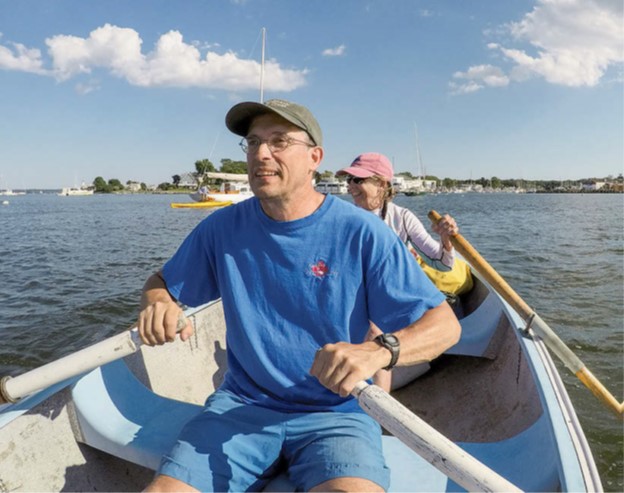
As Tom climbed into the stern of the rowboat, I patted Ajaja’s hull and took a position at one of the two pairs of oars, and we rowed up the fairway past all the other boats settling into their berths after the day out. The girls had raced off to get us cups of Del’s frozen lemonade, a Rhode Island treat, leaving us adults to contemplate the staider chores of figuring out what to have for dinner. But I remained distracted, contemplating living by sail aboard a sturdy little boat that’s an important 3 feet longer than my own.
Resources
For the complete article about Atom’s round-the-world odyssey, go to: www.atomvoyages.com/articles/voyaging
Ann Hoffner and her husband, photographer Tom Bailey, spent 10 years cruising on their Peterson 44, Oddly Enough. They sold the boat in Borneo, returned to the US, and bought a Cape Dory 25 in Maine. Ann is a longtime contributor to sailing magazines, most often writing about weather events on passage and places she’s been.
Thank you to Sailrite Enterprises, Inc., for providing free access to back issues of Good Old Boat through intellectual property rights. Sailrite.com