A sudden and unexpected dunking ends an uneasy alliance
Issue 17 : Mar/Apr 2001
Carmine and Chico ran Venice Boatyard at the foot of Emmons Avenue in Brooklyn’s Sheepshead Bay. Many years ago, I would walk the long distance from the Brighton Line subway stop, past Lundy’s Restaurant and the harbor crammed with fishing party boats with names such as Helen H, Ranger, and Hi Hook, to Venice Boatyard, which was tucked into a small cove on Gerritsen Creek.
Even today I can still smell the oily saltwater foaming around the wooden hulls — a rainbow smeared with diesel fuel and foam — and see the red-and-green-and-orange enamel peeling away from the window trim and the signs calling to wandering gawking anglers for a night’s fishing for porgies, or blues, or sea bass in the oceans off the Jersey shore or Roamer Shoals.
In those days, three people — Frank, Carmine, and Chico — ran the yard. Frank sold hot dogs. Carmine and Chico hauled boats on two railway tracks and, with logs and planks and greased wheels, shoved them sideways to where they’d spend the winter. Cursing and spitting, the old man, Frank, reached into the steam tables and hauled out hot dogs and slathered Gulden’s mustard on the rolls. I always ate one after the long walk from the subway to the boatyard. No one complained about Frank’s picturesque manners. He was very old. He was very surly. He was Carmine and Chico’s father, and he owned the marina, or more precisely, the boatyard — marinas not yet having been invented.
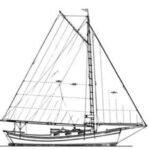
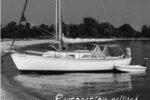
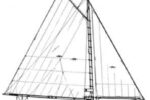
My boat, to which I made this pilgrimage from lower Manhattan every Saturday, was an old Eldridge-McGinnis-designed sloop in need of “some work,” as I blissfully used to tell acquaintances of mine in the Greenwich Village of the 1960s. Some work meant some painting, some fixing up of wooden stuff, some fixing up of sail stuff, and some fixing up of engine stuff. But, alas, getting out of The Village every Saturday and heading, with tools in hand, to the wilds of Sheepshead Bay was adventure enough for one such as I, who, at that time, had little or no interest in traveling to Saugerties, New York — you may remember it as Woodstock.
Moreover, I had help. Another lost soul from The Village had agreed to be my partner and help fix up the “good ole girl” as he called this wooden sloop named Windhover. We’ll call him Paul in case he’s still alive and reads this story and finally realizes how thoroughly I came to despise him. Paul had a clever phrase with a certain nautical twang to it for everything. He loved nautical twanging, and he loved to talk about nautical things. So when he arrived at Venice Boatyard, he was immersed in the nauticality of the place, surrounded as it was with nautical stuff, the very stuff of which nautical consists.
Stuff to fix
At first, with the help of Carmine and Chico, I got straight to work. And, as the scene in boatyards seems to arrange itself, kibitzers would sidle by and admire Windhover. Twenty-four feet of lovely sheer masked twenty-four feet of stuff to fix. To the kibitzer she was to be talked about. Now that’s the part Paul liked the best. Nautical talk with nautical kibitzers about his boat, a “good ole girl.” I was content to work along, scraping, painting, varnishing, and re-building the engine while Paul served the function of so profoundly boring the kibitzers that eventually the kibitzer brigade gave wide berth to the Windhover cradle site. As Paul regaled people with his infinitely tedious anecdotes and outright lies, they eventually developed sharp pains in their heads and, as though from post electro-shock treatment, wandered away.
For most of the winter, work on Windhover went well. With the wind blowing sharply off Jamaica Bay, it was cold and hard work, but late-afternoon respites of clams and beer at Lundy’s and the promise of great sailing past the Rockaway jetty into the Atlantic off Sandy Hook made it all seem wonderful and a marked contrast from Greenwich Village and my daily grind in the New York City Department of Markets.
By the time spring was sprung, as they say in Brooklyn, Paul had stopped coming to the boatyard altogether. His audience had evaporated and so, without an audience, his reason for being was gone. No nautical people upon whom to heap nautical manure. So I was content to let Paul be forgotten, and prepare Windhover for launch day. And so it came to be, but not quite as planned.
On launch day Paul showed up wearing some old yachting togs. As he waddled down the path toward the launching windlass and railway, I filled with hostility like I had never experienced before. This lout, who had done no work, tendered no coin, carried no tools, was expecting to now go sailing. (I was aware he didn’t actually know how to sail.)
As the boat hit the water, Paul strolled down the adjacent pier and admired her. “Boy, doesn’t she look great!” Back and forth, as if awestruck by his own handiwork. And, as people who are delusional often are, he was giddy with the prospects of sailing off into the briny sea, wearing a lot of nautical stuff. My anger grew and grew but, having been brought up by the good Sisters, I couldn’t find a way to tactfully explain to Paul that his dreamboat was setting sail without him. He had made no contribution, other than a series of unsolicited lectures on nautical themes in Venice Boatyard to a student body which began to boycott the course. What to do? This partnership must be ended and ended now. But, how?
Benevolent intervention
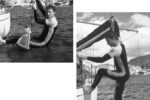
Perhaps it was plain good fortune. I tend to believe it was by the direct intervention of a benevolent pantheon of gods. Paul, as he wandered mindlessly up and down the pier, gradually got caught up in the euphoria of his achievement. Not watching his footing as carefully as any sane man might, he took a long walk off a short pier, as the expression goes, and plunged into the frigid waters of Gerritsen Creek. I exploded into laughter. Paul burst upward sputtering and yelling. I couldn’t stop laughing.
Now, when a partnership goes bad on a boat, it can go very bad. So many things left unsaid get said in moments like this in one expostulation. Laughter. Long, loud peals of laughter! Paul knew everything I felt at once, as though delivered by a sharp blow to the front of the skull. Only one question remained. Was I going to help him out of the water? Was the hostility so great that I would let him die from hypothermia? It took a long time for me to decide. This was not an easy choice.
Finally, though, I hauled him out of the drink, called a cab, handed him $20, told the cabby, “East 7th Street, in The Village,” and never saw Paul again. It was a long, humid walk that afternoon from Venice Boatyard back to the Brighton subway stop, not far from the old firehouse in Sheepshead Bay. The clams at Lundy’s seemed never to taste sweeter, the beer never colder, creamier, richer. Windhover was at last launched, sparkling, rigged, and ready.
Windhover sailed briskly upwind toward the Narrows, past Coney Island and the silhouette of the Parachute Jump, into an iridescent fog and the elegiac notes of the horns and whistles in the entrance to New York Harbor by the green knoll in front of Fort Hamilton where, after all the years that had passed since the troop ships came back to the Brooklyn docks, you could still make out the impression of the words of a weathered sign in the grass: Welcome Home.
George, formerly a marina owner in upstate New York, sails with his wife, Susan, aboard their Tartan 34, Temujin. Their sailing plans include voyages around the Great Lakes, passages to Cuba, Ireland, and other points around the compass. He is still contemplating the meaning of relationships. If your name is Paul, we hated to have to break it to you like this, but then perhaps it’s time you knew.
Thank you to Sailrite Enterprises, Inc., for providing free access to back issues of Good Old Boat through intellectual property rights. Sailrite.com