The beginnings of marine chitty chitty bang bang
Issue 18: May/June 2001
Each time I am becalmed in the Sargasso Sea when single-handing my virtual ketch around the world in my best Walter Mitty style, I fire up my ultra-reliable diesel auxiliary engine and look for trade winds. Others would hear the steady, smooth somnambulant hum of the four cylinders doing their thing. But like Walter, I hear “ta-POK-eta, ta-POK-eta,” which is the sound of a vintage three-cylinder engine that was all the rage early in the last century.
Perhaps it’s the result of my inherent Walter Mittyness, but I find it fun to reminisce about the old days of marine engines and some of the salient steps in the development of the engines we enjoy today. To me at least, there is a nostalgic hook in seeing, hearing, and smelling an old and noble engine of that era, running merrily along at, perhaps, 300 rpm.
To understand and appreciate the evolution and development of marine engines for sailboat auxiliary power, a bit of history might be warranted. Back around 1880, the steam launch had become popular, but the size and weight of the boiler-engine combination did not really lend itself to smaller sailing craft. Furthermore, it took too long to build up sufficient steam from a cold start for the small boater (except for the “steam nuts” who loved steam so much they didn’t care how long it took).
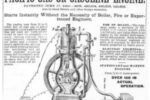
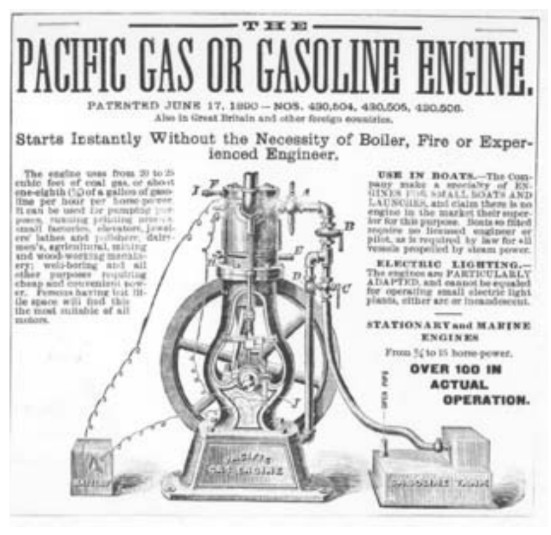
In 1890, the Pacific Gas Engine Company patented their version of a single-cylinder engine that was designed to run on either coal gas or gasoline vapor. Their ads stated, “Starts Instantly Without the Necessity of Boiler, Fire, or Experienced Engineer,” and “Persons having but little space will find this the most suitable of all motors.” On a per-horsepower basis, this concept was a great advantage to the small boater, much smaller and lighter than steam plants, and ready to go (more or less).
Small-boat adaptations
The company made a specialty of adapting the engine for small boats, and for the first time a practical power plant for relatively small sailboats began to emerge, albeit in fits and starts. Within a few years, there appeared on the marine scene an estimated 200 manufacturers of marine engines. Some of the names are legendary — Universal, Gray, Detroit, Red Wing, Kermath, Scripps, Lockwood-Ash, Knox, and Hartford come to mind. In general, they served a rather local market, since advertising by radio and television was impossible at the time, and marine magazines were few. However, those ads that you can see in old vintage nautical magazines of the time were sometimes wonderfully naive: “Oriole Engines — Built in Baltimore, Will Run Anywhere” and “The Bridgeport Engine is Guaranteed To Run You Across Long Island Sound Without Fail.” What joie de vivre!
Most of the early gasoline internal combustion engines were initially of the two-cycle variety, with make-and-break low-voltage ignition. However, the German, Nicholas August Otto, who invented the basic proposition of the internal combustion illuminating-gas engine, had also invented the earth-shaking Otto four-stroke cycle in the 1800s. This design proved to be smoother, easier to start, and more efficient than the two-cycle variety, and pretty well took over except for outboard motors.
It is interesting to note that until Otto patented this type of machine, which would dramatically transform our world, his illuminating gas engine was capable of but 30 rpm and ignited from a steady flame in a box. The engine stood waist high, developed but 0.86 horsepower, and transferred the piston movement to the flywheel with a rack-and-pinion arrangement. (Otto had bypassed the crankshaft of the steam engine, considering it inefficient in its translation of piston action to rotary motion. Oh, well, Edison had some lousy ideas, too.)
Herr Diesel’s engine
Rudolph Diesel, who came a bit later, invented the engine concept that bears his name to this day. His great idea was to design the engine in such a manner that the compression in the cylinder created a high enough temperature to ignite the fuel without the necessity of a separate ignition system. He must have created great levity when he first tried his prototype; using a mixture of powdered coal and air to inject in the cylinder, he blew his engine to smithereens on its first bang. However, posterity forgives him, and his invention is ubiquitous, as we all know.
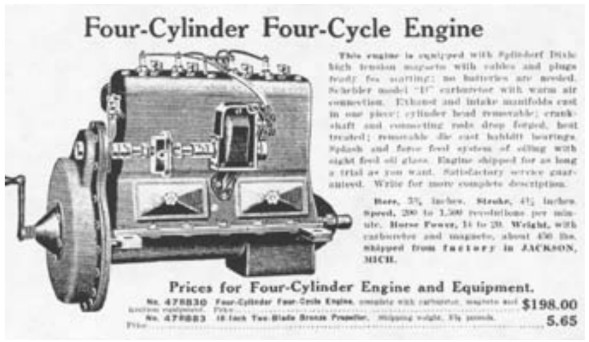
By 1905, anybody who could buy castings and cut metal on a lathe seemed to jump into the engine business. Typically, the Lackawanna marine engine was built by the Coldwell Lawnmower Co. of Newburgh, N.Y., and the Caille Perfection engine was built by the Arthur Caille Co. of Detroit, whose main business was “one-arm bandit” slot machines. Along with the bewildering variety of engines there came a concomitant bewildering variety of “options” — options for carburetors, ignition systems, reverse gears, clutches, reversible propellers, and so on. There was even the Kitchen rudder, a device that not only steered the thrust of the propelled water, but had a separate lever that could reverse the thrust — the same principle used on our modern jet aircraft today to reverse thrust when landing.
My! What carburetor should I choose? Schebler, Monarch, Panhard, Daimler, Garllus, Breeze, Holly, Kingston? You picked your own reverse gear: will it be Baldridge, Gies, Ball, Capitol, Joe’s, Tuttle, or Paragon? As far as ignition was concerned, you could choose between low-voltage make-and-break, and a high-voltage jump spark generated by either a magneto or a spark coil/vibrator rig energized by a battery. Atwater-Kent ultimately did away with the necessity of a spark coil for each cylinder by coming up with a single spark coil and a high voltage distributor. That was the ticket! (Atwater-Kent subsequently went on, of course, to fame in radio manufacturing).
Pump choices
You even had a choice of the type of water pump you wanted. Plunger pumps were best, some said, because they ran off an eccentric, and had less wear than these new-fangled gear pumps. Steam and naphtha men swore by the eccentric, and saw no reason to ever change this scheme of things.
This, then was the general scene during the years from about 1900 to 1917, when World War I came our way. For the relatively short time we were engaged, there was a hiatus in marine engine development for small craft, as emphasis was placed on the design and development of larger engines for Army, Navy, and Army Air Corps use. For example, a lot of effort went into the large V-12 engine that went into the Army Air Corps’ JN-4 trainer (the Jenny). The marine conversion version of this machine was also used in Elco’s 80-foot patrol boat, of which the company constructed 550 units in 500 working days! This engine was the Curtiss Liberty OX-5, and they were sold as surplus after the war, brand new and in crates, for $50 each. Many of them made their way in the 1920s into private craft of various types.
It was after the war that the development of marine engines resulted in sufficiently low weight, compactness, reliability, and efficiency to make them really practical as auxiliary power for relatively small sailboats. Many new ideas (and much new wealth) entered the scene in the 10 years following the armistice in 1918. This led to the design and development of the Atomic 4, among others, which became very popular for auxiliary power, and which in turn led to standardization that allowed mass production for the mass market. For example, the Brennan “IMP” was almost a carbon copy of the Atomic 4.
Early outboard
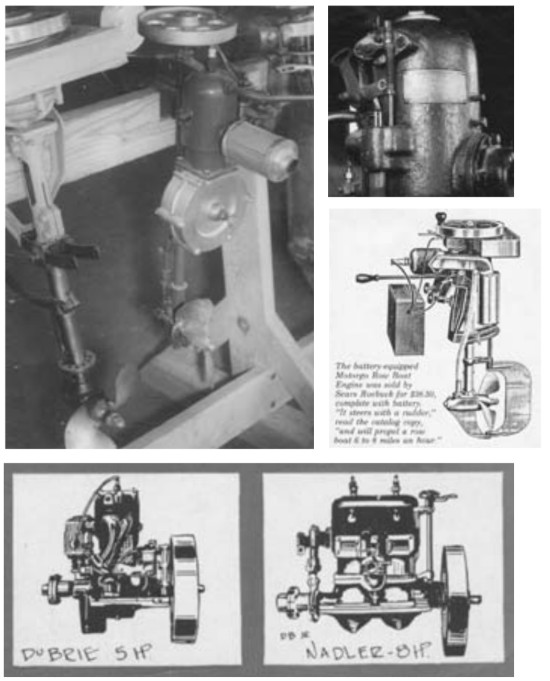
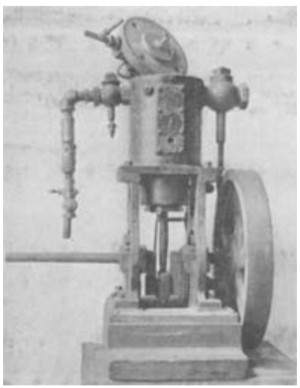
The first auxiliary power plants were inboard engines, of both the 4-cycle and 2-cycle variety. Then, one day in the early years of the century, Arthur Caille put an outboard engine on the market, to be attached to the transom. This was nothing more than a small 1-hp marine engine, tilted at an angle, with a long propeller shaft running down into the water behind the boat. Then Ole Evinrude decided it would be better to mount the engine essentially vertical, and transfer the rotation to the propeller by the use of right-angle gears. For sailboats, the “long shaft” was applied. (Notice in the photo on Page 51 that some of the bevel gears, the water pump, and the non-retractable, knuckle-busting starting handle on the flywheel are in evidence).
Then someone further decided that the cylinder would best be laid horizontal — this was a better orientation, and since they were 2-cycle engines, they needed no oil sump. This scheme has lasted approximately 85 years to this day in 2-cycle outboards.
Yes, those were halcyon days of auxiliary power, to be sure. At least from the standpoint of the romance of it. Those who lived through the era without a broken thumb can be proud.
Wes Farmer is a retired engineer, now living in Deephaven, Minn., on the shores of Lake Minnetonka. He has had a lifelong love affair with small boats, both motor and sail, having owned one type or the other since he was 13. (His first boat was named the Leakin’ Zephyr.) He has a continuing interest in marine history, especially that of small craft.
Thank you to Sailrite Enterprises, Inc., for providing free access to back issues of Good Old Boat through intellectual property rights. Sailrite.com