Sailing where the water goes from thin to none
Issue 53 : Mar/Apr 2007
When you live in a foreign country for a while, you come to know it and the way of life there. But the important thing is not so much what’s learned about that country and its ways but how your own country appears when you get home.
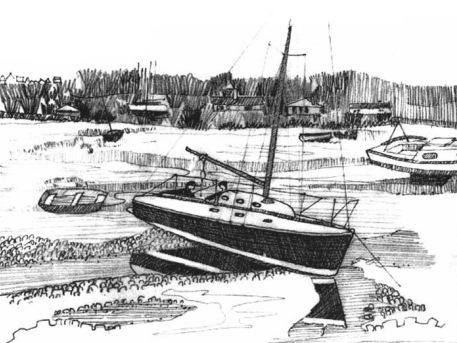
Taking the ground — intentionally drying out between tides — is common practice in England where harbor and marina space is scarce and seafaring is in the nation’s blood. Over the centuries, British mariners and yachtsmen have evolved many ways of making the best of a largely inhospitable coast. This has often meant finding ways of getting from land to sea as expeditiously as possible.
From earliest times, boats have been carried or rolled over logs and launched through an angry surf to ply the fishing grounds of the North and Irish Seas. Boats have been crowded into tiny man-made harbors that often ran dry, denying access until the sea moved back to fill them again.
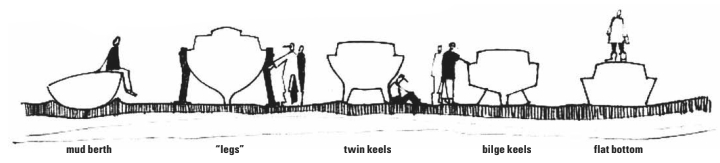
British owners of pleasure craft have their own ways of coping with a scarcity of natural harbors. They often find shelter in the drying creeks and backwaters of tidal estuaries. Some boats take well to these conditions while others do not. Boats have to be tough to take the ground twice a day. Stout little twin-keelers, like Westerly Centaurs and Kingfishers, stand upright on their iron legs along with bilge-keelers, such as Maurice Griffiths’ Waterwitch ketch, that have long keels with angled steel plates on either side. Wooden or fiberglass boats with firm bilges fare well along with flat-bottomed boats.
Some deeper-keel boats adapt “legs,” portable wooden or steel pipe stands with wide bottom feet providing support when grounded. Still others rise and fall with the tides while leaning against walls.
Lacking moorings
I lived in Liverpool, about 10 minutes from the River Mersey, but in spite of its great maritime tradition there was a distinct lack of small-boat moorings available to sailors like me in 1984. I wanted something close by and inexpensive, so I did what the Romans did and found a mud berth for my Fairey Atalanta.
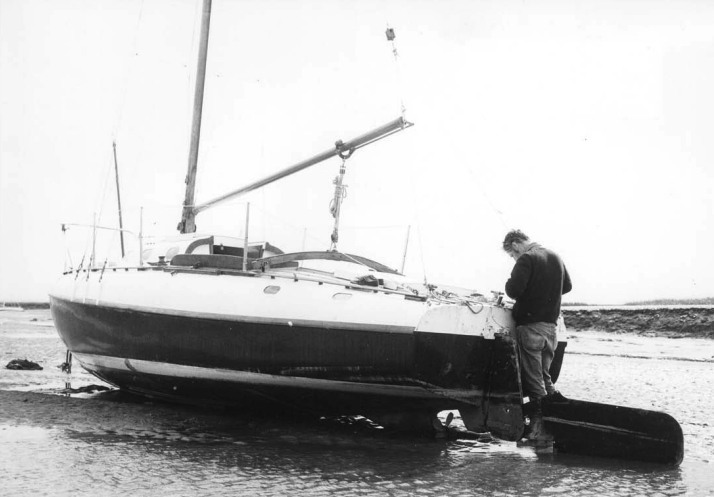
Jane Duck was a 26-foot barge-yacht design by Uffa Fox, a derivative of the wartime airborne lifeboats (profiled in Good Old Boat in May 2006). Hot molded, she was relatively light, with firm bilges and twin, ballasted, lifting keels. She was extremely tough, with hefty mooring bitts.
I kept Jane Duck in Heswall, a small seaside town on the Dee Estuary about a half-hour’s drive from Liverpool. The Dee leads, or did before it silted up so badly, from the Irish Sea to Chester. Parkgate, located a few miles from Heswall, was a major port in the 17th century. It was from here that Cromwell launched his ships to terrify and vandalize Catholic Ireland.
Local knowledge had it that Lord Nelson sailed a few ships up the Dee to Parkgate where, so the story goes, he met Lady Hamilton, who was there for the area’s renowned sea bathing. If true, the landlocked fleet would have been highly vulnerable to French marauders, to the great embarrassment of the Admiralty and possible security of the realm. I like to think that it just might have been worth it.
The 30-foot tides that would have bottled up Nelson for several hours cause the estuary to virtually disappear at low tide. The situation at Heswall, when it was Jane Duck’s port of call, was that a ramp led down to the water where a boatman maintained a line of buoys that he moved about as the channels shifted. These provided wet moorings a few hours before and after high tide, thus allowing for a few hours spent sailing before the sea ran out, barring access to the moorings until the next tide. Obviously, the shallower the draft, the more time a boat had to sail.
Tractor boatman
A boatman assisted with launchings and haulouts. He drove around the sand, viscous mud, and pools of water, when the tide was out, on a farm tractor, moving buoys, checking and replacing chain and shackles, clearing out logs and other bits of flotsam and jetsam from the anchorage, and generally seeing to the welfare of the Heswall squadron.
The mud was difficult to negotiate on foot; it took a bit of practice to get from ramp to boat without leaving a boot in the mud. Some sailors towed sledlike carts loaded with boat gear and provisions over the mudflats. I generally tried to meet the tide when there was enough water to float my inflatable. On the ebb, this meant a good few hours before I could get back to shore unless I wanted to wade through the ooze pulling the dinghy, which I did a lot. One time just short of Jane Duck, I fell over while loaded with an armful of boat gear. I hardly felt the fall into the soft sludge, but it was a job cleaning out the muddy cockpit with so little water around, to say nothing of drying clothing on a small boat.
Like seabirds whose habits are shaped by the tides, those of us who moored in the Dee paid little attention to night and day. We hitched rides with each other and from the boatman’s tractor, which carried us out to our boats like Spitfire pilots on their way to meet the Luftwaffe.
We were all in a narrow channel, sometimes running with water, sometimes dry, behind a bank of sand dunes that gave good protection from the sea at low tide. But as the sea rolled in, the bank disappeared, giving the distinct impression that we were a long way from shore — somewhere in the middle of the Irish Sea.
In bed, worrying
The larger waves at high tide were knocked down a bit by the sandbank, but never enough to wholly relieve my anxiety. When I first moored in Heswall and a storm came up, I’d lie in bed back in Liverpool and worry. I worried a lot until the tide fell enough for her to take the hard. I knew just when Jane Duck would roll and pitch with the sea and when she’d lie down in her mud berth. When high winds corresponded with high tide, it was all I could do to resist calling the boatman:
“Is she OK, John, is Jane Duck OK?”
“Aye.”
“How does it look out there, John? Do you think it’ll get much worse?”
“Aye, mebbe.”
“I should come out and have a look — what do you think?”
“Well, now, Mr. Smith, were I you, I’d go back to bed now. She knows how to take care of herself, she does. Don’t you worry now. Go back to yer bed.”
Eventually, when I came to trust the idea of leaving a boat to find her way with wind and tide, and when I came to appreciate what a tough old bird the Fairey Atalanta was, I began to take it all in stride. As long as Jane Duck was on a Heswall mooring, I was always aware of the state of the tide and just how she lay.
As the sea fell, the bank offered more protection so that when the boats met the mud, it was a pretty smooth touchdown . . . usually, but not always.
Holed and sunk
It was not unknown for a thin-skinned hull, whatever the material, to land on a sharp rock and be holed, and not to rise with the next tide. This was more easily avoided with a boat resting on twin keels or a long keel with steel bilge plates. It was possible with experience to avoid the worst of the gullies and other bottom irregularities and coax a boat into a well-fitting mud berth. With shallow-draft boats such as the Atalanta, one could wade knee-deep and push the boat to the best alignment, but it was far short of an exact thing. Round- and V-bottomed boats weren’t expected to provide any sort of accommodation when grounded.
When I took the ground in an unfamiliar bay or harbor, I liked to anchor in deep water and wait for low tide. Then I’d take a good look at the bottom and choose a level place to set down another time.
One rainy winter afternoon a few of us gathered around the coal stove of a Waterwitch ketch, drinking tea and telling lies. Someone flicked a tea bag through a portlight with a unique wrist movement. That set off the first annual River Dee Tea-Bag Pitching Competition. We took turns flicking bags and jumping overboard to place a stick in the mud to mark the longest toss. When we could dinghy to shore, we bought a couple of pints for the winner at the local pub.
We sailed into Douglas, on the Isle of Man, one summer. There was rather a lot of wind and rain in the Irish Sea and the floating berths were full, so we went against the wall. This is a mooring method whereby a boat ties off against a stone wall, another rafts up alongside him and another to him and so on and so forth. We wound up in the middle of such a boat boom, waiting along with a collection of fishing boats and yachts for the tide to set us all on the ground. It was a mish-mash of bow, stern, and springlines, over and under, criss-crossing each other as they wrapped around mooring cleats and bollards.
Maze of connections
Fenders of all sorts kept us off each other — posh colorful ones for the yachts, car tires and wood planks for the workboats. The maze of connections, which at first looked haphazard and hopelessly snarled was, in fact, an arrangement such that, with considerable cooperation between friendly crews, any boat, at any place in the stand, could leave when the tide was in.
Argument and dispute among the skippers seemed inevitable but, after a day or two of watching the coming and going of boats of all types and at all times into this scrum, I was amazed at how politeness, good boat tending, and a spirit of cooperation allowed this most complex of mooring arrangements to work.
Now, having lived in the Pacific Northwest for 10 years, I still can’t get over how easy it is to sail from my deep-water marina berth, 10 minutes from home. It’s absolutely secure in any state of wind and tide and there’s no hopping about trying to retrieve a boot stuck in the mud.
There are no coal stoves drying out wet socks and certainly no tea bag-throwing contests from cabins so thick with cigarette and pipe smoke, you could cut it with a bosun’s knife. I can leave the dock and come back any time of the day or night, and there’s no thrashing about in a choppy sea, cold and wet, waiting for enough water to raise my mooring buoy.
I sometimes wonder why I miss those days in England so.
Thank you to Sailrite Enterprises, Inc., for providing free access to back issues of Good Old Boat through intellectual property rights. Sailrite.com