Eight years into a cruise, here’s what’s still operating well
Issue 47 : Mar/Apr 2006
I wrote an article for Good old Boat (January 2001) about the preparations we made for liveaboard bluewater cruising on Veleda IV, our 1978 Ontario 32. I talked about major upgrades we’d made, including a new Yanmar 3GM30 engine; a new dodger/Bimini with a full vinyl and mosquito netting enclosure; a new electrical system including a 100-amp alternator, smart regulator, echo charger, Link 10 battery monitor, 30-amp marine battery charger, wind generator, four 110-amp golf-cart batteries; and complete rewiring from domestic to marine-grade wiring. I also commented on our Dinghy-Tow system, mast steps, radio/tape deck/CD player, and a few other modifications and pieces of equipment we were using.
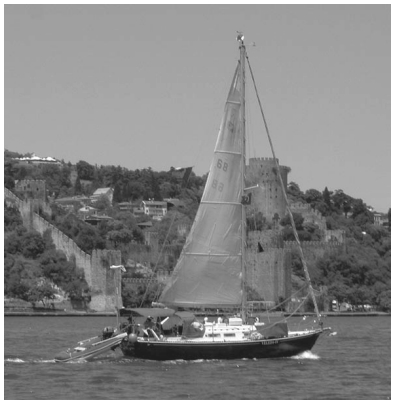
Time has moved on. Judy and I have been living aboard Veleda since July of 1998, when we left Toronto, Ontario, on our open-ended retirement journey. Since then we have sailed 27,000 nautical miles down the Mississippi, through the Bahamas, across the Atlantic, around the United Kingdom, through the rivers and canals of France, and the length of the Mediterranean and eastward to the Canary Islands. We have taken Veleda through 27 countries, including 9,305 nautical miles in the Mediterranean and 1,523 nautical miles around the Black Sea.
As I write this, we are in Porto Turistico di Roma, where the Tiber enters the Tyrrhenian Sea. Our plan is to exit the Mediterranean this summer (after cruising Elba, Corsica, and Sardinia), going through the Canal du Midi (instead of Gibraltar) from southern France up to the Bordeaux region on the Bay of Biscay. We will cruise down the Atlantic coasts of Spain and Portugal, over to Madeira, the Canaries, and the Cape Verde Islands before crossing the Atlantic to Barbados in December or January. We anticipate spending a few years in the Caribbean, then perhaps through the Panama Canal and into the Pacific. We trust our good old boat to take us anywhere in the world.
Here’s a rundown of what has worked well for us.
Engine and electrical system
We are quite happy with our 1997 Yanmar 3GM30 diesel that replaced our original Yanmar 2QM15 and which now has over 4,250 engine hours on it. Our fuel tank has a capacity of only 28 gallons, and we keep another 30 gallons on deck in plastic jerry cans. We fill the tank only from the jerry cans, using a Baja filter, and we have two Racor fuel filters in line before the engine’s own filter to ensure clean fuel in the engine. I use the dinghy to take empty jerry cans to fuel docks. When ashore, I go up the road to a local service station.
Our only problem has been with the water pump and with air getting into the water strainer. We have lowered the strainer below the waterline to ease the pressure and reduce air intake. A squeeze bulb in the fuel line leading from the tank makes it easier to pump fuel through when having to bleed air from the engine. We may have to replace the water pump eventually, as we have rebuilt it twice. Conscientious routine maintenance has kept the engine in good operating order.
We replaced our 100-amp alternator with another in Mallorca in 2001 and suspect the original one was out of alignment, causing wear on belts and bearings. However, we are very happy with the 100-amp heavy-duty alternator that replaced it. Its extra demand on the engine is hardly noticeable.
Efficient charging
Together with the smart regulator, our engine can fully charge our batteries in an hour or so of running once every two or three days at anchor. It is so efficient that I question the need for our wind generator. The 3 or 4 amps it puts out in wind over 10 knots are minimal to our requirements since we still have the Ontario 32’s original refrigerator and freezer unit, installed in 1978.
We have it well insulated, but the thermostat seems defective and causes the refrigerator to run for 18 hours out of 24 if we leave it turned on. We have isolated our starting battery, so even if the house bank is drained we can start the engine and charge batteries rapidly. The combination of a 100-amp heavy-duty alternator with a smart regulator works extremely well.
We do not have room for (nor do we want) a generator. We do not have anyheavy draw tools or appliances that require it. Instead, we have a 175-watt cigarette lighter plug-in inverter that does well powering the laptop computer and charging batteries for our battery-operated drill, toothbrushes, portable shortwave radio, blender, and handheld VHF.
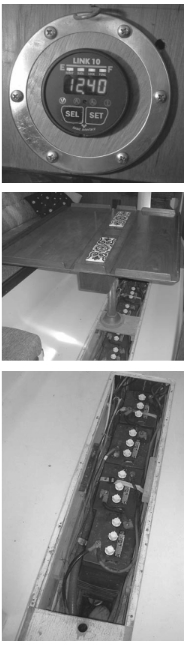
Our four Trojan golf-cart batteries (combined as a single house bank for a capacity of 440 amp hours) have served us well and are still working with no problems after almost seven years of constant use. However, we have replaced the dedicated 12-volt engine-starting battery twice. The golf-cart batteries are small enough that I was able to build a shelf above the keelbolts. We strap them in on this shelf below the cabin sole.(Caution: Putting batteries in the bilge of a boat is controversial. It is a fairly safe practice if sealed batteries like AGMs or gels are used. These batteries can be immersed in seawater without serious effects. Open vented cell designs, like the golf-cart batteries shown here, will go through more deep cycles than any of the sealed batteries, but if they are immersed in seawater a reaction will occur which will generate chlorine gas. This may be deadly in an enclosed space. –Ed.)
I really enjoy the Link 10 monitor LED readout about my batteries, indicating the amp hours used and remaining, the draw and charge rates from the engine, the 30-amp marine battery charger, or the wind generator. With this device, I can shut off all other current draws, turn on one piece of equipment, and immediately identify its battery draw.
The 1,500-watt industrial transformer we purchased in Horta in 1999 is still working well, delivering 110-volt power into Veleda from the 220-volt shore connections in Europe. Another advantage of the transformer is that we do not have to worry about the polarity of the connections.
Dodger/Bimini
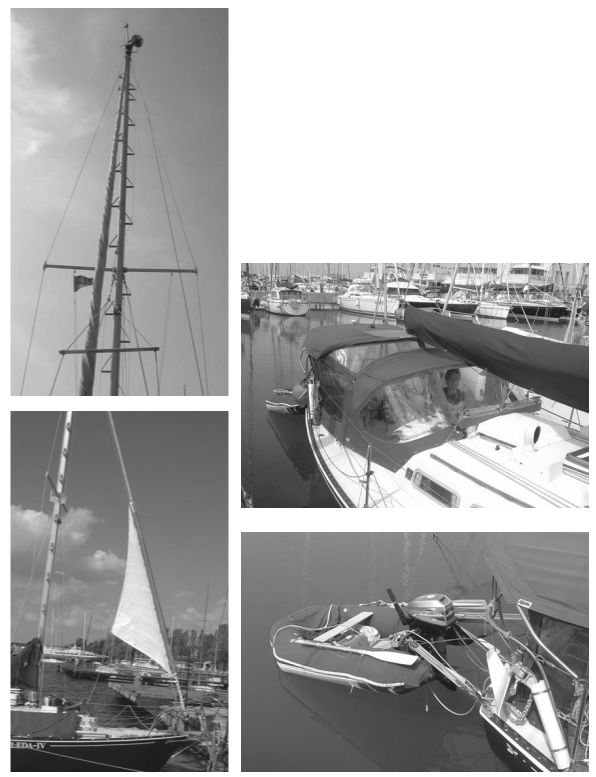
The dodger/Bimini made for us in Toronto in 1998 is still working well, although we have replaced several vinyl windows and zippers over the years. We had the full dodger/Bimini with its side curtains up all the way across the Atlantic. I haven’t used my foul weather gear for years, as Judy does the wet foredeck work and the cockpit is quite dry. The only other use of the side curtains has been in our winter moorings in London and in Porto Turistico di Roma, where they permitted the cockpit to be used as an additional room for winter marina living. We have rarely needed their mosquito screening. If planning again, given the money and opportunity, I would prefer a hard dodger and possibly a hard Bimini.
Dinghy
We bought a new Zodiac dinghy three years ago and immediately made a cover for the tubes to protect them from UV degradation. The fabric of our previous dinghy had been badly deteriorated by UV. We use our dinghy as we would a car ashore, going long distances in it. It is an essential part of our cruising lifestyle. However, if I could have managed and afforded it, I would have purchased a rigid inflatable dinghy, as the fiberglass hulls of the RIBs take to sandy and rocky shores better than inflatable hulls.
We are still very happy with our Dinghy-Tow. Because of it, we can have a heavy powerful 10-hp outboard. If we had to manhandle the motor on and off the dinghy each time we anchored — well, we could never manage such a large engine. The two rigid arms mounted on our stern raise the aft end of the inflatable dinghy with just the bow trailing in the water, creating minimal drag. We leave the engine, fuel tank, life jackets, and so on in the dinghy, ready to go as soon as we lower it into the water.
This came in very handy when we lost our propeller shaft in the Danube River in Romania. We were able to deploy the dinghy in a couple of minutes and use it to take Veleda to a dock using a side tow. We carried the dinghy on deck for our Atlantic crossing, but have had it on the stern on the Dinghy-Tow for the past six years, including a stormy crossing of the North Sea and all around the Mediterranean and Black Seas. It is easy to hook up and provides anti-theft security at anchor. I am considering leaving the dinghy on the Dinghy-Tow for our Atlantic crossing when we return to the Caribbean next winter.
Other gear
We are happy with our triangular-shaped mast steps, which provide considerable stability and security, especially when going aloft at sea, as we have done several times. We tie light lines down the outer ends of them to reduce the tendency for the main halyard to catch. We riveted a double set of mast steps near the masthead so we have a firm two-foot platform on which to work at the top. When going aloft, we always wear a safety harness tied to the main or spinnaker halyards. We have a Davis metal radar reflector permanently mounted at the masthead.
We bought a small used PUR watermaker six years ago. It is still working well. It produces about 1 1⁄2 gallons of fresh, virtually distilled, water per hour. It is used to supplement our shoreside water resources. In some cases shoreside water is accessible only from a water tap inland. Sometimes the shoreside water is brackish or not potable. Then we rely on the water left in our tanks or made by the watermaker. We turn on the watermaker any time we are at sea and have the engine running. We do not have any other filters in our system and have been drinking municipal water all over North America, Europe, Turkey, and the Middle East. A larger output watermaker would be of greater value.
Before we left Toronto we installed a used automobile AM/FM radio/CD/ tapedeck which is still working well. It has been most enjoyable, especially since I have stereo speakers in the main cabin and also in the cockpit. I enjoy listening to classical music in the cockpit with the beauty of a golden sunset or a starry night in an isolated anchorage. The tape cassettes take up more space than do the CDs; I would like to be able to record them on CD. The system I have has a CD cartridge that will take 10 CDs at a time.
We do not have an SSB transmitter/receiver, but we do have a good shortwave radio for weather forecasts and BBC radio news.
Sails
We crossed the Atlantic in 1999 with the original 1978 Dacron main and genoa sails. Our 150-percent genoa had foam pads in the luff to keep the sail shape better when partially reefed. This sail was destroyed when our forestay broke in 2001, but we had a 130-percent used genoa to replace it. We are still using the original fully battened main, albeit with a few patches, a reinforced grommet at the tack, and much seam stitching. We like the fully battened main and the luff pads in the genoa. We frequently use the furled genoa as a storm sail. However, last year we bought a Gale Sail made by ATN. It is a storm sail with a reinforced sleeve on the luff which is done up with hanks so it can be hoisted over the furled genoa. We haven’t had cause to use it yet, although we have checked its suitability to be hoisted.
The sails may be old, but it is usually the seams that give way as Dacron is a hard-wearing material. It may not be good for high-tech racing, but it is very acceptable for economical cruising. We have a sail repair kit and can re-stitch seams, replace grommets, and do minor patching by hand.
We are still using the original 1978 spinnaker also. We did not have much experience flying a spinnaker using the spinnaker pole, so we bought an ATN Sails’ Tacker, a plastic harness that fits around the furled genoa and permits us to fly the spinnaker as a drifter. ATN also made a snuffer for it, complete with blocks and hoisting lines. It is a very good downwind sail. In heavier weather downwind sailing, we use the genoa supported on one side by a heavy-duty whisker pole (we had a lighter one break on us) and the main out the other side secured with a preventer. Our old sails are still serving us well.
The Ontario 32
Our 1978 Ontario 32 is a well-built fiberglass sloop that either of us can singlehand if necessary. I like Veleda’s stiffness with 45 percent of her 5-ton weight as lead in the three-quarters keel. She is a dry boat, with her bow riding over the waves and her contoured hull splitting the waves, rather than slapping them. Her stern rises up with overtaking waves. We have never yet had a wave break across our stern, and rarely has Veleda buried her bow. The 4 1⁄2-foot draft was quite valuable in shallow waters of the Bahamas and allows us to travel many bays, canals, and rivers that deeper-draft vessels dare not explore.
I am a bit concerned because we have a spade rudder with no skeg. Even though it has a sturdy 1 3⁄4-inch rudder post and the bottom of the rudder is 1 1⁄2 feet above the keel, it does not have the extra protection a skeg might provide. However, it is a very responsive helm and controls the boat well, even when going astern. The keel-stepped mast is a stable structure that withstood a broken forestay and a full genoa and roller furler flogging in a Force 8 gale while crossing from Barcelona to Mallorca. I fear a deck-stepped mast would have collapsed in similar conditions. We received a back-handed compliment from E&C Marine in Toronto when they had to drill another through-hull for our engine water intake. They complained that the fiberglass in the lower hull was so thick it was hard to drill through.
Dream list
Changes or additions I would make are few. I wish I had bought a Bugel clone anchor when in Turkey, as I have heard high praise for them. Our CQRs are only adequate. As mentioned, I would like a hard dodger and Bimini, a rigid inflatable dinghy, and a larger-output watermaker. A larger fuel tank would be valuable. A modern refrigerator might use less power. However, the main difficulty is simply one of space.
Any boat is a compromise, involving what one would like, what one can afford and manage, and the kind of sailing planned. Many sailboats, when upgraded, can serve well.
Summary
We are happy with our planning and with Veleda, the upgrades made before we left and the few we have done since. We have not had to spend a great amount of time making or waiting for repairs (other than the roller furling which was destroyed crossing over to Mallorca and four days in Romania while a new propeller shaft was machined for us). We are glad we replaced our 2QM15 Yanmar with our new 3GM30 and 100-amp alternator. Our trouble-free golf-cart batteries, smart regulator, and electrical upgrades have proven most worthwhile.
We are happy with the Dinghy-Tow, mast steps, keel-stepped mast, and old sails that work well and don’t owe us anything. We are also glad we replaced our manual windlass with an electric vertical-axis windlass (after deepening the anchor locker). The heavy construction of the modified C&C-design Ontario 32 as a racer/cruiser is very reliable, comfortable, and seaworthy. Veleda IV allows us to economically pursue our dream on nothing more than my retirement pension as a high-school teacher.
Thank you to Sailrite Enterprises, Inc., for providing free access to back issues of Good Old Boat through intellectual property rights. Sailrite.com