Protection for fiberglass countertops
Issue 113: March/April 2017
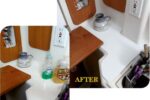
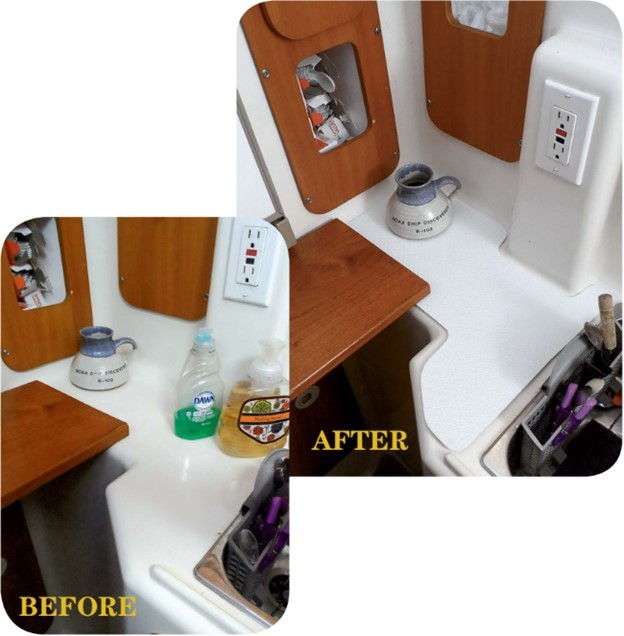
Molded fiberglass galley countertops are fairly common on older boats. When taken care of, they look good and are easy to keep clean. They are not, however, easy to repair. A permanent stain, deep gouge, or burn can be repaired only with major surgery. Aboard our 34-foot catamaran, Shoal Survivor, I came up with a means of protecting our molded countertops that keeps my blood pressure low when a hot pan is set down on one or a or sharp knife is dropped. My countertop protectors even make the galley seem a little bigger because we can use the counters a little more freely, and the worst “oops” simply requires that I make a new protector.
I fabricate the protectors from .09-inch fiberglass shower-enclosure paneling obtained from a big box home-improvement store. I can make a number of them in the time I might otherwise waste watching a movie.
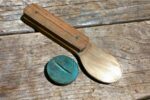
I start by making patterns from cardboard or freezer paper of the areas I want to protect. I make an allowance for the radius where the counter transitions to the backsplash and, where there is no fiddle, I stay away from the countertop edge to reduce the likelihood of a protector becoming snagged on clothing. For shaping an inside or outside corner, I find a jar or lid that matches the radius and draw around that on the template. And I always mark on the template which side is the top.
Using the template, I trace around the shape onto the fiberglass panel, allowing about 1/8 inch for chipping. The pebble side of the panel is best as the top as the raw side has a greater tendency to stain. I use a drill or hole saw to cut inside corners because they do a neater job than a saber saw, which tends to shatter and chip the fiberglass.
To make straight cuts, I score the sheet with a plastic cutter, then bend the material firmly back and forth until it parts. Pliers can help in tight spaces and with narrow strips. Simply snapping the sheet in one direction, as you would when cutting glass or plastic, will cause chipping on the reverse side.
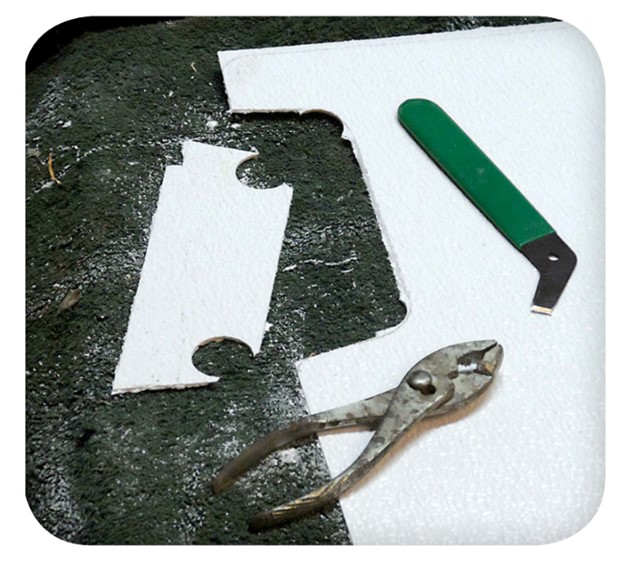
After rough cutting the entire shape, I make the outside radius cuts, remove the trim allowance with a disk sander and 150-grit sandpaper, and finish by lightly sanding all the edges by hand or with a finish sander. I apply pads of the loop side of Velcro or a felt-like material to the raw fiberglass undersides of the protectors. This keeps them from sliding around and from abrading the countertop.
Like any fiberglass product, the protectors can burn, so we keep them off the stovetop. Although we have tested them with a hot frying skillet fresh off the burner, we try to limit heat exposure to pots of boiling liquid. The air gap created by the felt or non-skid ensures the underlying counter will never get more than slightly warm. And we don’t cut on them because they contain glass fibers that will dull knives in short order.
I have tried other materials for countertop protectors. We used wood on our last boat, but it was too thick and hard to clean. Our first set on Shoal Survivor was clear acrylic, but they started to look messy when dirt got under them, and they didn’t stand up well to the heat of a hot pan. Polyethylene cutting board material can also be used but it, too, is less tolerant of high temperatures than fiberglass.
Drew Frye cruises Chesapeake Bay and the mid-Atlantic coast aboard his 34-foot catamaran Shoal Survivor, searching for out-of-the-way corners known only by locals. A chemical engineer by training and a 40-year climber and 30-year sailor by inclination, he brings a mix of experiences to solving boating problems and writing about them.
Thank you to Sailrite Enterprises, Inc., for providing free access to back issues of Good Old Boat through intellectual property rights. Sailrite.com