A versatile boat for different owners
Issue 115: July/Aug 2017
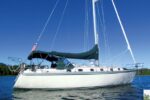
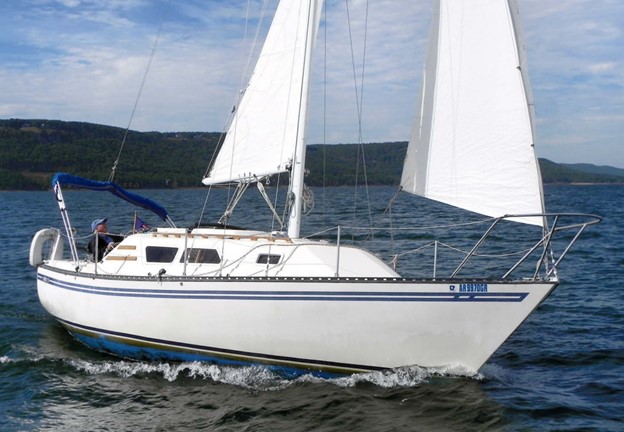
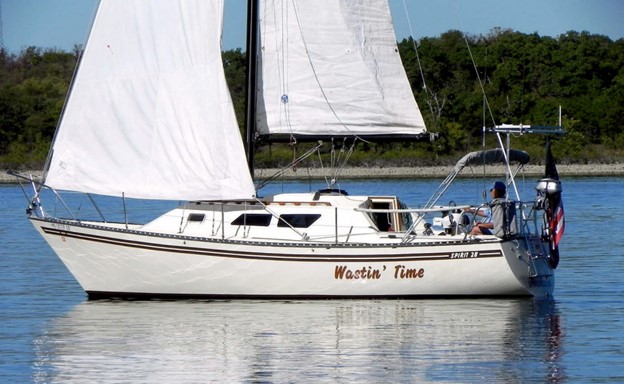
For this review of the Glastron-built Spirit 28, I looked at two boats with identical hulls that have taken on vastly different characters at the hands of two south-central Midwestern owners.
Jim and Linda McCraw keep Wastin’ Time, their 1981 Spirit 28, on Missouri’s Stockton lake, not far from their home in Springfield. Jim is a longtime ham radio hobbyist and something of an electronics aficionado. He made many changes and additions to the boat in preparation for an extended Caribbean cruise . . . that did not happen after Jim decided against exposing their boat to salt water. Wastin’ Time is loaded with electronics, gadgets, and innovations. Jim spends much of his free time “hanging out” at the marina, so Wastin’ Time feels lived in.
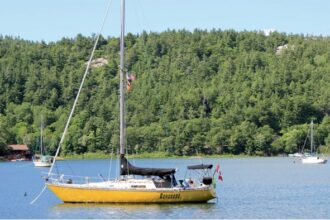
Phil and Pat Shupe of North Little Rock, Arkansas, daysail Rejuvenation, a 1980 Spirit 28, on beautiful Greers Ferry Lake in the Ozark Mountains, where they keep her in a marina not far from their waterfront vacation home. Her name alludes to her having been raised from the bottom of the lake, after which Phil, an engineer, and Pat painstakingly repaired and restored her. She is nearly bone stock and carries none of the clutter of liveaboard use.
Design history
The Spirit 28 was the last in the line of five sailboat models built by powerboat builder Glastron (six if you count its 1966 Alpha Super Sailboard) in the early 1970s through 1981. Two of the five, the 1976 North American 23 and the 1978 Spirit 23, are the same boat. Glastron had been making the hulls for North American Yachts, based in Austin, Texas, and changed the model name when it acquired the company. The details of the history vary from source to source, but most accounts agree that all of Glastron’s sailboat production was carried out at the former North American Yachts facilities.
Glastron was founded by Bob Hammond, a plastics engineer with aerospace and fishing boat experience who, in the early 1950s, was looking to build a performance powerboat with the new material fiberglass. Having designed the Meteor and other boats for Lone Star, Hammond built his first boat to his own design in a rented Austin, Texas, garage in 1956. He and three partners with business backgrounds were soon producing what are now iconic 1950s runabouts with fins on the top of the hull, like those on a ’57 Chevy. By coincidence, Phil Shupe once owned a 1958 Glastron inboard ski boat with fins that was powered by a 292 Ford straight six. He says it was a great well-made boat like the Spirit.
Interestingly, the company was not named after boat dealer/partner Bill Gaston, but was a hybrid name from the word “fiberglass” and the futuristic sounding “tron.” Hammond was still at the helm of Glastron in the early 1970s when the company decided to enter the sailboat market. Hammond retired in 1974, but quickly got back into boatbuilding, founding Hammond Boats to build more performance powerboats. Glastron was sold in 1987 to Genmar Holdings, which moved the company to Minnesota. In 2009, Genmar filed for Chapter 11 bankruptcy. In 2010, PBH Marine Group bought Glastron. Glastron boats are still in production.
Glastron’s flirtation with sailboats lasted 11 years, starting in 1970 with the Nacra beach catamaran called the Alpha Cat 18. The North American 23 followed (later to be renamed the Spirit 23), then the Hank Hinckley-designed Spirit 21 (aka 6.5), and finally the Robert Finch-designed Spirit 28. The sales brochure lists Robert Finch and Earl Blackwell as co-designers. Robert Finch did most of his 16 designs in the early 1970s, including the Catalina 27 and the Coronado 30. Glastron ceased production of the Spirit 28 in 1981 after building around 300 boats.
Our review boat has no connection to the Van de Stadt-designed Spirit 28 or the English boatbuilder Spirit Yachts.
Hull design
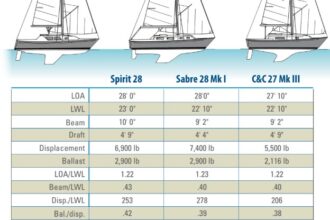
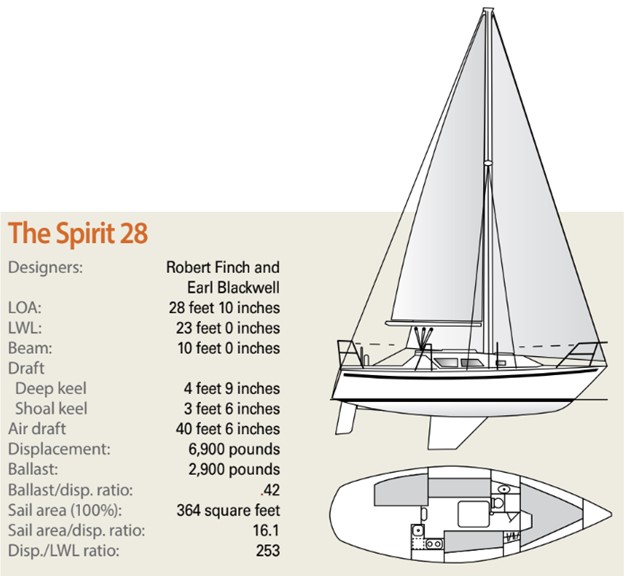
A typical cruiser/club racer of its day, the Spirit 28 is sloop-rigged with a fin keel and spade rudder. The hull has a straight raked bow, a sweeping sheer, and a slightly reverse transom that almost reaches the water. The tall cabin trunk allows for large windows. With a moderate displacement/length ratio of 253 and a somewhat conservative sail area/displacement ratio of 16.1, it has enough volume for adequate tankage and storage, and enough pep to satisfy most coastal cruisers.
Both boats reviewed here are the deep-keel version, which draws 4 feet 9 inches. The shoal-draft version drew only 3 feet 6 inches.
Construction
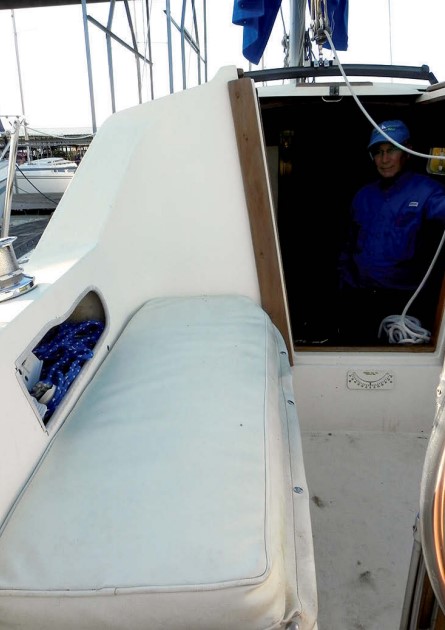
The hull and balsa-cored deck are hand-laid fiberglass joined together on a hull flange with 1⁄4-inch-diameter stainless-steel screws on 4-inch centers through the slotted aluminum toerail. The owners of both test boats report that, even at this late date, the joint sealant is still soft and pliable. The same sealant is used on all other hardware and fittings, and leaks are minimal to non-existent. Our owners report no problems with the balsa core.
Two water tanks, one under the V-berth and the other under the port settee, hold a total of 19 gallons. The holding tank holds 13 gallons and the fuel capacity is 15 to 19 gallons. Of the 11 bronze through-hull fittings in the stock boat, five are below the waterline.
Engine choices available from the builder were an inboard 2-cylinder Yanmar diesel, a 15-horsepower OMC Saildrive, or an Atomic 4 gas inboard. Wastin’ Time has the diesel and Rejuvenation has the saildrive.
Rig
The Spirit 28 has a single-spreader masthead rig with double lower shrouds, which are mounted inboard. (The masts were originally black, but Phil has painted his white so it is cool to the touch). Typical for the era, the mainsail has a high aspect ratio, which makes it difficult to find a used one in good condition. One owner reported buying a used J/80 sail online and cutting it down to fit his Spirit 28. The mainsheet is rigged from mid-boom to a short traveler on top of the cabin trunk. There is also rigging for a staysail.
On Wastin’ Time, Jim has a 120 percent genoa on a roller furler, while Rejuvenation’s headsails are hanked on. There are two #40 winches on the coamings for the headsail sheets but no stock winches for the halyards that are led to stoppers on the cabintop. A winch here would be handy for applying luff tension. Many boats may already have them installed.
Deck
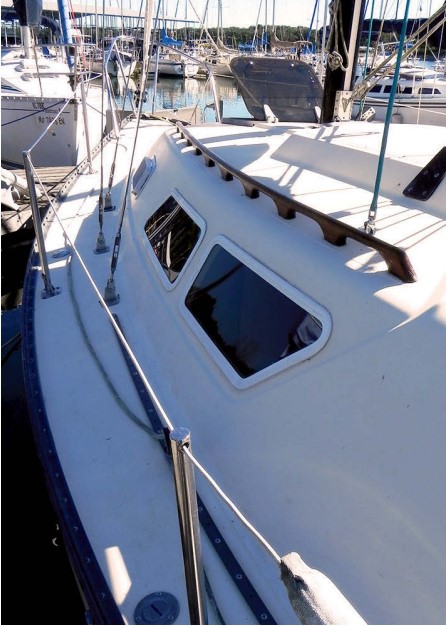
At the bow, there is a large anchor locker, one large stout cleat, and chocks on either side. Stanchions bolted through the deck support single lifelines between bow and stern pulpits. Crew negotiating the sidedecks can hold on to long teak handrails on the cabintop.
The companionway has a low sill, so going below is quite easy. Three dropboards and a solid hatch slide (that is housed in a sea hood when open) secure the companionway.
Belowdecks
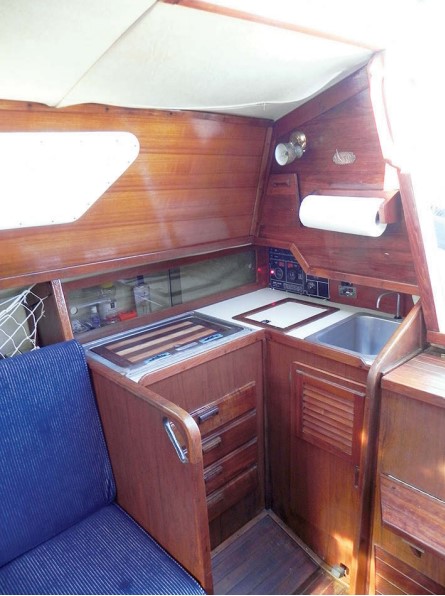
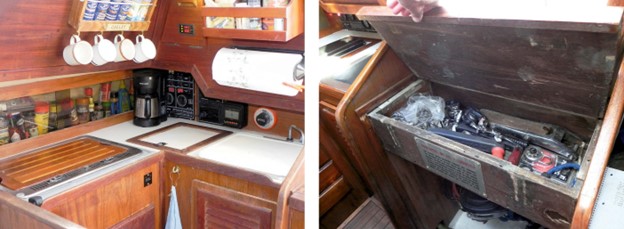
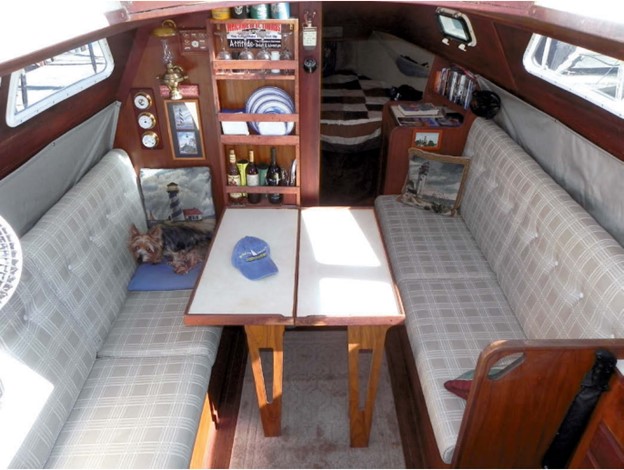
While Phil and Pat have restored Rejuvenation to near stock, Jim has added lots of his own touches to Wastin’ Time, to the systems and to the joinerwork. Both boats have new windows made by the original manufacturer, and these, together with two overhead opening hatches and two small opening portlights, let in plenty of light and air.
Under way
My wife, Ruth, and I traveled some distance to these large south-central reservoir lakes. Both lakes contain far more sailboats than one might imagine. Unfortunately, during our time with Jim, Stockton Lake was flat calm, so we couldn’t test Jim’s claim that the Spirit’s high ballast-to-displacement ratio (42 percent) allows carrying full sail to about 20 knots of wind. We can say that Wastin’ Time’s Yanmar 2QM15 purred and, with the wheel hard over, the boat would spin on a dime. I could feel the prop wash through the rudder, and considerable prop walk is evident in reverse; otherwise handling under power is typical.
I did, however, move about the boat to check on ease of movement and comfort. While the foredeck, sidedecks, and cabintop are plenty wide enough for working, the height of the coachroof aft makes stepping off it a bit awkward. The best place to step up or down from the coachroof is at the shrouds. The sloping forward end of the foredeck/cabin trunk has no non-skid, making it slick when wet, but great for sunbathing.
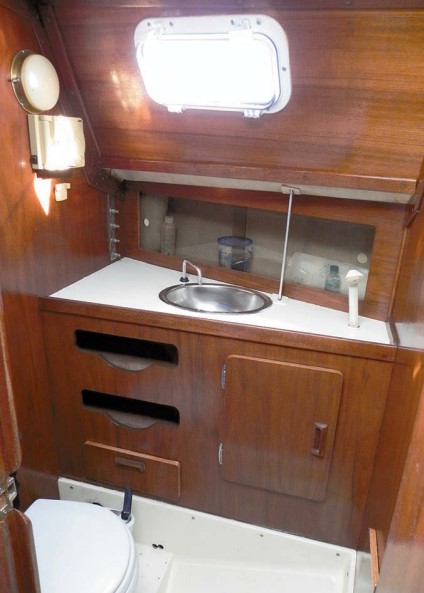
portable toilet with a pump-out in lieu of the marine head. Due to its age, most owners find themselves replacing the entire waste system. A helpful description of this process and other tips can be found at the Spirit 28 website.
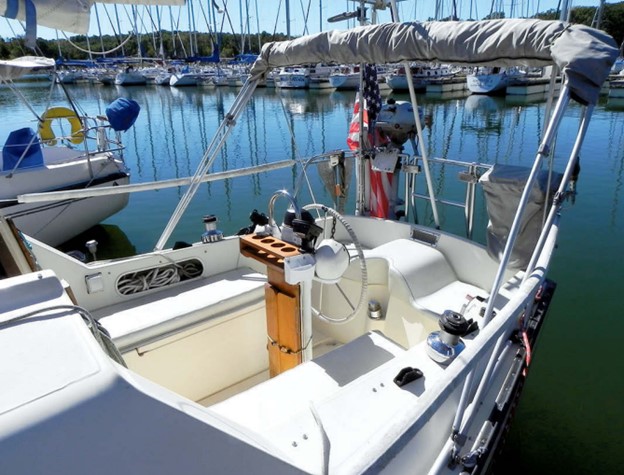
Cushions on the coamings and seatbacks would help but, because of the narrow seats and the cubbies in the backrests, the most comfortable way to sit in the cockpit is to lean back against the bulkhead. If it were up to me, I would avoid installing anything on the bulkhead and find a different place to belay and coil halyards.
At Greers Ferry Lake we got some wind on our second day, so we saw the effect of the high ballast-to-displacement ratio. We didn’t get 20 knots, but Rejuvenation was stiff in the puffs. When sitting on the leeward side to steer, I found I needed some padding behind my back as I leaned against the pulpit.
Curiously, Rejuvenation and Wastin’ Time handled differently, and I hesitate to speculate as to why. While light on the helm, Rejuvenation did not feel “sweet” — that super-light responsive feeling you expect from a spade-rudder/fin-keel boat. Although I did not sail Wastin’ Time, Jim reports that his boat indeed has that sweet fingertip steering I had expected.

Apart from that, Rejuvenation accelerated well in puffs, tacked quickly, and otherwise handled normally on all points of sail, topping out at about 6 knots. With a PHRF of 186 to 200, the Spirit 28 compares well with a Sabre 28 at 192 to 210 or a Beneteau 285, also at 192 to 210. I have no reason to believe it would not do well in rougher conditions.
Motoring with an OMC Saildrive was a different experience — not in handling, but in sound and smell. The exhaust is above the waterline and it has the sound, smell, and feel of a smooth-running, muffled two-stroke motorcycle. Vibration is minimal, and with a fixed prop the boat handles well in reverse too.
Back from the dead
Now is the time for Phil’s story. As a young couple Phil and Pat built a South Coast 22 from a kit, and then sailed it on their honeymoon in the Florida Keys. Years later, Phil saw Rejuvenation sunk at a Greers Ferry Lake dock. She was submerged for several days before being refloated, and Phil tried to buy her “as is, where is” but could not find the owner. A year later (2007), he and Pat purchased her for $300 in back dockage fees. Phil and Pat then worked on her for two years. She had no hatches; no sails; the cabin cushions were all missing; and the bottom had hundreds of blisters that they fixed with epoxy putty, gelcoat, three coats of Epiglass epoxy resin, and five coats of bottom paint. They had to strip the boat and start over. Phil finally found the previous owner, who then supplied a lot of the missing equipment.
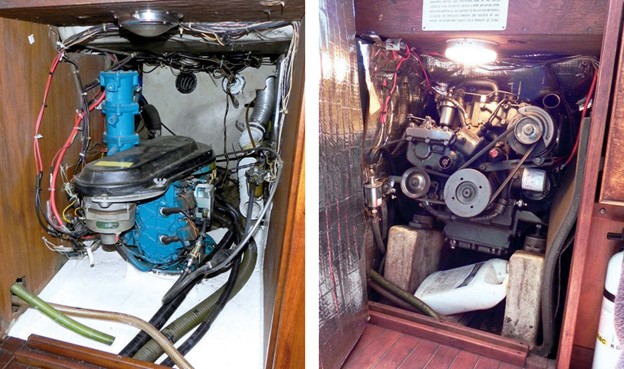
The previous owner apparently had had trouble with the OMC, so he hung a large outboard on a bracket on the transom. This weight aft put the bilge-pump through-hull in the water, and a leaky hose let water in. The Shupes live in the North Little Rock area, quite close to the OMC manufacturing facilities, so Phil and friends took on rebuilding the original engine and Saildrive. Starting with a new engine block (Phil says not to expect to find another), he could have made it into a 25-horsepower engine during the rebuild but felt 15 horsepower was more than adequate.
Conclusion
The Spirit 28 is a nice boat for coastal cruising or club racing — or both. Obviously there will be no factory support, and many components will be in need of restoration, but they are fairly easy to find or fix. It is nice to hear about a boat that does not leak at the hull-to-deck joint.
I found only a few for-sale listings online, and of those, ready-to-sail boats were selling in the low to mid teens. You may find Spirits for sale outside the U.S. and Canada as Glastron’s dealer network was global.
Allen Penticoff, a Good Old Boat contributing editor, is a freelance writer, sailor, and longtime aviator. He has trailer-sailed on every Great Lake and on many inland waters and has had keelboat adventures on fresh and salt water. He owns an American 14.5, a MacGregor 26D, and a 1955 Beister 42-foot steel cutter that he stores as a “someday project.”
Thank you to Sailrite Enterprises, Inc., for providing free access to back issues of Good Old Boat through intellectual property rights. Sailrite.com