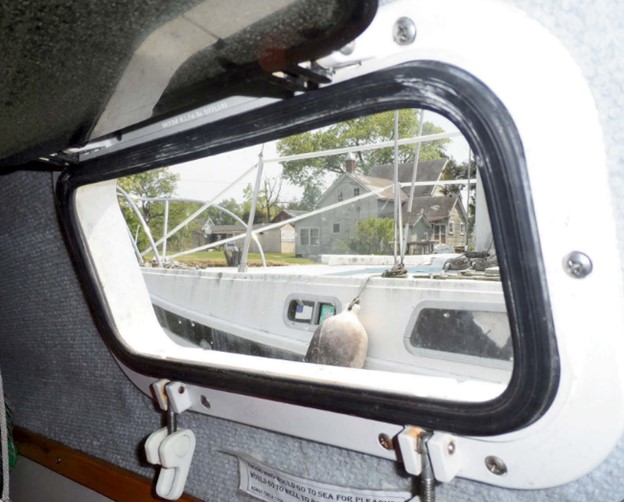
Storm windows on hatches and ports help keep the cabin cozy
Issue 120: May/June 2018
How many northern sailors miss the glory days of sailing? I’m talking about the fall when, in many parts of the continent, the winds are steady, thunderstorms a distant memory, the bugs have packed it in for the season, and the crowds are home watching football. The oppressive heat is gone, replaced by crisp mornings and pleasant days, but a chill comes with the night air and evenings are long. Making the best of the season takes a little preparation.
The first line of defense against cool nights is a heater, preferably a sealed solid- or liquid-fuel device that exhausts outside the boat and can be left on throughout the night.
But with or without a sealed heater, keeping drafts out and adding insulation pay big benefits. There is also the matter of condensation. My boat has hatches over the bunks that are perfect for stargazing and also strategically located to drip condensation on my forehead at 0300.
Hatches and portlights
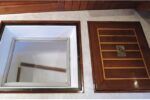
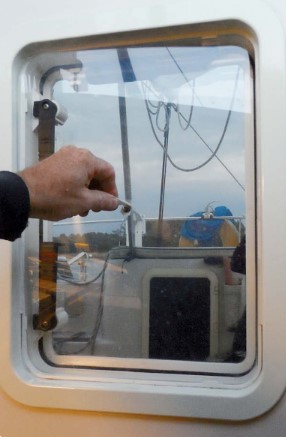
One step I’ve taken to reduce heat loss and eliminate drips is to fit Lexan (polycarbonate) “storm windows” to my hatches and portlights, similar in concept to those used on homes in northern states. While acrylic (Plexiglas) would work just as well, and is less susceptible to scratching and to degradation by UV radiation from the sun, I prefer Lexan for this duty because it is less prone to cracking during fabrication and when being installed in low temperatures. In my view, UV exposure is not a serious concern in winter.
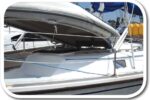
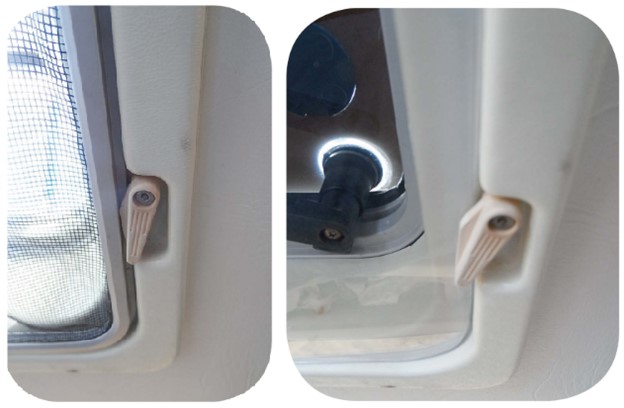
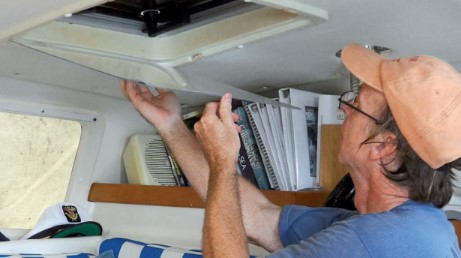
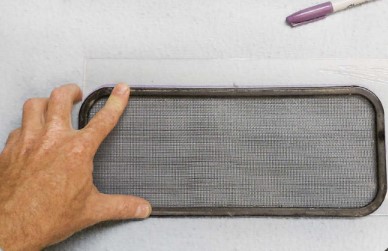
Adding storm windows to hatches that are fitted with removable bug screens and twist fasteners is a snap (Bomar and Lewmar). I simply traced around the screens onto 1⁄8-inch Lexan (see “Shaping Lexan and Similar Plastics,” below), cut them out, and slipped them into place. We have nine hatches with such removable screens, and can swap out all the screens for storm windows in 10 minutes.
Gasketed Beckson portlights are a bit more complicated and time-consuming. Because the screen fits inside the gasket, the screen and gasket must be removed. After a season of rain, fallout, and algae growth, the gasket must be peeled from the screen and scrubbed clean, inside and out. The storm window, made the same way as those for the hatches by tracing around the naked screen, then slips into the gaskets. We have 12 of these and they take about five minutes apiece to swap.
For those without ready access to a workshop, clear flexible materials can work. Wrapping a portlight screen in either hardware-store window film or cling wrap will suffice for a season. For overhead hatches, 20-gauge window vinyl cut to shape and laid on top of the existing screen will keep the warmth in and is reusable.
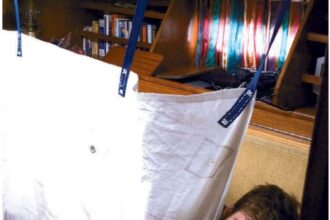
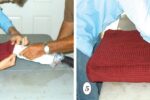
To protect the storm windows in the off-season, I wrap them in long strips, a little wider than the windows, cut from old bedsheets or similar fabric. I can get several windows in each long strip, flipping between windows to make a neat stack for transport and summer storage.
Additional steps
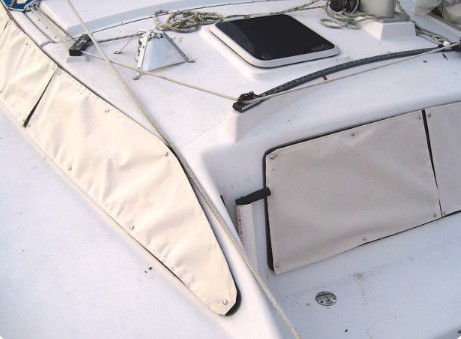
External window covers are good for UV protection in the summer and also trap some heat in the winter. We use them on fixed windows where storm windows are impractical. (See “Protective Covers for Fixed Windows,” November 2016.)
Fabric covers attached to smooth cabin liners with snaps will help the boat feel warmer and cut down on condensation.
Exploring the boat with hands, senses, or even better, an IR thermometer, will reveal other cold leaks. We found a few we could mitigate with inexpensive and practical solutions.
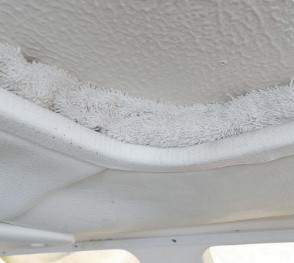
The 10-foot-wide companionway slider on our catamaran creates a huge heat and cooling leak. Fortunately, it is easily insulated with long sausages made from old towels. I made these by rolling a towel lengthwise until I had a roll of a suitable diameter, cutting the towel, turning the cut edge inside, and finishing it with round stitching. We use these anytime the heat or air conditioning is on, and when the mosquitoes are unusually thick.
While an insulated and weather-stripped companionway door would be the right answer, we like being able to see through the stock Lexan door. We simply drape a large beach towel over the door at night. It makes coming and going a little awkward, but it seals the drafts and provides some insulation. Tucking the corners into the slider or placing something heavy on top secures it. At anchor, the dodger keeps it out of the wind.
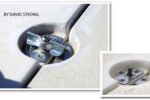
A varnished cabin sole is pretty, but beneath it is the cold bilge. Covering the sole with removable carpeting, secured with twist-lock fasteners if needed, provides a layer of insulation.
So, bundle up in your fleece midlayers, windproof outers, and a warm hat, and go enjoy the other season. Or seasons. Once the boat is insulated against chilly fall days, it’s good for springtime too. It’s amazing how the cost/benefit ratio improves when you sail more!
Shaping Lexan and similar plastics
Trying to cut thin Lexan with a saw is slow going and invites cracking. It is faster, neater, and safer to score the material and snap it along the score. This technique works equally well with acrylic and other sheet-plastic materials, even thin fiberglass laminates.
A few simple tools and procedures make for rapid fabrication. Use the screen as a pattern for the storm window. Trace around the screen with a Sharpie angled slightly inward to ensure the mark is flush. The line will be just outside the true dimension and will be trimmed off.
A scoring-type plastic cutter is needed (there are many types of plastic cutter). After every five to 10 cuts, or 100 strokes, resharpen the cutter on a grinder. Resharpen the cutting face, not the V-angled sides.
Use the plastic cutter to score the straight lines. About 10 firm strokes should do.
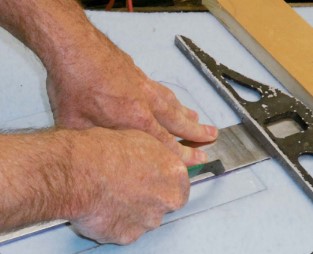
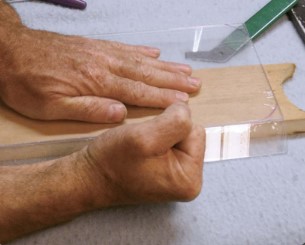
After scoring, snap the Lexan over a wooden board with a straight square edge. Narrow strips require a firm bump.
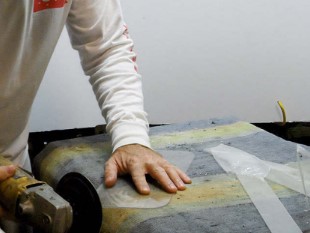
Shape the rounded corners with an angle grinder using a 150-grit disc and light pressure. Deburr the edges with fingers or 200-grit sandpaper.
Drew Frye cruises Chesapeake Bay and the mid-Atlantic coast, until recently aboard his 34-foot catamaran Shoal Survivor, searching for out-of-the-way corners known only by locals. Last year, he went up a hull, and now sails his Corsair F-24 trimaran. A chemical engineer by training, and a 40-year climber and 30-year sailor by inclination, he brings a mix of experiences to solving boating problems and writing about them.
Thank you to Sailrite Enterprises, Inc., for providing free access to back issues of Good Old Boat through intellectual property rights. Sailrite.com