Issue 132: May/June 2020
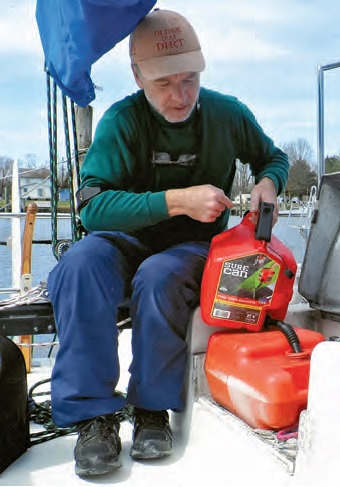
Filling Fuel Tanks Neatly
Just over a decade ago, filling outboards, mowers, chainsaws, and small tanks got messy when CARB (the California Air Resources Board) mandated low-emissions cans. I’ve found compliant cans awkward to use, spill-prone, and slow. Until now. The SureCan solution is so simple, I wonder why it took so long. I’m in my second season using it and can say it’s the first gas can I’ve used that is spill-proof. The flow is controlled by a valve located at the bottom outlet, operated by an internal linkage. To dispense fuel, I unscrew the small gasketed spout cap, rotate the spout down into the tank filler, kick a safety latch out of the way with my thumb, and squeeze the dispensing lever. As fuel dispenses from the bottom, there’s no need to lift and tilt a can to pour. I can regulate the flow as needed, anywhere from two gallons per minute to a thin dribble, making it easy to fill the smallest chainsaw or tiny integral outboard tank in complete control. Instead of a dual-flow spout glugging slowly along, there is a separate vent located under the lever that opens when you squeeze the lever. This ensures good flow when open and closes and locks when closed. Like all CARB cans, the plastic is low-permeation, but this is the first gas can I’ve used that is odor-free in the car (probably because I haven’t dribbled gas down the side; that said, never leave any gas can in a car on a hot day). The cans are more expensive than alternatives but are a joy to use. SureCans come in different sizes and colors (for gasoline, diesel, and kerosene). I see that Edson sells replacement parts for them too.
For more information, edsonmarine.com/surecan or surecanusa.com —Drew Frye, Good Old Boat Contributing Editor
Drying the Air


Moisture is a problem aboard every boat, and there are many approaches to combatting it, from leaving an incandescent bulb burning in the cabin to commercial dehumidifiers to passive moisture-absorbing units. I’ve found great success with my own version of the moisture-absorbing solution. I buy Dry & Dry indicating silica gel beads online and then fill burlap bags with the beads. They change color as they absorb moisture (that’s what the “indi¬cating” means), and after about a month it’s time to recharge them. Recharging (or reactivating) the beads is easy. I can either spread them out on a cookie sheet and bake them in the oven for an hour or so at 200°F or stick them in the microwave for 10 minutes on the defrost setting. Besides the low cost of buying the desiccant beads online in bulk, the big advantage of my solution over most similar commercial solutions is the beads’ reusability. I make the burlap bags myself, but the beads could also be put into plastic containers with holes cut into the lids. Either way, I really love the difference these make in keeping our MacGregor’s cabin dry. One note: While silica gel is nontoxic, the blue beads in particular (they turn pink when they’ve absorbed moisture) contain cobalt chloride, a known carcinogen. I use the orange beads (they turn dark green), as they are nontoxic. Avoid white beads as they are not indicating.
For more information, dryndry.com —Carol Severson, Good Old Boat contributor
Thank you to Sailrite Enterprises, Inc., for providing free access to back issues of Good Old Boat through intellectual property rights. Sailrite.com