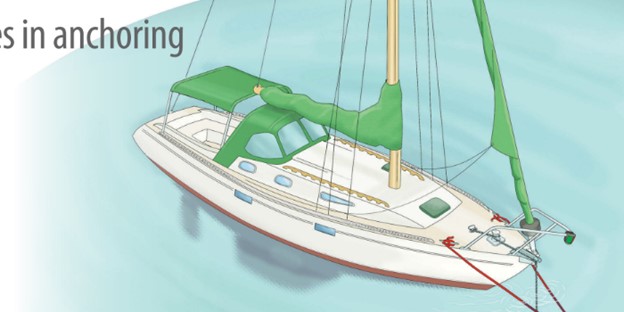
Learning from adventures in anchoring
Issue 114: May/June 2017
For the first two months of cruising on MonArk, our 1979 Dufour 35, I barely slept at anchor. I was too nervous about the possibility of the anchor dragging or the rode chafing through. Any knock or noise and I was out of bed like a shot. I would wake the next morning bleary-eyed but thankful we had made it through another night without catastrophe.
In the years since, we have devel- oped a system for anchoring that works well for us. Surprisingly, to us anyway, we use only a handful of techniques 99 percent of the time. Aware that all sailors have their own anchoring methods — and mindful that telling others how to anchor is like telling them how to raise their children — I thought I would share some of the techniques we employ successfully and how we came to use them.
Scope and tide
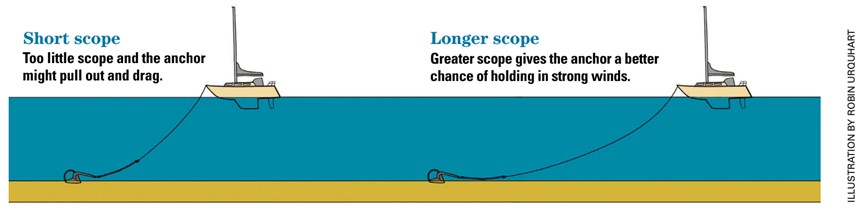
We began our adventures in anchoring with a 30-pound CQR and 15 feet of chain attached to rope rode. Anchoring in the protected waters of the Pacific Northwest, our biggest concern was the large tidal range, sometimes in excess of 15 feet. This kind of change required that we check the tide tables so we could plan for adequate scope at high tide. We had read in the 67th edition of Chapman Piloting Seamanship & Small Boat Handling that appropriate scope is 7:1 in moderate conditions and 10:1 in heavier weather. (Scope is the ratio of length of rode deployed to height from seabed to the anchor roller.) As paranoid newbies, we always used greater scope than recommended for the given conditions.
One night, the wind picked up to 35 knots in the small bay where we and another boat were anchored. We had used 11:1 scope, just in case. When I got up for one of my many anchor checks over the course of the night, the boat beside us had disappeared. I whirled around and saw they had tied up to the small gas dock. Surprised, but relieved, I went back to bed.
Talking with the crew the next day, we learned they had dragged repeatedly overnight. They had calculated their 6:1 scope at low tide and didn’t factor in the 10-foot rise in tide. The result was that in the middle of the night, at high tide and in the strongest wind, they had little more than 3:1 scope. It was a good lesson for us (and them) on adequate scope and factoring in the tidal range.
Now, no matter where we anchor, we carefully check the tides and adhere to a schedule we’ve agreed on for scope: 3:1 for lunch stops, 5:1 for overnight in mild conditions, 7:1 for moderate conditions, and 10:1 when the wind is (or is forecast to be) over 25 knots.
Rigging a bridle
As I began to feel more comfortable about trusting the set of our anchor, I still worried about chafe on the anchor rode. Our rode is forced to lead at an angle from the bow roller to a cleat, causing it to chafe on an edge of the bow roller. I put a section of old bicycle tire around the rode in that spot as a chafe guard, but I never slept well, worried that the chafe protection might move or wear through. More experienced sailors recommended I use a bridle to act as a sacrificial layer of sorts and to help reduce our boat’s tendency to yaw.
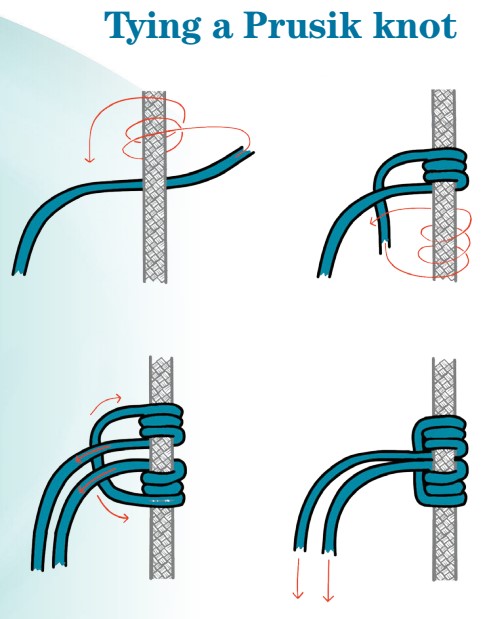
I made a bridle from a single length of 5/8-inch nylon rope. I tied it to the center of the rode with a Prusik knot (see “Tying a Prusik knot”) and ran the tails of the bridle back to the bow cleats. When we later added a lot more chain to the rode, we fashioned a bridle that we could hook onto the chain for occasions when we didn’t have to pay it all out. From that day on, except for a quick lunch stop, we have always used a bridle to reduce wear on the rode, keep the boat pointed into the wind, or act as a chain snubber.
Windlass or winded lass?
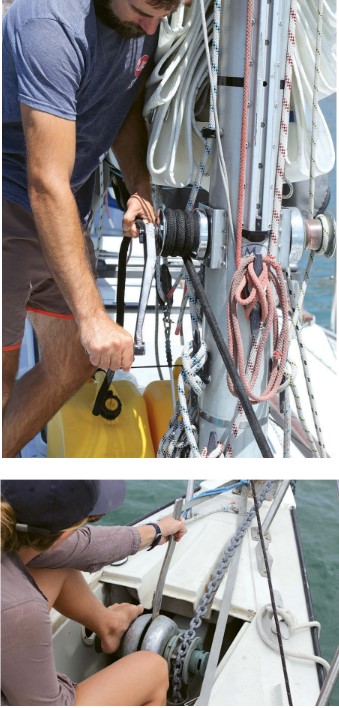
We pride ourselves on keeping our boat simple and ourselves fit. We never wanted a windlass and were happy to raise our anchor by hand. This worked well when we used a 35-pound anchor and only 15 feet of chain. In strong winds, we would wrap the rope rode around a winch on the mast and simply crank it in.
When we upsized to a 45-pound anchor and 150 feet of chain, things got a little harder. One morning, anchored 50 miles north of San Francisco in a 20-knot wind, even with my partner, Fiona, motoring MonArk slowly forward, I still needed all my strength to bring in the anchor. It occurred to us that, if we lost the engine or if I were injured, Fiona would be hard-pressed to do it alone. That realization scared us enough to purchase a used manual windlass in San Francisco. I still bring in the anchor by hand when conditions allow, but we’ve used the windlass more times than I can count.
Anchoring in swell
Having sailed mainly in protected waters, we were not used to anchoring in swell — and especially unaccus- tomed to swell and wind or current coming from different directions. After one extraordinarily rolly and uncom- fortable night, we realized we would have to do something differently.
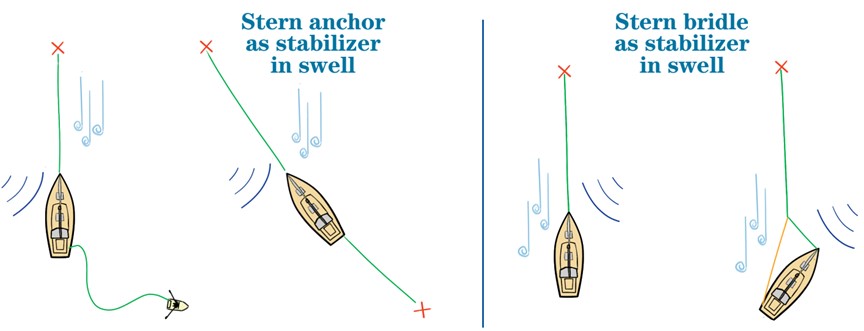
The next day, the swell and wind were still at odds, so I rowed out our Danforth stern anchor in the dinghy and dropped it at a point where I imagined its rode, made taut, would swing the bow into the oncoming swell. When we hauled in the stern anchor rode on a cockpit winch, the boat swung into place and we were immediately more comfortable. (See “Stern anchor as stabilizer in swell”, below.)
If the difference in angle between the swell and the wind or current direction is not more than 25 degrees, we tie a separate line to the anchor rode with a rolling hitch, lead it directly to a cockpit winch, and make it taut. This pulls the stern in the direction of the rode, changing the angle of the boat relative to the wind and the swell (see “Stern bridle as stabilizer in swell”, below).
Coping with current
One of our more awkward anchoring adventures resulted from strong incoming and outgoing tides combined with a 25-knot wind. From previous experience in similar conditions, we knew that turning the rudder hard over to one side and locking the wheel would prevent the boat from sailing around on its anchor. It’s the same principle as heaving-to: the forward motion of the boat causes it to turn, thereby changing the angle of the forces (wind and current) acting upon it. This worked well for three days and we sat still while other boats moved around rather dramatically.
When it came time to go, we could not bring up our anchor. In fact, we could not bring in the rode. Because we had kept the wheel hard over in one direction, every time the current switched, we would turn in the same direction, clockwise in this case. This caused us to wrap our rode around an underwater obstruction, most likely an old mooring block. After working out how many tide changes there had been since we dropped anchor, we motored in a counterclockwise circle three times, while being careful to keep the rode taut and at an angle away from the bow. Fiona suggested an incantation, as it seemed almost superstitious to turn in a circle three times to release the anchor. But at the end of our third circle, we were free! We still lock the wheel when anchored, but we change the direction of the rudder after every tide change so we don’t wrap the rode around an unseen hazard.
Outboard overboard!
Our worst at-anchor fiasco resulted in damage to a new outboard motor. The wind picked up in our anchorage to more than 30 knots over a fair amount of fetch. After checking the bridle and paying out more rode, I felt reasonably secure. What I didn’t check was the dinghy painter. The next morning, our dinghy’s absence was immediately apparent. It was later rescued by a Good Samaritan and returned to us, but not before the outboard had been bashed against rocks and submerged for hours. We are now more careful to ensure that everything attached to the boat stays attached while at anchor as well as while under sail, which means doing a walk-around before we turn in for the night, or when the wind picks up significantly.
Anchor alarms
One Halloween, Fiona and I went in costumes inspired by sailors’ nightmares. She was a dragging anchor and I was a broken head.
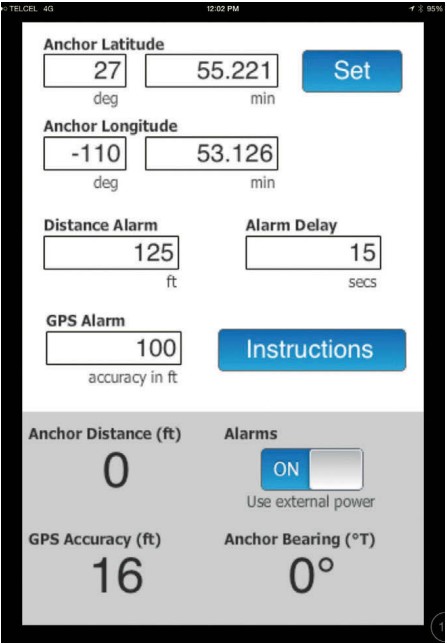
While just the thought of a dragging anchor is scary, we have a few alarm systems to alert us should our anchor ever drag. As soon as we drop anchor, we mark our position on our chart- plotter and turn on the course track. This lets us know whether and how we are moving in relation to our anchor. We also set a depth alarm on the chart- plotter to a depth a few feet shallower than our current depth, or a few feet shallower than the expected depth at low tide. Lastly, and most important, we downloaded Drag Queen, an app for the iPad that tracks our GPS position and sounds an alarm if we move outside set parameters. The chartplotter is in the cockpit and we can’t hear it very well in a strong blow, but we can take the iPad with us into the V-berth. We just have to remember to shut it off before we take it to shore or we get a rude awakening 30 seconds into the dinghy ride.
Developing a system
It is important for every crew to develop its own procedures for anchoring that best suit the boat, its equipment, and the waters it sails in. Along our anchoring journey, we have learned a great deal from other sailors, and we are grateful for that. We encourage all sailors to take advantage of opportunities to learn from others, and we hope that some can take a lesson or two from our experiences that will help them down the “rode.”
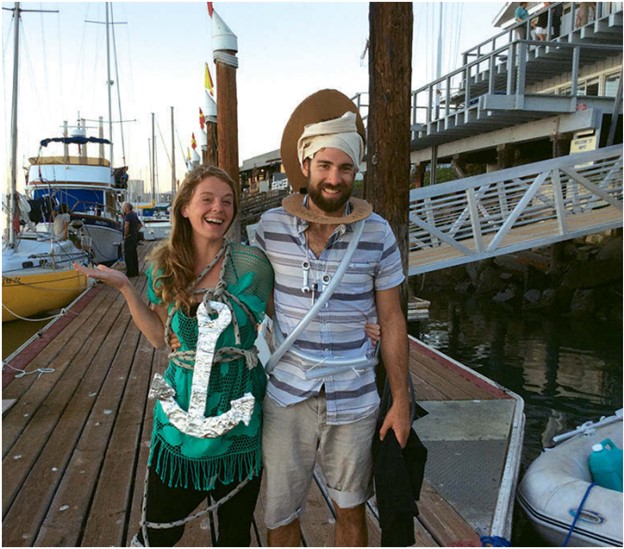
Robin Urquhart’s master’s degree in building engineering has been severely tested since he and his partner, Fiona McGlynn, headed south from Vancouver on MonArk, their good old 1979 Dufour 35. Follow their projects, problems, and adventures at www.happymonarch.com, and check out their blog at www.youngandsalty.com, where they reach out to younger sailors and the young at heart who share their passion for good old boats.
Thank you to Sailrite Enterprises, Inc., for providing free access to back issues of Good Old Boat through intellectual property rights. Sailrite.com