If you change the boat, the boat changes you
Issue 55 : Jul/Aug 2007
In the old days when quality was truly more important than price, those of us who were charged with designing things that would be manufactured came to understand that it was the process that mattered. If you wanted high-quality product, you didn’t design a product, you designed a process. The product that resulted from that process could only be better than the process by rare and improbable accident, and a good process would simply not allow the product to be worse than the process. A good process worked toward ever-improving quality, tolerating less that would drag the quality level lower with each passing day.
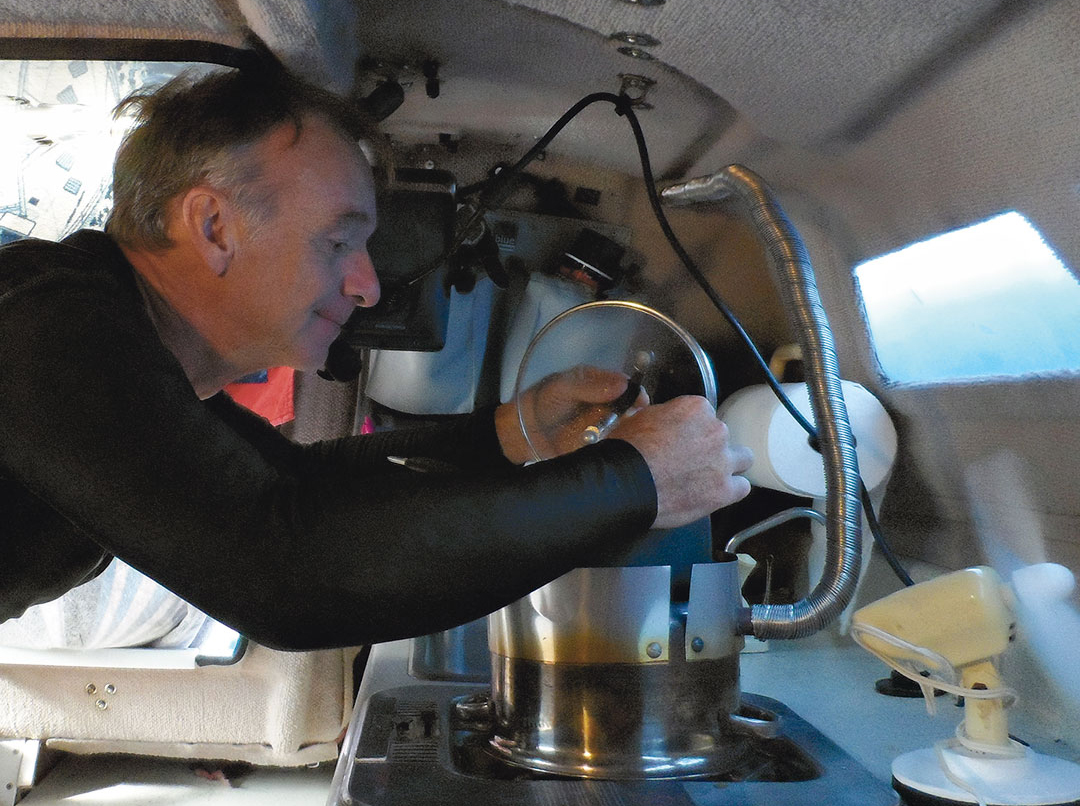
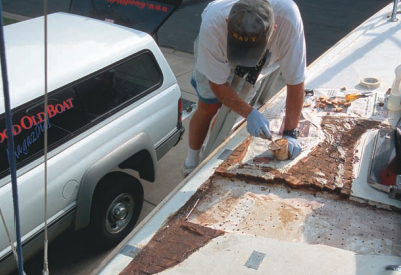
In the refit of our Mega 30, I try to remember those lessons. It’s taking longer than we had hoped and it’s costing more, but I’m keeping the quality up and improving the process as I go along. It will be done when it’s done; that will be the first point at which I will be able to determine how long the task should have taken. In something like this refit, old friends and a few new ones play important roles.
The drill press in my shop is older than I am. My dad bought it before the start of World War II. Many of the hand tools are also that old. They served my father, then me, and will serve another generation if I’m careful to place them in the right hands when I don’t need them anymore. The small power tools are like lollipops, however: good for a while, then gone. Bosch makes a really good random orbital disk sander. I’ve completely worn out two of these on the Mega and have three more in various states of function and demise.
Any process or tradition that prevents improvement is wrong-headed, so the new friends are equally important. People bad-mouth silicone rubber (RTV), but just about every deck fitting on our C&C 30 was sealed with that stuff by the previous owner, and none of them leaked.
Built samples
On the Mega 30 I have taken to using a new product called Life Seal, which is a blend of polyurethane and silicone rubber. I built samples and cycled them many times from extreme hot to extreme cold. Adhesion is good, but the real charm is that, unlike some of the other sealants, the cleanup is easy. Cleanup is a big deal. Working with other polyurethanes and polysulfides makes me think of Br’er Rabbit and the Tar Baby.
The humble cake frosting decoration bag is also a new friend. After I mix a batch of epoxy, I scrape it into one of these bags and am able to put the material exactly where I want it, including into cheap syringes from the farm store, which I use to inject epoxy into even more delicate places. Working on the Mega has been an interesting project during which I’ve learned some things and been reminded of others I’d forgotten.
- You are not born with very many skills. You have to acquire most of them.
- It is better to use good tools.
- It is better to acquire the tools at the beginning of the project rather than finally giving in and buying them near the end.
- You might be able to estimate how long something will take and how much it will cost if you have done it several times before. Otherwise, you’re kidding yourself.
- Don’t build too many things you could buy.
- It is better to start with a boat that is as close as possible to what you really want. Everything you have to fix will take time, and everything you want to change will take time too. They will also take more money, but the time is the big deal.
- When it is over, if you think it was worth it, it was. Nobody else gets to make that decision. Remember to factor in your old friends and your new ones. You changed the boat and the boat changed you.
Thank you to Sailrite Enterprises, Inc., for providing free access to back issues of Good Old Boat through intellectual property rights. Sailrite.com