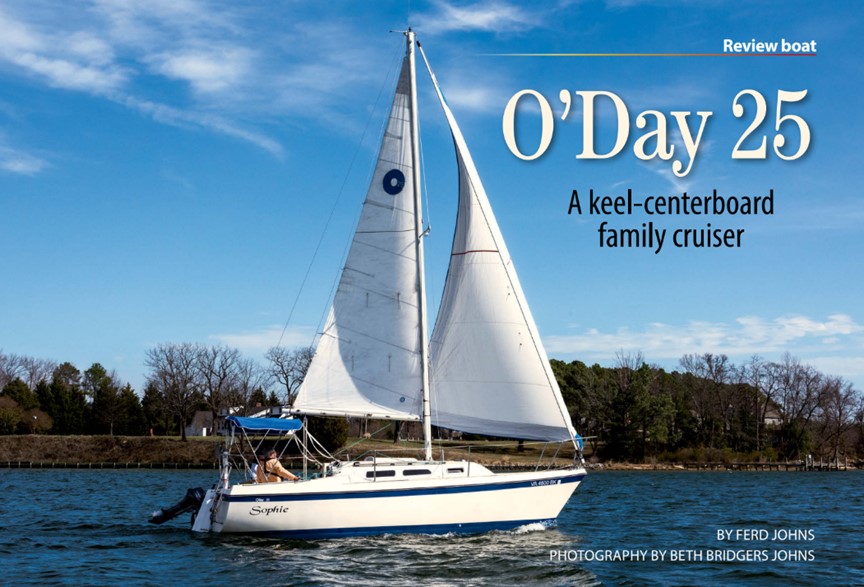
A keel-centerboard family cruiser
Issue 113: March/April 2017
Dan Benjamin has been coastal cruising since 1976, in boats ranging from a 17-foot Com-Pac Sun Cat to a 35-foot Hallberg-Rassy and in conditions from slick calm to a stress test for his safety harness. He has sailed the Pacific Northwest, Chesapeake Bay, Florida Bay, and the Florida Keys. A professor of economics at Clemson for many years, Dan loves numbers, and his sailing friends nicknamed him “Dan the Navigator.”
“I used to know a lot about navigation,” Dan says. “Now I just look at my GPS!” Plans for future adventures include tracing the route of John Smith’s historic explorations of the Chesapeake and its tributaries.
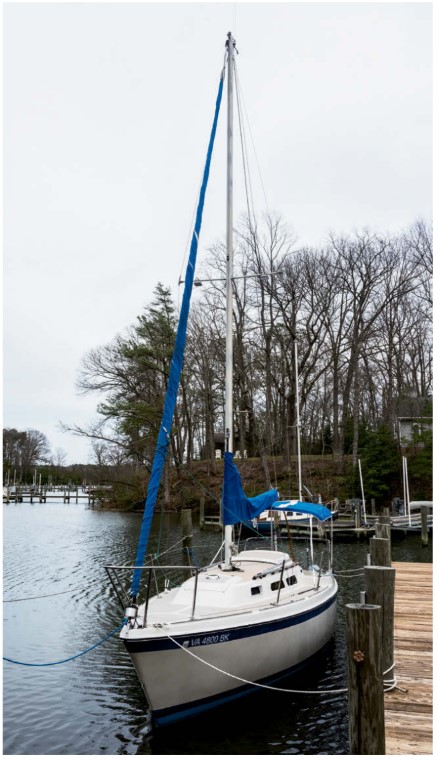
For their retirement, Dan and his wife, Robbie, selected a spot on the Northern Neck of Virginia at the head of a tree-draped creek off the Potomac River, close to where it empties into Chesapeake Bay. Their dock has a bit more than 3 feet of water at low tide. Dan wanted a boat he could moor there, that sailed well, was stable in heavy weather, and had reasonable cruising accommodations for two . . . plus a couple of grandchildren on rare occasions. In 2006, he purchased a 1983 keel-centerboard model of the hugely popular O’Day 25. He named her Sophie after the fictional Jack Aubrey’s first command and has spent the last decade gently tweaking her to fit his preferences. He recently added an asymmetrical cruising spinnaker to the mainsail and furling 135 percent genoa that came with the boat.
Design and construction
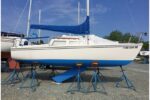
The O’Day 25 is a keel-centerboard masthead sloop first built in 1975 in Fall River, Massachusetts, by the O’Day Corporation. It is one of a popular series of trailerable cruisers designed for O’Day by C. Raymond Hunt Associates, a firm with a reputation for innovation in both sail and power boats. (Ray Hunt, who died in 1978, developed the deep-V powerboat hull and the early Boston Whalers.) Led by head designer and president John Deknatel, the firm designed the O’Day 20, 22, 23 (several versions), 25, and 26 between 1972 and 1987. All were shoal-keel or keel-centerboard sloops that followed a conservative model with a relatively straight sheer, raked bow, reverse transom, flattish bottom, and hard bilges.
O’Day was the largest builder of sailboats in the U.S. when, in 1966, its founder, George O’Day, an America’s Cup sailor and Olympic 5.5 Meter gold medalist, sold it to Bangor Punta (later Lear Seigler). O’Day had built well over 25,000 sailboats by the time the O’Day 25 was conceived, and built 2,898 of this model from 1975 to 1984, when it was replaced by the strikingly similar O’Day 26. The O’Day 25 was also available in a less-versatile deep-keel model.
The O’Day 25’s designers cleverly disguised the hull’s rather high free-board by extending the deck mold several inches below the sheerline, so the visually dominant line is the rubrail fitted over the hull-to-deck joint. Aesthetics aside, the high freeboard pays off in interior volume and reserve stability, although it adds windage. A low-profile cabin trunk helps balance the overall design. Considering that 40-plus years have elapsed since the design left the drawing board, the O’Day 25 has aged quite well when compared to other trailerable boats of the era.
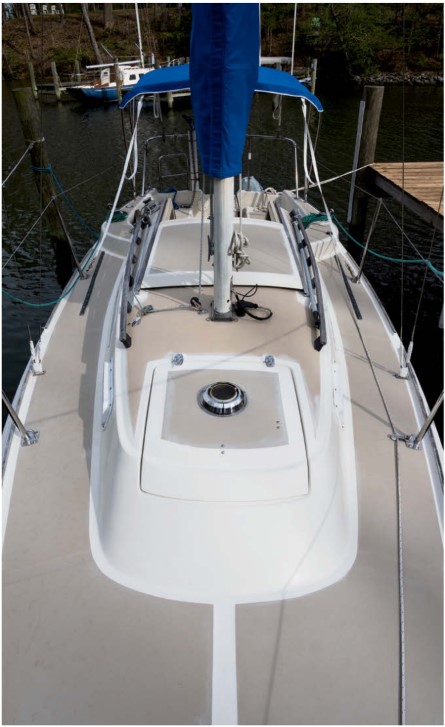
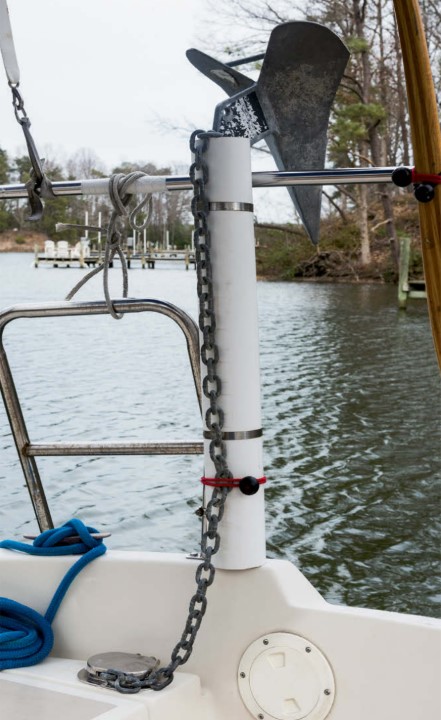
uncluttered foredeck has an anchor locker and large mooring cleats. Dan keeps a Fortress anchor and rode forward as his “Plan B,” but has not yet been able to devise an anchor roller installation that will fit around the stainless-steel pulpit, the running lights, and the stemhead fitting.
O’Day used construction techniques and material specifications typical of the period and appears to have maintained good quality control throughout the production run. The hull and structural fiberglass liner pan are a solid hand-laid laminate of mat and roving, and the deck is cored with end-grain balsa. The shoebox hull-to-deck joint is secured with screws and 3M 5200, and the rubrail is screwed through the shoebox lap into plywood encapsulated in the hull lamination. Structural plywood bulkheads and the liner pan are tabbed to the hull (but not to the deck), while the solid-teak trim and teak-veneer plywood furniture are fastened with screws.
The lead ballast is fully contained and sealed within the keel molding, and the centerboard pivots completely up into the keel without intruding into the cabin. Fittings and construction quality are as good as or better than most trailerable boats of that era, and owners confirm that these boats, when reasonably maintained, have held up well.
Deck areas under factory-installed fittings on O’Day boats of this era are typically solid fiberglass or cored with plywood rather than balsa, but spongy cored decks can still be an issue on any older boat. On Sophie, a large area of deck skin and balsa core had to be removed and rebuilt where a previous owner had installed a standing block on the cabin trunk near the mast step without properly sealing the balsa core. Dan has re-caulked his deck fittings to prevent any further issues.
Rig
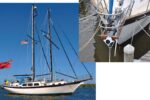
The single-spreader masthead rig is supported by a forestay, backstay, and upper and lower shrouds. The shrouds terminate at single chainplates on each side that penetrate the deck and are through-bolted to the plywood main bulkhead, which also supports the deck-stepped mast. Leaks are likely around the chainplates because the absence of tabbing between the deck and the bulkhead can allow movement in this highly stressed area. Sophie’s bulkhead had apparently suffered from rot before Dan purchased her, as it has been locally reinforced with solid teak pads where the chainplates are attached.
The mainsail has typical sail-shaping controls in a traveler and vang, as well as a topping lift and jiffy reefing. The genoa furls on an aftermarket CDI FF4 Flexible Furler.
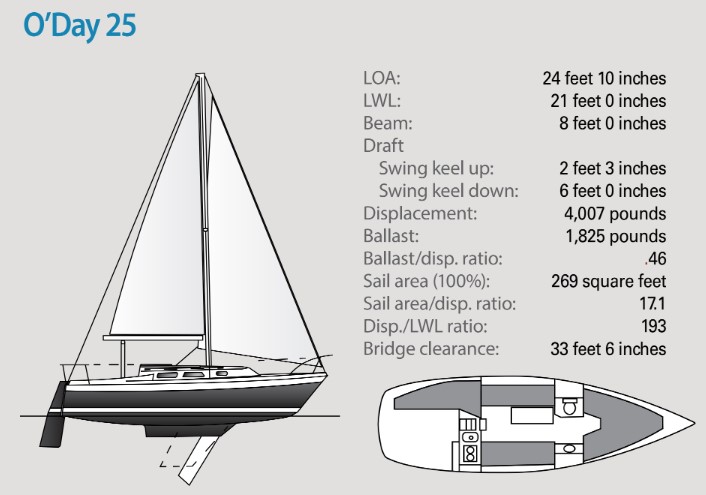
An optional mast-raising system, with a pivot ring spliced into each lower shroud to accept stabilizing bridles, allows an owner to use the boom as a gin pole. I have observed the process of rigging and launching an O’Day 25 with this setup. It took a couple of hours, an excellent ramp, and a lot of effort. Because of this and the 60-pound mast, a 2-foot 3-inch fixed-keel draft, and a towing weight of approximately 3 tons including the trailer, even the keel-centerboard model is really more “transportable” than casually trailerable. Dan does not trailer Sophie but simply takes advantage of her shallow draft to navigate to his dock.
Accommodations
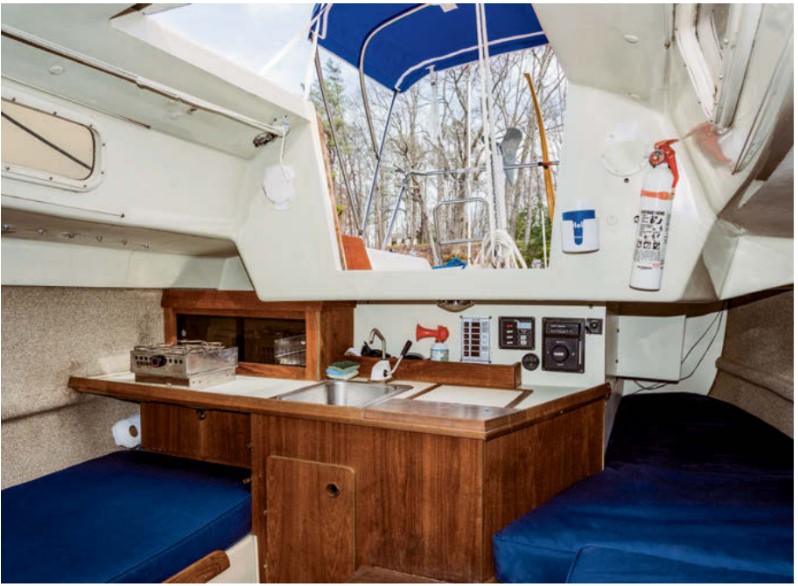
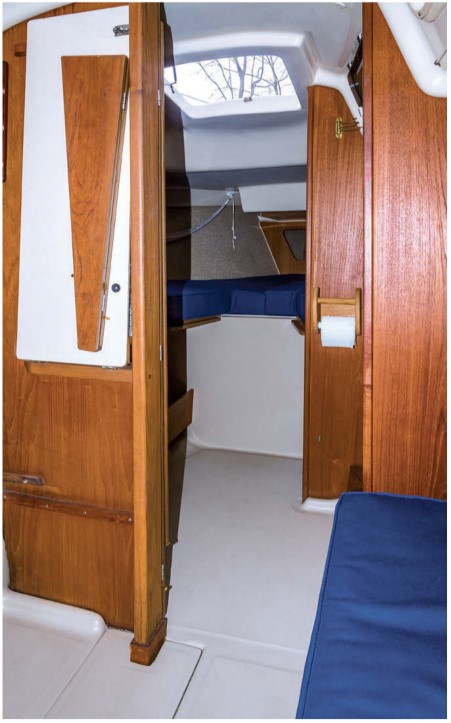
The first step down into the cabin is mounted on the galley countertop, which is directly under the wide companionway, an arrangement that allows Dan to stand under the open hatch while cooking in fair weather (or, with his custom boom tent deployed, in any weather). Otherwise, the headroom is 5 feet 6 inches, enough to enable a couple of “well-seasoned” 6-footers to move comfortably from the main cabin to the head, and to get dressed without undue contortions.
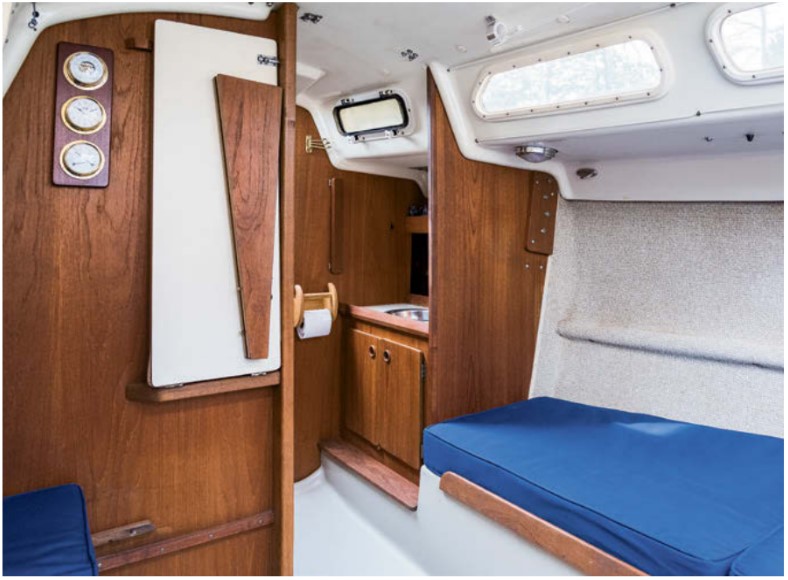
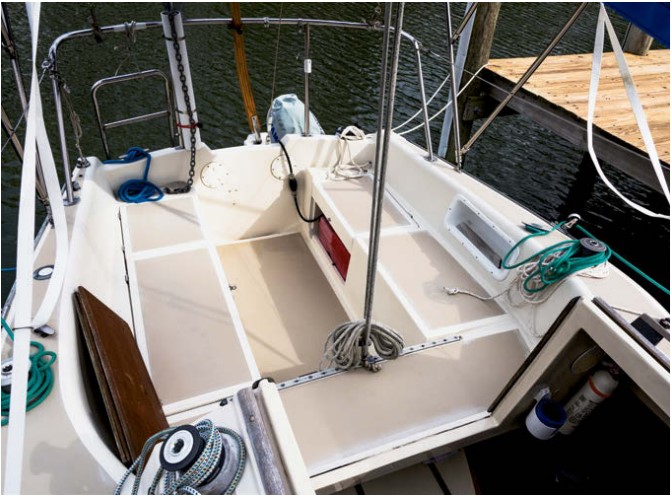
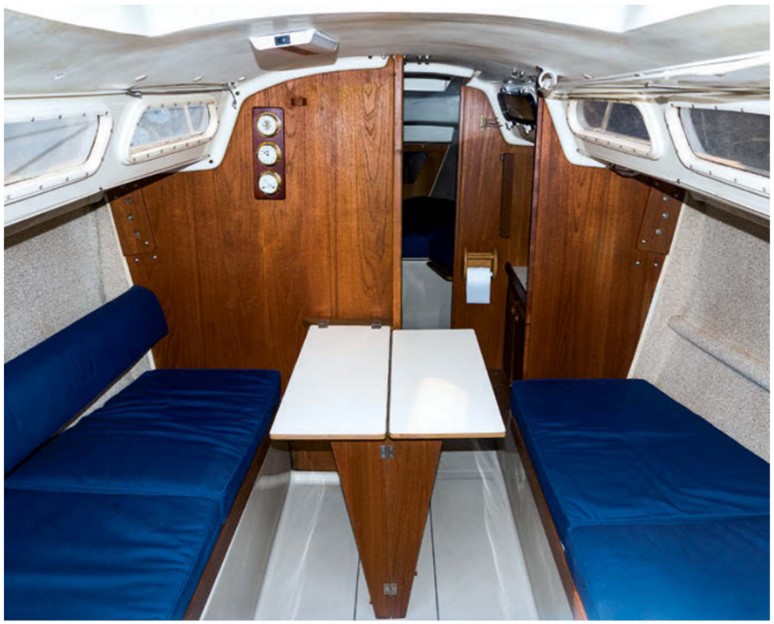
The galley counter extends over the after end of the starboard settee berth, and a deep shelf/backrest significantly reduces the usable width of this berth, especially at its narrow forward end. Dan removed the shelf, and his adult-sized cruising companions can now sleep comfortably. Throwable flotation cushions substitute for the original backrest and do double duty in the cockpit. The port settee berth expands to make a snug double, but the port “coffin” quarter berth seems best suited for stowage, especially if the port settee berth is occupied. Stowage areas under every berth are fitted with removable fiberglass pans to keep stores dry.
The athwartships head is comfortably set up with Dan’s high-capacity Thetford electric-flush portable toilet opposite a tiny vanity with a miniscule sink. A folding door gives privacy from the main cabin, and the molded-fiberglass forward hatch provides good ventilation. Dan added a solar fan to the hatch and louvers in the companionway dropboards to keep the boat fresh year round.
Under way
Dan’s outboard, a 93-pound electric-start Yamaha tilt-and-trim 9.9 four-stroke, hangs on a new stainless-steel Catalina Direct lifting mount. The previous outboard was very difficult to tilt manually, due to the awkward angle and interference with the stern pulpit, but the new extra-long-shaft high-thrust Yamaha easily pushes the boat at hull speed under all but the worst conditions, yet can be readily tilted to eliminate drag while sailing. The boat maneuvers best under power with the board down but still handles predictably in either forward or reverse with the board up.
The rudder draws more than the keel and is too heavy to remove while under way, so allowance must be made when powering in shoal water. Dan has not yet found a permanent solution to persistent problems with rudder delamination.
I have enjoyed several cruises on Sophie, so I have quite a few in-depth personal observations, most of them seconded by owners we surveyed. The O’Day 25 has the feel and motion of a bigger boat and sailing it is a pleasure, so long as you don’t expect it to be a racehorse. It tracks well, is stable, predictable, relatively dry, and rounds up safely to weather when over-powered. In about 15 knots of wind, a single reef in Dan’s older mainsail, easing the traveler, and taking a few rolls in the genoa kept Sophie’s speed up and heel angle down. Owners we surveyed were pleased with the O’Day’s performance and seaworthiness.
A keel-centerboard design is an excellent compromise in a shallow-draft boat, so I anticipated decent performance on a reach. Where this boat surprised me was on a long leg to weather, which it held with relatively little leeway and a well-balanced helm. With enough breeze, this boat is a good little coastal cruiser, but while most owners agree that light air is not its strong suit, nor does it point very high, on Sophie we have on several occasions enjoyed ghosting into an anchorage or short tacking along a narrow channel.
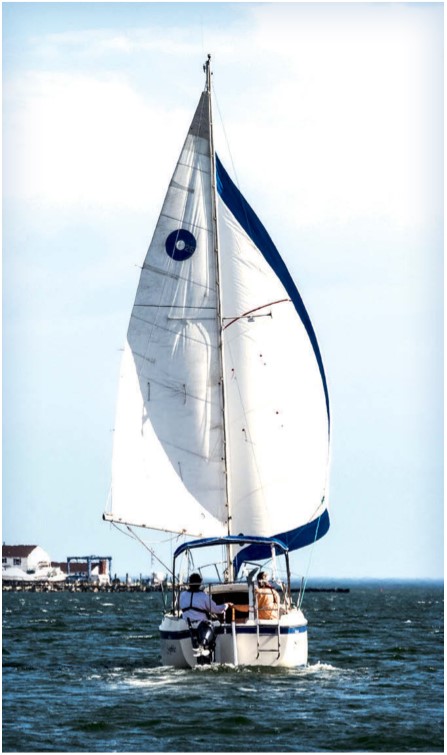
O’Day cruisers have been criticized for being slow. The 25, with an average PHRF of 234, is certainly not in the same league as the J/24 (174) or the Olson 25 (159), but it has the same PHRF as an Ericson 25 Mk I or a Helms 24 and is rated faster than a Seaward 25 (270). The solid but unsophisticated construction adds weight, and the sail area is moderate, each of which can be an advantage in a cruising boat. The 1,800 pounds of ballast in her shoal keel keeps her on her feet, while the deep centerboard and rudder foils keep her in the groove.
Conclusion
Current asking prices for an O’Day 25 range from $3,000 to $15,000, depending upon seller optimism, condition, location, and whether a trailer is included. Most fall between $5,000 and $8,000. The youngest boat would now be 32 years old, the oldest 41. Subtle changes were made over the years, mostly cosmetic, but the basic design and rig remained the same throughout the entire production run.
A prospective buyer should sound the entire deck thoroughly to check for delamination or spongy core, especially around fittings and chainplate penetrations. The area of the main bulkhead where the chainplates are attached should also be carefully checked, as well as the mast step area and bulkhead tabbing. Centerboards, pendants, and pins wear and break, rudders split, rigging frays, once-neat wiring becomes a tangle as new electronics are added. These problems are common in all boats of this era, and all can be remedied with some effort and expense.
With just a few easy modifications, upgrades, and updates, the O’Day 25 can become an economical, comfortable, capable, shoal-draft compact coastal cruiser for two adults. Although not easy to tow, rig, and launch, it is at least transportable to distant cruising grounds with a suitably stout tow vehicle.
Although the builder has been out of business since 1989, D&R Marine still carries some O’Day parts. Suitable replacements for most fittings and systems are readily available and a large community of loyal owners is always happy to help. In short, there is not much about these uncomplicated, sturdy, handy little sailboats that can’t be found or fixed.
Ferd and Beth Johns currently live on Whidbey Island, Washington, and regularly cruise the Pacific Northwest, Chesapeake Bay, and the Florida Keys. Ferd is an architect and professor emeritus of architecture, while Beth is an architect and photographic artist. Ferd cannot count the number of old fiberglass cruising boats he has owned (Beth can!), but the fleet is currently down to three . . . two trailerable sailboats and one mini trawler.
Thank you to Sailrite Enterprises, Inc., for providing free access to back issues of Good Old Boat through intellectual property rights. Sailrite.com