This nimble George Hinterhoeller design excels at club racing
Issue 118: Jan/Feb 2018
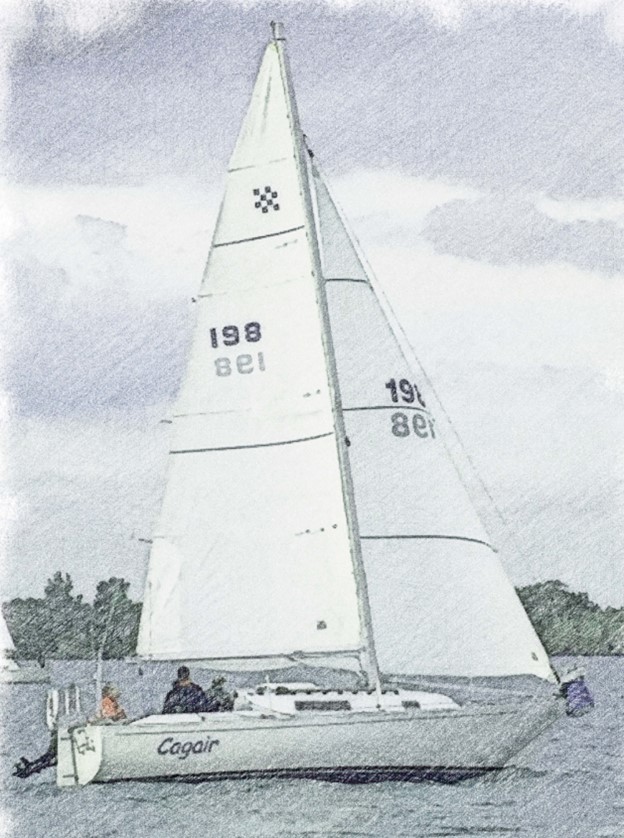
Boatless, having sold his Bayfield 23, Brian Casey scratched his sailing itch by racing on friends’ boats and caught the racing bug. As a budding racer with a growing family, he wanted a boat that performed well, could be crewed by his growing family, and was small enough to handle shorthanded or singlehanded. Almost 20 years ago, he found his perfect boat, a 1981 Niagara 26.
One day, when volunteering on the committee boat for a regatta at a local yacht club, Brian saw a Niagara 26 bounding over the waves in the pre-start maneuvers. The boat’s beautiful lines drew him in and its turn of speed confirmed this was the boat for him.
“It was a light-air day, and this Niagara was moving over the water like the outboard was still running,” Brian says. “When the boat tacked and I saw the outboard was tilted up out of the water, I knew right then that this was going to be my next boat.”
Brian actively races Cagair on the Detroit River at LaSalle Mariners Yacht Club. He and his family have also enjoyed cruises among the islands of Lake Erie.
“I find the boat to have just enough cabin for short-term cruising,” he says. “Over the years, we have had a lot of fun racing and cruising Cagair.”
History
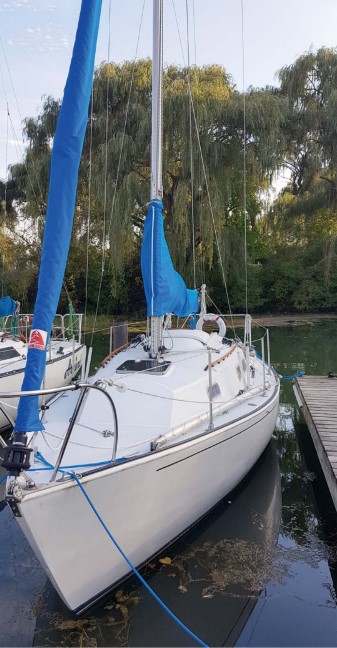
The Niagara 26 was designed by George Hinterhoeller, an Austrian-born immigrant to Canada. He initially found work building powerboats, but his passion was designing and building sailboats in his spare time. What started as a hobby eventually led to his making a major contribution to the Ontario sailboat industry over more than 40 years. George’s most famous design is the Shark 24, which, with more than 2,500 hulls built, is one of the most successful one-designs ever. It is regarded as the Canadian equivalent of the J/24.
A cofounder of C&C Yachts, where he ran the production shop, George left in 1975 to form his own company, Hinterhoeller Yachts Ltd., which he ran in St. Catharines, Ontario. He had a knack for designing seaworthy boats that sail very well, and the Niagara 26 is no exception. There is little doubt that, when George penned the lines of the Niagara 26, he saw the boat as an all-out cruising version of his Shark design. In fact, some of the original brochures and marketing materials bear the name Shark 26.
Approximately 170 Niagara 26s were built in total. Hinterhoeller Yachts produced the first 69 boats and the remainder were built under license by Goman Boat and later by Halman Manufacturing, both of which were Canadian firms located in Ontario. The production run started in 1976 and continued through the mid-1980s. Cagair, our test boat, is a 1981 model from Goman Boat.
Design
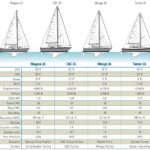
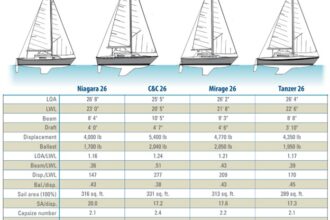
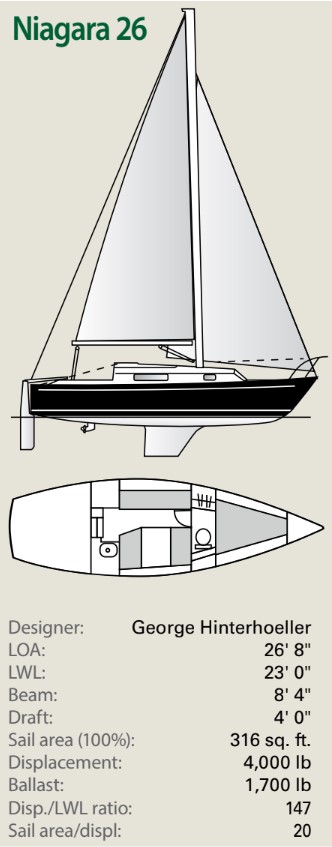
The Niagara 26 was not designed to any particular rating rule. Rather, Hinterhoeller envisioned a light-displacement hull with a shallow canoe body capable of surfing in the right conditions. Its relatively flat run aft enables fast speeds off the wind. Compare its displacement/LWL (D/L) ratio and sail area/displacement (SA/D) ratio with those of the immensely popular J/24 club racer and you quickly appreciate the Niagara’s performance. The Niagara has a slightly lower D/L ratio of 147 versus the J/24’s 173, and its SA/D ratio is a tad higher, at 20 versus 19.7.
Neither boat is considered to be particularly beamy, so both rely heavily on ballast for stability. Both draw 4 feet. While the Niagara has a respectable ballast/displacement ratio of 43 percent, the J/24’s is just 30 percent, which helps account for its sensitivity to capsize and its stability when inverted.
Original literature for the Niagara 26 touts its 7/8 rig as being as “fast” as a masthead rig, but easier to manage, as smaller headsails require less energy to trim. Swept-back spreaders give Cagair an attractive look of being in motion even while standing still.
Construction
There is little doubt there are differences in construction between boats from the three different builders, but the hull, keel shape, and rig remain the same. The hull of the Niagara 26 is solid hand-laid fiberglass and the hull-to-deck joint is a through-bolted overlap topped for some of its length with a flat track for movable sheet leads.
The deck has a balsa core. Over the last 20 years, Brian has had to make repairs a couple of times where water intrusion around deck hardware had delaminated the deck, causing soft spots around the mast step and the handrails. Brian cut off the outer fiberglass skin, removed the bad core material, replaced it with new balsa wood, saturated that with epoxy resin, then popped the deck skin he’d cut out back in place. That meant he had to repaint the deck, which gave him the opportunity to apply KiwiGrip non-skid deck coating. It not only looks great, but is a hit with the crew compared to the worn-out original non-skid.
The stainless-steel chainplates are through-bolted to knees glassed into the deck and the hull about a foot aft of the main bulkhead.
The main bulkhead, backed up by a 2 x 4-inch hardwood compression post, supports the deck-stepped mast. Brian has repaired and replaced this area because the base of the compression post, which is in the bilge, rotted over time due to moisture intrusion.
The external lead keel is fastened with stainless-steel bolts to a well-reinforced shallow sump molded into the hull.
On deck
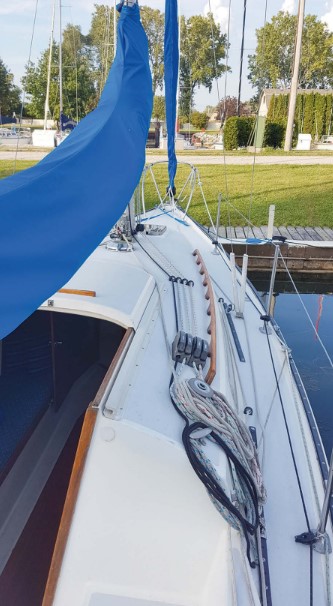
Bulwarks taper from a height of about 2 inches at the bow to flat where tracks are fitted for movable sheet leads. Brian uses this for spinnaker sheets and to open the slot between the main and the 155 percent furling genoa when heavy-air reaching.
The high, wide cabin trunk creates a great sense of space down below, but the trade-off is narrow sidedecks further obstructed by inboard jibsheet tracks and cars.
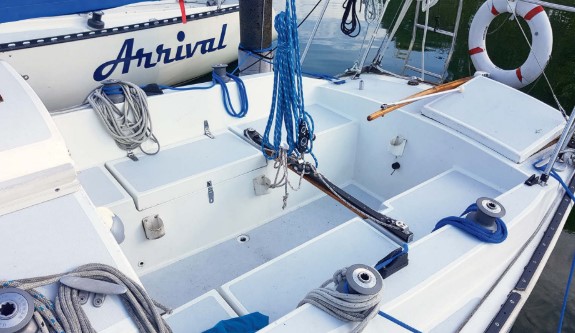
The cockpit is spacious for a 26-foot boat. It’s divided by the boom-end mainsheet and its traveler, which allows some separation of the helmsman from the crew but makes singlehanding more difficult. Brian overcomes this by steering with a tiller extension.
On some Niagara 26s, the space beneath the cockpit is occupied by an inboard engine with a sail drive. The majority of boats, though, were set up for outboard power.
Aft is a “poop deck,” under which is a large lazarette with a cutout in the transom for the outboard motor. On Cagair, that motor is a new 4-stroke Mercury 9.8. It pushes the boat well and does not require a long reach back to operate the controls. Even the large 9.8 motor has plenty of clearance to completely swing up out of the water when sailing. The lazarette houses the gas tank with room to spare for other deck gear.
The transom-hung rudder is semi-balanced. Several owners say they have had gudgeons and pintles fail. The solution has been to replace the gudgeons and pintles with larger ones and, in some cases, to beef up the attachment points on the transom.
Accommodations
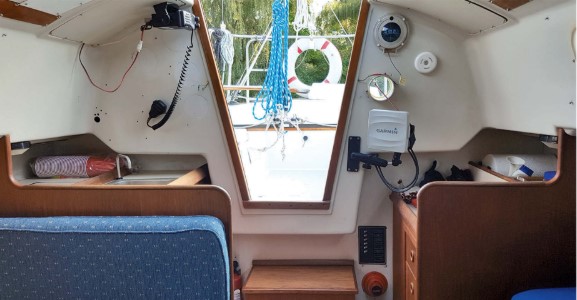
Easy entry to the interior is provided by the large companionway with its low sill, and the opening lets plenty of light and air into the cabin.
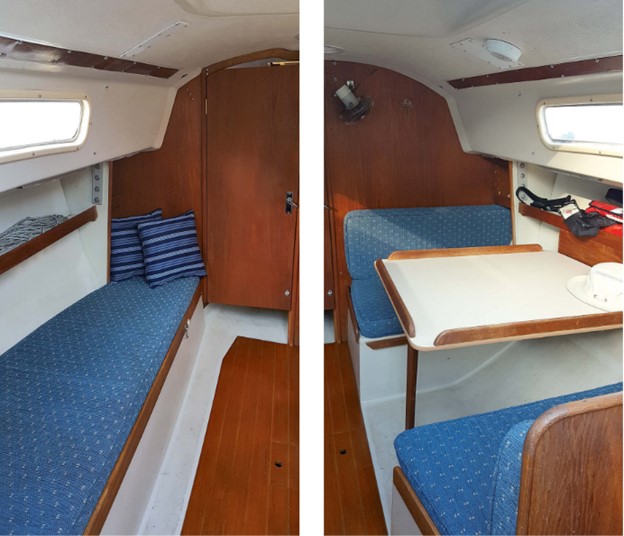
The interior of the Niagara is simple and straightforward, a blend of clean white fiberglass surfaces accented with enough teak to make the cabin feel traditional without being dark. A fiberglass floor pan forms the cabin sole as well as bases for the settees and other furniture. The bilge, which is deep enough to accommodate a good automatic bilge pump, is covered with a teak-and-holly board. Bulkheads are marine-grade plywood covered with an attractive teak veneer.
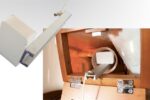
A liner creates a clean and attractive overhead, and the manufacturer thoughtfully provided panels that can be removed to give access to deck hardware and wiring.
A handsome teak storage box forms the sole step in the companionway. Although the Niagara 26 does not have standing headroom (it tapers from about 5 feet 7 inches to 5 feet 2 inches), moving forward and aft is reasonably easy. However, a stay on board longer than a weekend could become tough on the back.
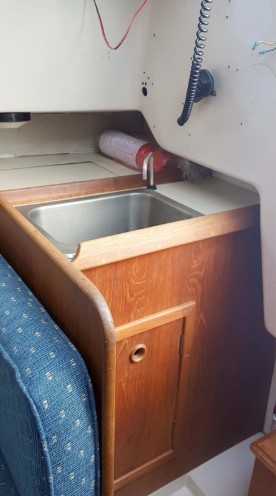
The galley is split either side of the companionway, a design that allows good ventilation via the companionway for cooking and also allows the cook to stand up when the companionway hatch is open — weather permitting. On the port side, there is a small counter with an alcohol stove and, beneath it, a handy set of small teak drawers.
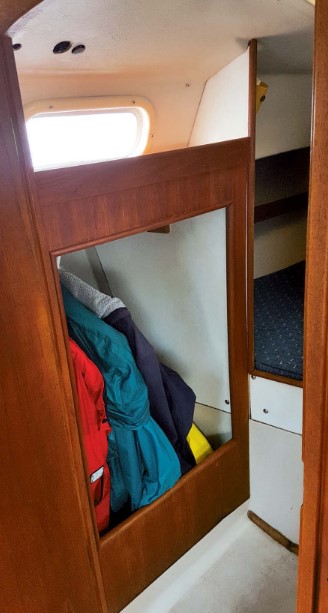
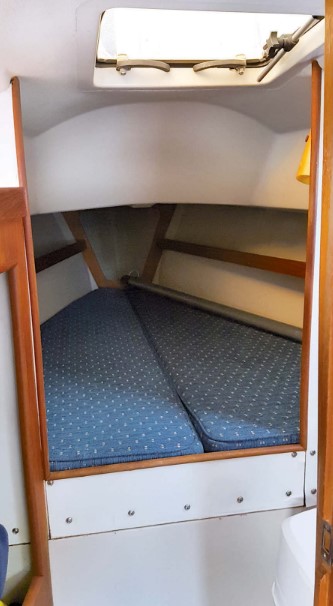
The forward cabin on Cagair has a plumbed portable toilet, which replaced the marine head and holding tank from the factory, and a hanging locker. A teak door on the main bulkhead allows for some privacy in the head as well as separating the V-berth from the main cabin. A clear hatch provides ventilation and light.
Several early models were delivered with twin port/starboard settees in the main cabin and a fold-down bulkhead-mounted table.
Under way
Our test sail was on a beautiful early fall day on the Detroit River in a light breeze of about 5 to 10 knots. I thought these conditions would be perfect for the Niagara 26 to confirm its reputation as a light-air performer.
Brian pulled Cagair’s outboard to life and we headed out of the club’s north basin, wasting no time hoisting the mainsail. Clearing the edge of the channel, we bore off to a reach down the river. We quickly rolled out the genoa and Cagair sprang to life. The boat moves easily and is very responsive to the tiller. Even in this relatively light wind, Cagair was both nimble and surprisingly fast. She struck me as very responsive, and she truly does move very well in light air.
We were only two on the boat, and we ran her through her paces on nearly every point of sail. The cockpit lent itself to easy boathandling. At 68, Brian both shorthands and solo sails and races the boat with relative ease. By adding roller furling and running all the control lines to the cockpit, he has ensured he will be sailing and racing Cagair for years to come. In gusts, the boat accelerated quickly, and her GPS noted speed over the ground of up to 6 knots even in the light air of the afternoon.
While the Niagara 26 is well-known as a light-air performer, Brian says Cagair holds her own very nicely in a blow as well, when properly reefed. Brian has a single-line reefing system on the mainsail. The Niagara does have a large mainsail, so when the wind pipes up, Brian starts by reefing the main and then shortens the headsail as necessary.
Perhaps most important, the Niagara 26 is a joy to sail. The boat is balanced, it moves well, and it is also forgiving and relatively easy to get moving well.
Conclusions
Many Niagara 26s are actively raced in beer-can club racing, with a concentration of boats in the Great Lakes region, where they were built. The boat is a manageable size for shorthanded sailing but the cockpit is large enough for entertaining four or more guests when sailing. The interior is simple and well thought out, with just enough room for light cruising.
A survey of the market revealed several Niagara 26s for sale at prices ranging from $6,800 to $13,500 for a particularly well-restored example. That the build quality is high on these boats is evident from how well most of them have held up through 40 or more years of sailing and racing. What is also evident is that the boats for sale appear to be well loved and cared for.
Robb Lovell grew up sailing on Lake Huron aboard his family’s Endeavor 40, where he caught the sailing bug. That was about 20 boats ago. Robb enjoys buying and restoring boats and is an avid racer and cruiser based out of LaSalle Mariners Yacht Club in Ontario. He currently races on a Cal 9.2 named Jade, but owns three other sailboats and a tugboat . . . yes, he has a problem!
Thank you to Sailrite Enterprises, Inc., for providing free access to back issues of Good Old Boat through intellectual property rights. Sailrite.com