Rebuilding an Atomic 4 on a mooring far from home
Issue 127: July/Aug 2019
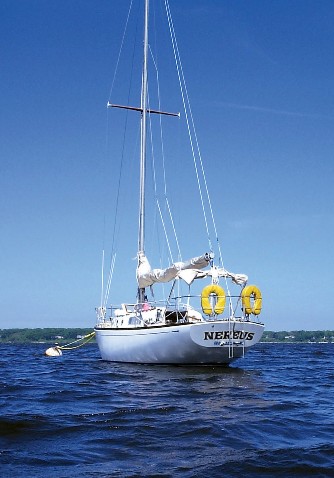
Although I lived in Michigan, I bought my 1967 Morgan 34 with a trip south in mind. I thought she would be a good boat for the shallow waters of Florida and the Bahamas, as she drew only 3 feet 4 inches with the centerboard raised and, weighing a respectable 13,000 pounds, was stable enough to cope with modest saltwater crossings.
Her name then was Nereus. That seemed a good name to me in 2004, when I was 52, and she is still Nereus. She was essentially factory; she had the original Atomic 4 engine and there were no signs anyone had tinkered with her, not even to install roller furling or wheel steering. Neither had she received much TLC. Her previous owner had painted over her deteriorating teak appointments with, I swear, house paint. “It’s what I call a good 100-foot paint job,” he told me. More like 100 yards, I thought.
The Bahamas were a long time coming.
I finally left the Great Lakes in the spring of 2014, via the Saint Lawrence Seaway. I bounced down the East Coast to mid-Florida, then took the Okeechobee Waterway to Fort Myers Beach, where I prepared for a simple day/night jaunt to the Dry Tortugas.
I took off across the Gulf of Mexico in the late afternoon with a good weather window, planning to arrive at the Dry Tortugas around noon the next day. As the shoreline disappeared, the daylight faded, and so did the wind. I cranked up the engine and puttered off into the night, mindful that crab pots were everywhere. But with Nereus’ centerboard retracted, her full keel would present nothing to hook a crab-pot line, or so I thought.
Deep into the night, I heard a noise coming from under the cockpit. It began as a light pounding, almost like the engine timing was off, then became a resounding thunk-thunk-thunk followed by a wackaty-wakaty-wakaty. After a loud punctuating bam, I shut off the ignition, then tentatively tried to restart the engine. It was seized. I sat in silence.
Continuing to the Dry Tortugas made no sense. The National Monument offers few resources, not even fresh water. There was still no wind and Nereus rolled uncomfortably in the swell. I lashed the inflatable dinghy to the side and started the 5-horsepower outboard. We headed back to Fort Myers at a blazing one and a half knots, and I eventually pushed the boat back to the mooring sometime after a long night and day.
The engine
Going through some of my old scribblings recently, I ran across a note to myself that read, “Someday I wouldn’t mind the opportunity to dig into the workings of this old engine.” I’m certain I had not imagined that opportunity arising when I was bobbing on a mooring a thousand miles from home. Be careful what you wish for.
My first analysis of the problem revealed no probable cause for the seizure. The engine’s temperature had never spiked, the oil-pressure warning alarm never sounded, and the oil level was OK. Strangely, after jostling the flywheel, I could sometimes get the engine to crank and even start and run for a bit. Then it would seize again.
A principal resource A4 owners have in keeping their old engines running is Moyer Marine, which maintains a comprehensive parts supply and hosts an active community of dedicated A4 owners on its website. Despite spotty internet access in the harbor, I was able to post my problem to the community, prompting lively speculation around my A4’s distress but no consensus as to a possible cause. I now had no choice but to fulfill that wish I’d expressed all those years ago.
I pulled the head and placed it on the spare pilot berth. Nothing was out of place. Rats. The next step would entail removing the engine from under the cockpit. A tow to a proper marine repair facility was beyond the means of this low-budget venture; the gauntlet had been thrown. I was going to rebuild or replace the engine myself while Nereus was afloat in Matanzas Harbor.
By moving the mainsheet and blocks halfway along the boom and doubling up the topping lift for strength, I was able to raise the 300-pound engine through the companionway to the level of the spare pilot berth where, after getting a little swinging action on it, I was able to drop it. In that cramped and not-quite-pristine operating theater, I began the next surgical procedure. The engine, cheaply built by 1940s standards, was like an iron bomb. The cast-iron oil pan alone is hard to manhandle, and a glancing blow from it cost me a big toenail.
Diagnosis and restoration
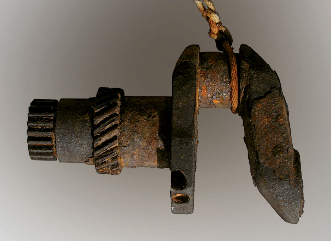
Looking into the crankcase, expecting to see a jumble of broken stuff, I saw nothing, even after I’d cleaned out the accumulated gook. I stared at it a long, long time, thinking, “Oh, no, the problem is in the transmission” before finally spotting the culprit. The crankshaft had broken neatly between the first and second cylinders. When jostled around, sometimes the crankshaft ends must have realigned and, held by the bearings, allowed the engine to turn and start. But its heart was broken. At a minimum, it would need a new crankshaft.
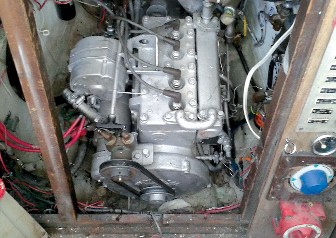
Moyer Marine supplied a rebuilt crankshaft and all the necessary gaskets, rings, and bearings for a complete rebuild, together with a comprehensive guide to the process. I had not done engine work since working on my Honda 125 in the 1970s, but the Moyer folks have done rebuilds for decades and their patient advice was instrumental. I took my pistons and connecting rods on a bus to a remote Fort Myers neighborhood that had an ancient machine shop, where the equally ancient machinist remembered working on Atomic 4s “in the day.” He gauged the straightness of the rods and roundness of the pistons, revealing no issues there, and also pressed in the new piston-rod bearings. I had to order some tools from Amazon, like the piston ring compressor and micrometer, but by following the instructions and advice from Moyer Marine over the phone (from Ken, specifically), I was able to successfully reassemble the engine. That no other engine part was affected in this disaster is testimony to the ruggedness of the A4 beast.
Reversing the extraction procedure, I placed the engine back on the stringers. Not without trepidation, I cranked it up for the first time. I followed a break-in procedure supplied by Moyer and the engine passed all the tests!
So, about a month after my first attempt, I left the harbor for version 2.0 of my voyage to the Dry Tortugas, and arrived there just days before Christmas. I went on to complete the trip to the Bahamas and then back home to Lake Michigan. To date, I’ve put about 600 hours on the engine and it purrs as it should — like a Singer sewing machine. Do I have to say that I’m planning another venture?
Why did the crankshaft break?
The Moyer parts guy told me he had seen fewer than 10 crankshaft failures in his decades in the business. As to the cause: Had I been revving the engine out? No. Did it run low on oil? No. Did it overheat? No. Had an oil passage clogged? No. That I knew because when I showed the main bearings to the Fort Myers machinist, he said they had not burnt out, that the damage to them was due to the crankshaft failure, not the other way around.
But what was the noise? There were no broken parts rattling around in the crankcase, and the couple of times it started immediately after it first seized did not produce the same cacophony, in forward or reverse.
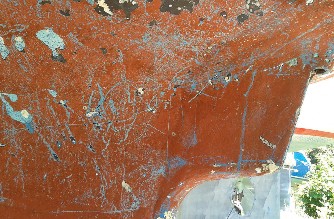
This remains speculation, but when I had Nereus hauled after we were back in Muskegon, Michigan, a clue was revealed. Above the prop, where the keel meets the hull, there were deep grooves in the fiberglass both port and starboard. This is not an area that would be involved in a grounding, or even a collision. Had I wrapped something around the shaft that subsequently unwound or fell off?
One of the virtues of a full keel that I was keenly aware of is its relative immunity to that bane of boaters, crab and lobster pot lines and buoys. My trial by fire was a night arrival in Bar Harbor, Maine, during lobster season. Although they are supposed to leave a passage for boats, lobster fishermen simply do not. That night, without incident, I bumped through dozens if not hundreds of pot buoys.
In the Gulf, there was an evil twist to this minefield of floats. Each pot had two floats connected to each other by 3 to 4 feet of line, and I think my boat ran across one of these getups. One on each side of the keel, unable to float up and away from the prop, the twin floats were sucked into the prop and spun around in a merry tangle that beat them and their hardware against the hull and finally, suddenly, locked the prop. Subsequently, did the buoys drop off when the line was cut by the prop or unwound in the couple of times the engine restarted? It is well documented that such a jolt has snapped driveshafts. Of course, 50 years of use could cause metal fatigue. I don’t have a conclusive conclusion. I do have half of a crankshaft that makes a nice catenary weight on my anchor rode.
None of this has shaken my confidence in the ole girl, but if she breaks again in another 50 years, when I’m 115 . . . I’ll fix her.
A4 Lore
Quite often, when I pull up next to the gas pump on a fuel dock in Nereus, with her 1967 Atomic 4, the attendant will ask, “Are you sure you want to put gas into a sailboat?” Gas attendants are a captive audience to a solo sailor, and 15 gallons gives me time to tell my Atomic 4 story I’ve cobbled together from bits and pieces of lore I’ve read over the years.
It starts with the buildup to D-Day, when the US government asked for bids for a 20- to 30-horse- power engine that would power 1,000 landing craft once. (Well, if it worked, we wouldn’t need to invade again, and if it failed, it was unlikely that Hitler would return the craft). The Universal Motor Company delivered a four-cylinder engine with, among other cost-cutting measures, no center crankshaft bearing. After the war, thousands of these “frail” engines were available as war surplus, and became very popular with sailors, who up to this time had not used auxiliary engines very widely. Thought good enough for going in and out of harbor, they turned out to be good enough to power boats for miles and miles and years and years.
When the supply of surplus engines expired, demand was great enough for the Universal Motor Company to begin producing them again. The production run ran through 1984, and an estimated 20,000 engines remain in use today, most of them in good old boats.
Resources
Moyer Marine moyermarine.com
Bob’s conversation is on the Moyer Marine forum: moyermarineforum.com
Search “titles only” with “mostly siezed” (yes, it’s misspelled).
Bob Baker is semi-retired with an accounting background and an interest in hiking and sailing. He got his first sailboat, a 24-foot Hunter, in 1994 and currently sails his Morgan 34, Nereus, which he’s owned since 2004. He’s sailed the Great Lakes in her and recently returned from a round trip to the Bahamas, via the Trent Severn, the Saint Lawrence Seaway, and the Okeechobee Waterway on the way down and the Erie Canal on the return.
Thank you to Sailrite Enterprises, Inc., for providing free access to back issues of Good Old Boat through intellectual property rights. Sailrite.com