Indulging that strong urge to stamp it with your own character
Issue 61: July/Aug 2008
Just after high school, I bought a good old car. The first thing I did was to wrap the sun visors and glove box door in fake ocelot skin. That made it my car — not my dad’s car — not just any 1947 Studebaker. It’s the same thing with good old boats.
I once, only once, bought a new boat: a 1975 Ericson 27. The problem with going out and buying a new boat, money matters aside, is that like a new car, it’s hard to wrestle the thing completely away from the manufacturer … or the bank. As new owners, we’re afraid to make any marks on it for fear of making it seem, well, used. But for some of us, there is a compelling and sometimes irrational need to possess a boat, to make it our own.
Naming a boat is a step in the right direction. It felt good to see the name I’d assigned my glossy new Ericson — Otter — proudly painted on that lovely transom in big bold letters, but it did little to make the boat feel truly like mine.
Case of the jitters
Popular taste for the new and shiny is right up there with the big and expensive. The thought of adding anything too personal could bring on a case of the jitters. I was intimidated by the pristine gelcoat that seemed to defy the attachment of anything more intimate than registration numbers. Polished teak veneer bulkheads dared me to drill holes to mount a clock and barometer. God forbid, what if I got the holes in the wrong place? Completely cowed, I left my battered old Navy surplus nav box in the garage.
Everything I added to the boat had to be off-the-shelf and brand-new: a depth sounder, VHF, and a few cockpit cushions. I indulged in a fine Dutch brass anchor light, but it didn’t seem entirely happy within the welter of stainless steel.
I strapped a crab trap to the shrouds and carried fishing poles on deck but, try as I might, I couldn’t get my new boat to feel as if it were mine, really mine, that nautical equivalent of a house that feels like home. In spite of my best efforts, it was beginning to look like everyone else’s clean and well-equipped boat, loaded like a lot of other Ericson 27s. Just after the second summer, I became overwhelmed by monthly payments and sold it.
In my view, buying a good old boat goes a long way toward owning a boat that is truly one’s own. It’s probably got leaks and a few nicks here and there. Previous owners may have left a trail of small holes: phantom reminders of once carefully placed, replaced, and finally rejected toothbrush holders, clocks, and fire extinguishers. The gelcoat may have sprouted a little crazing and gone flat in places. (Incidentally, I’ve found that a good exterior, water-based, semigloss paint matches the 30-year-old gelcoat on my boat almost perfectly. It’s easy to work with and holds up well.)
Involvement counts
Half the pleasure of sailing an old boat comes from gradually getting to know it and setting it right, one small project after another. This takes time. It doesn’t matter whether it’s filling holes, scraping blisters, changing zincs, cleaning out the strum box, or replacing duff instruments or worn-out upholstery. It’s the involvement that counts, that and realizing your old boat is getting to be a good old boat of your own.
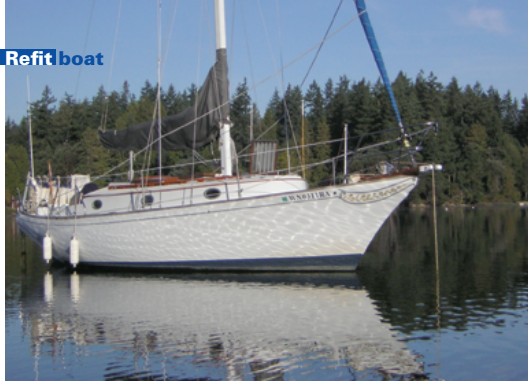
My present boat is another Ericson, a 1977 Cruising 31 that I’ve had for 10 years. When I first saw this boat it was a real mess. It had the essential features I felt I wanted but it had been badly treated by a succession of own-
ers. It took X-ray vision to see through to the good old boat beneath the surface of confused, misplaced, and ill-conceived add-ons, not to mention star-crossed ideas that hadn’t quite worked out.
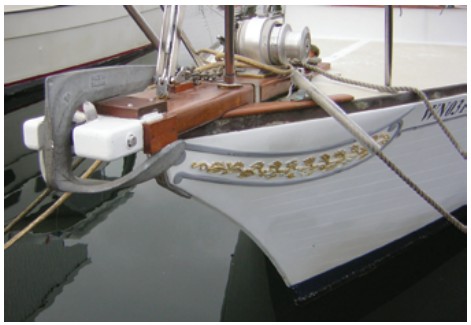
To my eye, the Cruising 31 is a good-looking boat, especially in the cutter version that sports a long and serious-looking bowsprit. But Kuma is the sloop version. She has the same graceful clipper bow, but without the sprit she seems a bit dressed up with no place to go, like a fine Irish setter without the long, fringed tail. Rightly or wrongly, I decided that I could improve her appearance and make the foredeck a bit handier by adding an anchor sprit and bow roller.
Building a mock-up
This was a big modification and I gave it a lot of thought. I made several drawings and built a mock-up to get the chain lead and other matters right. Stainless-steel straps hold the 3-inch iroko laminations to the deck and are bolted through a large 1-inch plywood blocking plate below. A windlass rides on top of the sprit and is also bolted through the backing plate. The anchor sprit continues the line of the sheer and stops at a point just below the upper pulpit rail, helping to unify the sprit and the rest of the boat. The whole affair is robust and works well.
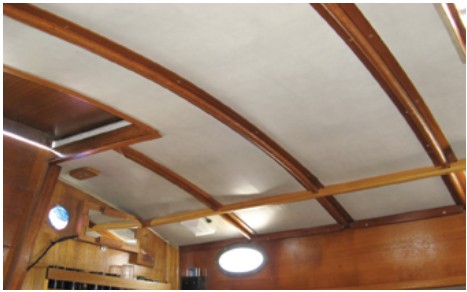
There have been many such projects, most of them far less complicated and irrevocable than the anchor sprit. It was a pain removing the vinyl headliner to get at the bolts that secured the cabintop grabrails so they could be re-bedded. I decided to fit removable wood trim pieces between the beams. These covered the slits in the fabric that were made in order to get at the bolts. While I was at it, I removed the crummy little plastic strips that hid the rusting staples alongside the beams. It was a few days well-spent, and the additional wood goes well with the snug cabin.
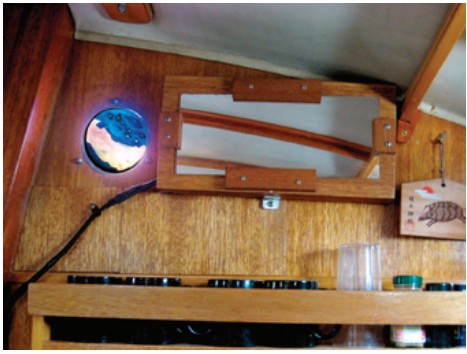
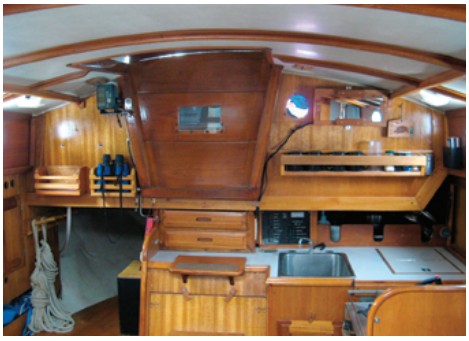
Along with the familiar array of essentials situated about the galley/companionway area, I’ve installed a piece of stained glass made by an old friend. It fits into a hole left over from a long-forgotten instrument. To me and my mate, Beth, it seems a good and lighthearted companion to the GPS, binoculars, flashlight, and such — a very small thing, but important in making the boat special.
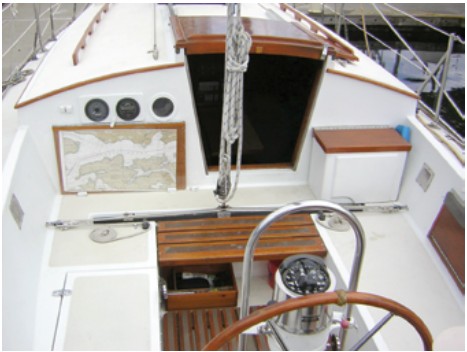
I’ve built a bridge deck of sorts abaft the companionway where it serves as a platform for chartwork. We place the wooden tray of nav gear (tide tables, log book, pencils) beneath it, where the instruments are out of the way but handy. The improvised nav station suits our particular use of the cockpit well (see Good Old Boat, May 2007).
The wooden cockpit sole (see Good Old Boat, September 2007) adds a certain individuality and warmth to the plastic cockpit and contributes to the traditional look of the little sloop. We don’t mind the marks of dropped winch handles on our homemade softwood floorboards; along with the stained-glass portlight, they’ve become part of the personal history of our boat.
Marking your boat
Making a boat your own is to let those peculiar habits and attitudes you’ve acquired over the years mark your boat, even if they alter the original design and seem to go against the tide of popular opinion. For instance, I confess to a basic mistrust and general avoidance of what I take to be less-than-essential electronic accessories. Not surprisingly, that attitude affects the character of my boat. If I don’t understand or cannot fix something that’s broken, I prefer a simpler arrangement, whenever possible.
We’ve taken out the rusting water heater from the engine compartment and replaced the pressurized freshwater system with a foot pump. The engine’s easier to get at, and we use less water.
When our propane solenoid valve failed, I moved the gas-bottle box from the foot of the mast to the cockpit seat just abaft the main bulkhead. The gas lines are shorter and there is a greater fall for the overboard gas hose. We can also reach through the hatch and turn off the gas directly at the bottle. It’s possible to get our arms wet in the rain, but when the knob is turned off, we know we’ve stopped the gas at the bottle and that feels good.
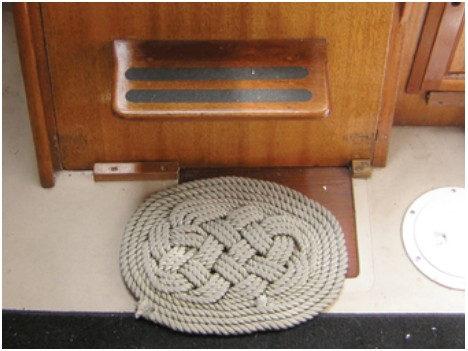
Beth and I made a small rope mat one winter when we were recovering from the flu. It’s the welcome mat when we’re in port, and we keep it under the companionway ladder when we cruise, where it contributes to a “shippy” feeling down below.
There are six berths on the Cruising 31, but I seldom cruise with more than two shipmates. Our house on land, on the other hand, sleeps two comfortably and has additional accommodation for one or two others. (It should be added that the house is 5 feet shorter than the Ericson’s overall length though, admittedly, it has a wider “beam.”)
Improved access
With this in mind, I’ve taken out the 5-inch-thick quarter-berth cushion to improve engine access. A simple thing, but the gymnastics required to check fluid levels, make crankcase and gearbox oil changes, and tighten the stuffing box are easier to do in the now enlarged scrunching-down space. I can get at the cockpit drain seacocks back up against the transom more readily, and we can slide in crates of additional cruising gear along with bulbous fenders and dinghy oars.
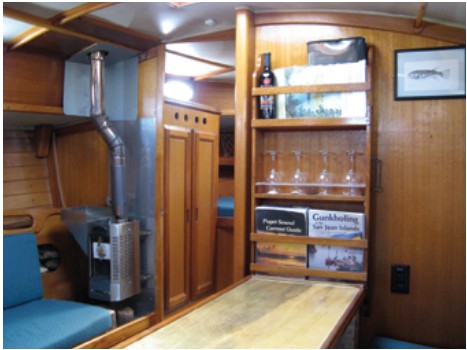
Considering that we can still accommodate more overnight guests in our boat than in our house, I’ve cut 18 inches off the end of one of the saloon cushions. That makes it a sort of inglenook next to the wood stove, which is now placed down at sitting level where it has a proper, albeit stainless-steel, hearth. The berth is useless as a bed for anyone other than a small child, but it’s a cozy place to read with feet up, nudging the warm Dickinson on cold mornings and nodding off on fog-bound days at anchor.
When we change the workings and appearance of a small boat, when we build something of ourselves into it, we help shape its character. That character, in turn, shapes us, making us feel at one with our boat — making us feel that we a sail a boat of our own.
Richard Smith is a contributing editor with Good Old Boat. He has owned and built several boats, including an Atkin Red Onion sloop, a 30-foot Alan Pape steel cutter outfitted from a bare hull, an Atalanta 26, five dinghies, and an Ericson Cruising 31.
Thank you to Sailrite Enterprises, Inc., for providing free access to back issues of Good Old Boat through intellectual property rights. Sailrite.com