Stirring paint without the Pollock effect
Issue 113: March/April 2017
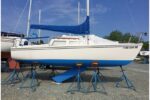
Our Creekmore 34, Eurisko, always looks sharp with her new black bottom paint, but we don’t wear it nearly as well. Bottom paint is tenacious and toxic and we prefer not to get it splattered on ourselves and everything we own. But it’s also thick, and contains suspended solids that must be mixed well into the paint before it’s used. For those of us working in a boatyard without access to a paint-can shaker, mixing paint can be messy, but we have overcome the problem.
We need more than a gallon of paint to coat Eurisko’s bottom, so we always buy two cans. This allows us to use one lid for our mess-free mixing technique. The other lid remains intact, and we use it to seal the can containing the leftover paint we will later use on the places we can’t reach while the boat is sitting on the jack stands and the keel blocks.
After removing the lid from the first can, we punch a hole in the center large enough to accept the shaft of a paint stirrer designed for use with drills (photo 1). We carry few bottom-painting tools on board, but we have held on to a drill-driven paint mixer for many years. It has proven its worth repeatedly.
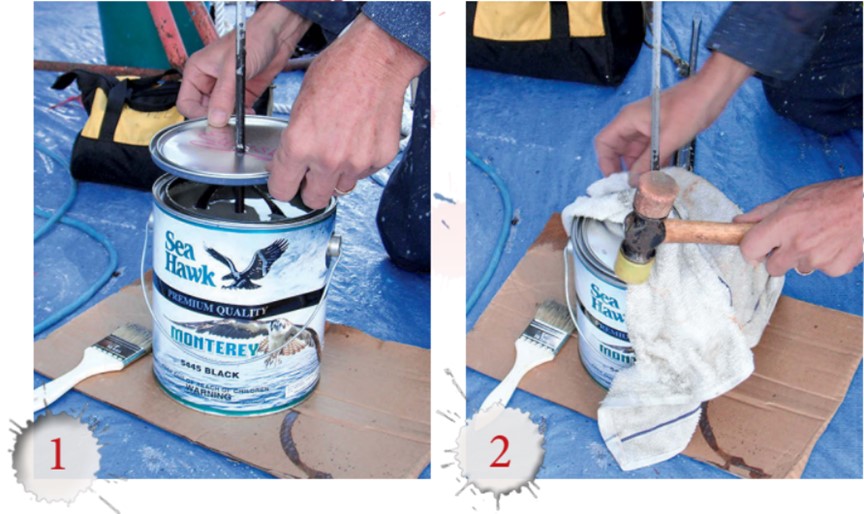
With the stirrer in place, we put the lid back on the paint can and secure it well (photo 2). Next, we attach a drill to the stirrer (photo 3). We’ve found it essential to use a powerful drill; in paint that has been in storage any length of time, the solids at the bottom of the can become very thick, and a low-power drill can be destroyed trying to mix it.
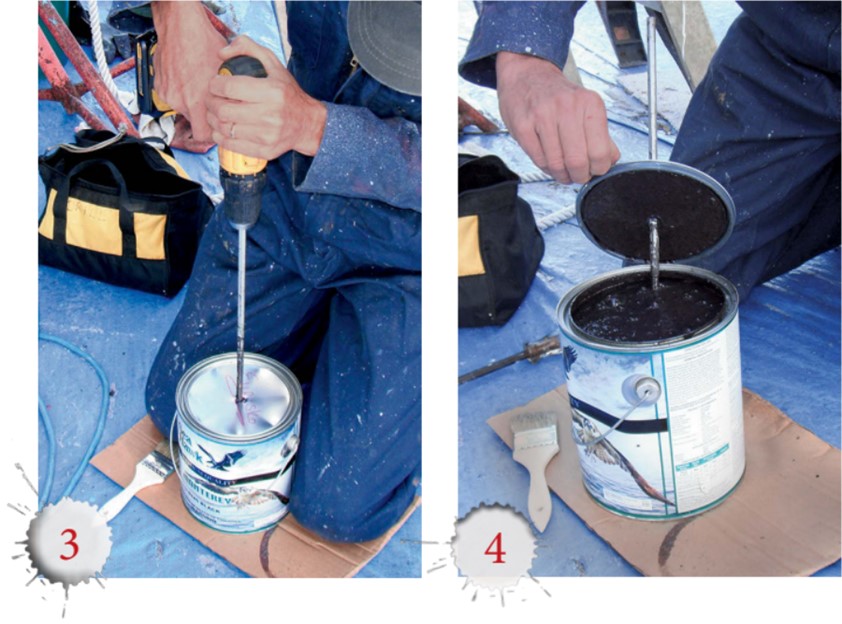
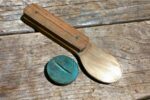
We start on low speed and mix the paint slowly, beginning near the top and working our way to the bottom of the can. Several times during this process we remove the lid and stirrer and scrape the bottom edges of the can with a stir stick (photo 4). The shape of the stirrer does not allow it to reach into the corners.
We repeat the drill/scrape/drill process until solids are no longer visible. At this point, we run the drill at a higher speed for a few minutes. This moves the paint much more quickly and can fling paint out the hole in the lid. We keep a rag nearby in case we need to cover the hole.
After applying the first gallon of paint, we remove the lid from the second gallon and set it aside. We then mix the second can using the mixer and the punctured lid. When we’re done painting, we seal the can with the intact lid to await launch day, when we will use the remaining paint. Now we can enjoy how good Eurisko looks with her new black coat without having to wear one ourselves.
The one-can solution — Jerry Powlas
A slight variation of this technique is to use a sheet of thin plywood, (3/16- or 1/4-inch) and drill a hole in it that is a close slip fit for your paint mixer. While stirring the paint, just apply downward force on the plywood so the paint does not fly out. It helps to hold a piece of paper towel around the shaft where it enters the plywood. This allows you to raise and lower the mixer and move it around the inside of the can without having paint leak out around the hole. If you’re wearing rubber gloves (recommended) don’t let them touch the spinning shaft (not recommended).
At the end of the mixing, pull the mixer up into the airspace above the paint (if there is one). Run the drill a few seconds to sling the paint off the mixer. Then lift the mixer and plywood from the can, put them into a paper shopping bag, and spin the mixer some more to further clean it. Finally, wipe the mixer with more toweling and clean it with solvent (or with water if you’re using a water-based paint).
This variation allows you to reuse the paint can lid.
Connie McBride, her husband, Dave, and their three boys set off in 2002 to begin their lives of adventure on board their 34-foot Creekmore, Eurisko. After nearly a decade in the Caribbean, including a year in Panama, they returned to the U.S. for a while. Now empty-nesters, Connie and Dave are in the middle of a slow meander back to the Caribbean. Follow their adventures, tips, and DIY projects on Connie’s website: www.simplysailingonline.com.
Thank you to Sailrite Enterprises, Inc., for providing free access to back issues of Good Old Boat through intellectual property rights. Sailrite.com