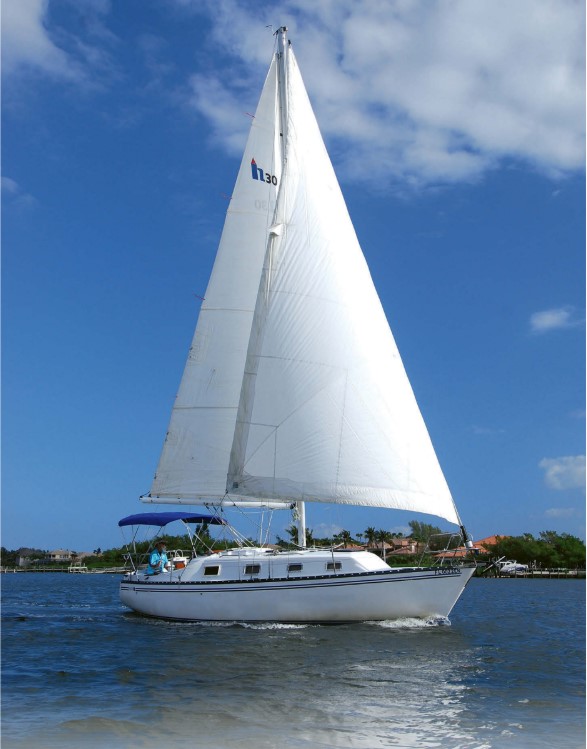
A good example of an early conservation Hunter
Issue 114: May/June 2017
Starting in the early 1960s, Florida became a hotbed of sailboat designers and builders, particularly in the Tampa Bay area. While the energy crisis of the 1970s helped spur sales of wind-driven boats, the rise in oil prices also drove up the cost of materials for all production boats. Quality issues that plagued some builders and a series of economic downturns resulted in most of the dozen or so builders closing their doors. Hunter Marine was one of the few that survived into the 21st century. To this day, Hunters are a common sight in many marinas, especially in Florida.
On early Hunter models, most systems and gear were fairly basic by today’s standards and most will need to be upgraded. But for a DIY sailor who doesn’t mind investing a little sweat equity, working on an older Hunter can be fun and rewarding . . . although at times frustrating.
Except for the frustrating part, this was exactly what longtime friends Nancy Knobbs and Steve Lambert had in mind when they bought Boundless, a 1981 Hunter 30. Nancy and Steve were co-workers when they discovered their mutual interest in sailing, and eventually agreed to split the cost of purchasing and maintaining a used sailboat. Boundless was perfect for them, a boat with good bones that they could learn how to fix and maintain while also enjoying local sailing on the east coast of Florida.
Nancy is no stranger to sailing. In the 1970s, her family sold their house and moved aboard Tanaquill, a 42-foot Abeking & Rasmussen double-ended ketch. They cruised down the East Coast and worked their way through the Caribbean to the Leeward Islands before heading west to the Panama Canal and the West Coast. Nancy is currently Commodore of the East Coast Sailing Association. Steve has enjoyed boating for many years on the local waterways while crewing on friends’ boats, often entertaining the crew by singing British sea chanteys. He wanted to get more involved in sailing and completed an American Sailing Association (ASA) certification class while on a charter vacation in the British Virgin Islands.
History
Hunter Marine was formed in 1972 by John and Warren Luhrs, who grew up building powerboats with their father in New Jersey. Warren was a sailor and realized that their building process could also be used to construct sailboats in a cost-efficient way. He raced in a small fleet with John Cherubini and commissioned him to do the design work for their sailboat line.
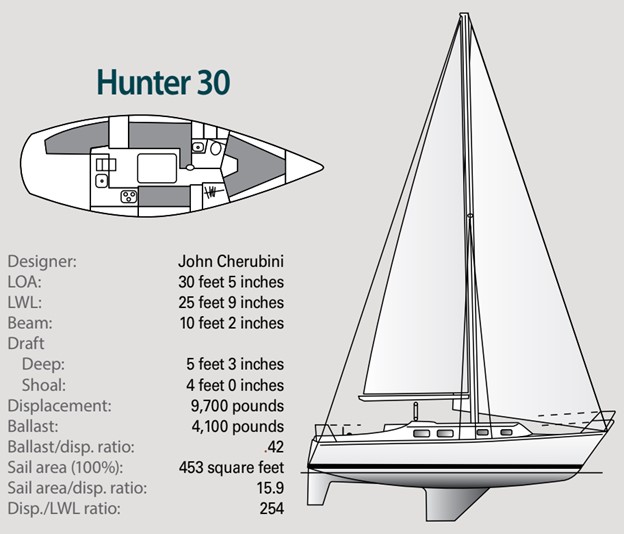
John Cherubini had studied naval architecture and, along with his brother, designed and built small runabouts in the 1950s and ’60s. His first design for Hunter Marine, in collaboration with Bob Seidelmann, was the Hunter 25. John’s next designs were the Hunter 30 (H30), in production from about 1973 to 1983 with more than1,000 built, and the Hunter 27. His son, John Jr., helped with the design, production, and office work. The Cherubinis went on to design the Hunter 33, 35, 36, 37, and 54. After John Sr. passed away in 1984, Hunter’s design work was handled by a different in-house team.
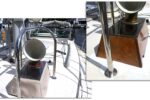
Hunter’s goal was to keep costs low by high-volume production, assembly-line processes, and making very few changes in a boat’s design. Hunter introduced innovations such as the arch over the cockpit for the mainsheet traveler and the B&R rig with swept-back spreaders and no backstay.
Peter Marlow bought Hunter Marine out of bankruptcy in 2012. He operates the company as Marlow-Hunter under a different business model that focuses on building boats in smaller numbers but of higher quality.
Construction
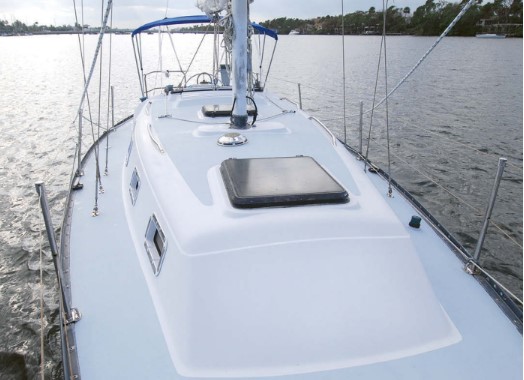
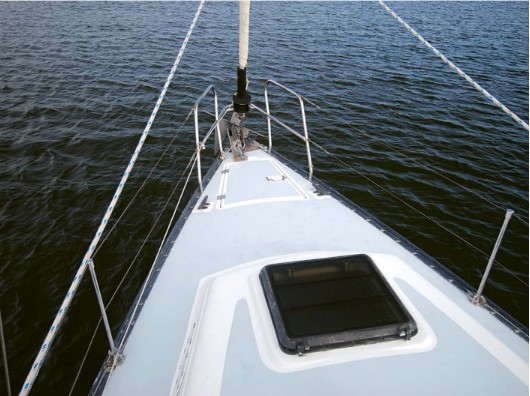
Construction of the H30 is fairly standard for production boats from the early ’80s. The hull is a solid fiberglass laminate, while the deck is cored with balsa except where plywood is substituted in high-stress areas around deck hardware. The hull-to-deck joint was made on an inward-turned flange on the hull to which the deck and an aluminum toerail were through-bolted. Non-skid was not molded into the fiberglass deck but was applied with a grit-filled paint. On older boats it will probably need refreshing.
Water intrusion around the deck mast step can lead to rot in the core. Another area of concern is in the bilge, where the aluminum compression post under the mast rests on a fabrication of 2-inch box-section steel tube glassed into the hull bottom. Owners have reported poor fiberglass work in this area and severe rusting of the tube.
The H30 was offered with a choice between a 4-foot-draft keel and a 5-foot 3-inch-draft keel. However, the listed displacement and ballast, which is lead, is the same for both versions, so the shoal-draft boat is likely more tender than the deep-draft version. On the shoal-draft model, the skeg is almost as deep as the keel, which increases the risk of rudder damage during a grounding.
Rig
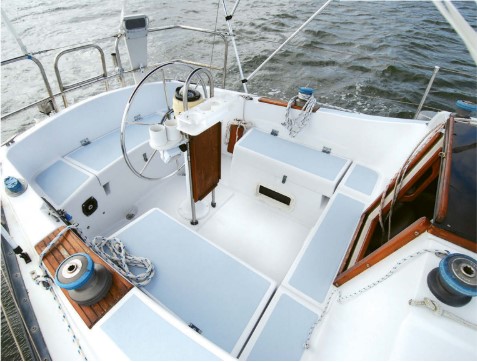
The H30 has a simple masthead rig with a deck-stepped aluminum mast and single spreaders. The backstay is split to provide headroom for the helmsman. A hanked-on headsail was standard equipment, but Boundless now has a 135 percent genoa on roller-furling for ease of handling. Main and jib halyards run inside the mast and are led back to line stoppers and two Barient #10 winches at the aft end of the coachroof. A short traveler manages the 197-square-foot mainsail. The jibsheets run through snatch blocks that attach to the aluminum toerail and then to Barient #22 winches on the cockpit coamings. While the snatch blocks allow plenty of fore-and-aft adjustment of the sheeting position, their distance outboard does not allow the tight sheeting angles needed for good pointing ability upwind.
Accommodations
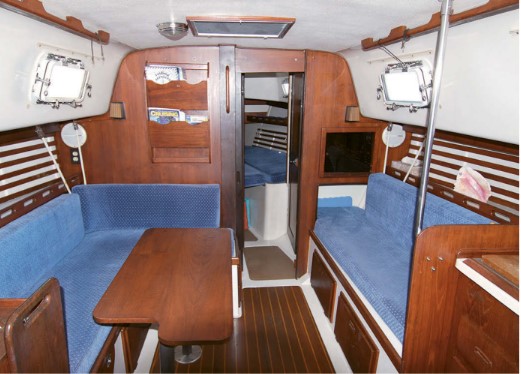
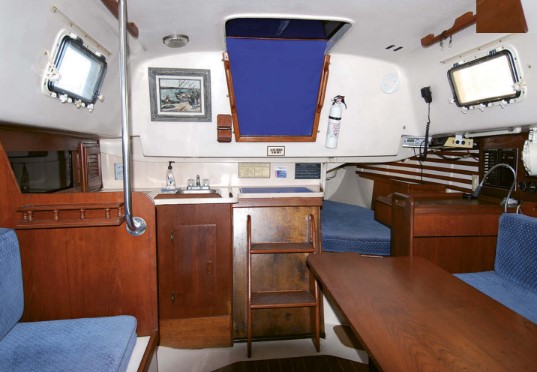
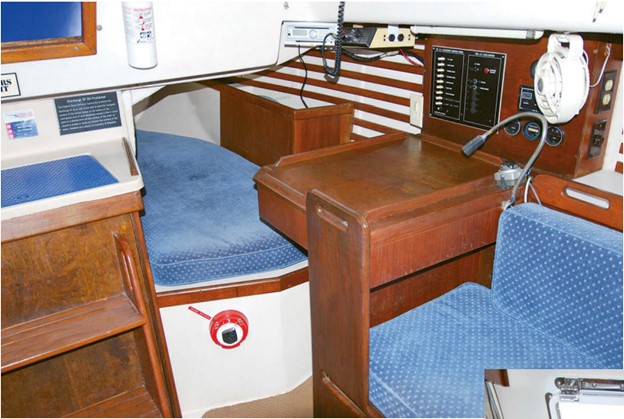
The sales brochure describes the H30 as “a very complete liveaboard-sized cruiser with every comfort and convenience.” This was a big selling point for the H30 — you got a lot of boat at a reasonable price. There is only so much room in a typical 30-foot sailboat, but the Cherubinis did a good job of packing in a lot of features down below, although some work better than others.
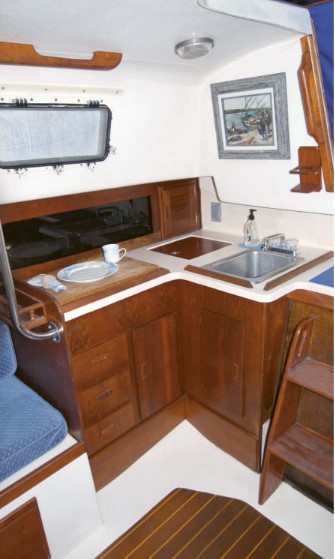
Both sinks, galley and head, are provided with pressurized hot and cold water. The freshwater tank holds 33 gallons and the water heater 5 gallons. The icebox and shower both drain directly into the bilge, which could lead to a stinky boat. Plumbing for the head includes a Y-valve for discharging overboard, where legal, or into a 5-gallon holding tank under the V-berth.
Engine
Through its production run, the H30 went through a progression of increasingly larger engines, starting with a 12-horsepower Yanmar and ending with the 18-horsepower model. Although the boat is not heavy, the larger engine helps when motoring into wind and chop. Boundless has a raw-water-cooled 13-horsepower 2GM; older raw-water-cooled engines that have lived in salt water can be subject to overheating as a result of deposits that build up in the coolant passages.
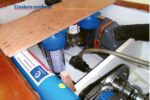
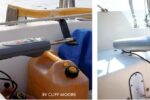
Access to the front and top of the engine is gained by removing the companionway ladder and a hatch in the galley counter. It’s tight on the sides, and working on the rear of the engine and stuffing box is a job for a contortionist. The 12-gallon fuel tank is located under the cockpit sole.
Some owners have replaced the two-blade propeller that came as standard equipment with a three-blade for more thrust. One owner states his H30 has “wicked” prop walk to port in reverse but others say it’s manageable. The propeller shaft is supported by an external strut. Due to the proximity of the rudder skeg, removing the shaft, should that ever become necessary, would require pulling out the engine.
Under way
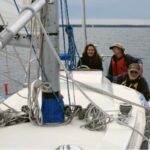
Our test sail was on the Banana River, just north of Dragon Point, in light winds that turned gusty, blowing up to the mid and upper teens. Winds on the east coast of central Florida generally are in the region of 10 to 15 knots, which suits this boat well, especially at the higher end of the range. As we left the dock, the prop walk to port was noticeable. With the running rigging led aft, raising the sails from the comfort of the cockpit was easy and we were soon under way.
The H30 is not a light-air performer, but Boundless picked up speed quickly when the wind ramped up. Although, with the shoal-draft keel, she tended to heel over in big puffs, I never felt that we were out of control.
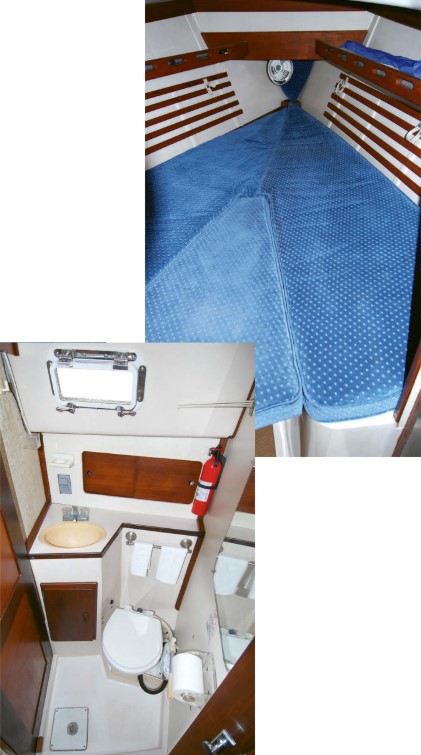
The head, lower left, has good elbow room and can be closed off from the main cabin and V-berth. It’s set up for a shower with a molded floor pan and a hose attachment to the sink faucet. A solar fan has been installed on Boundless to keep the air moving. A large hanging locker with a shelf on top is opposite the head.
When the wind pipes up above 15 knots, it’s time to start furling the headsail. Pushing too hard or not easing the sails in a gust creates weather helm and signals it’s time to adjust course or trim. Boundless comes about easily, neither losing too much speed nor falling off before settling in on the new tack. The helm feels responsive and balanced, and the boat will sail itself when the sails are properly trimmed. While the H30 is an older design, it actually performs very nicely and is pleasant to sail.
PHRF ratings for the H30 vary considerably; from 174 to 204 seconds per mile, depending on keel and rig (Hunter offered a tall-rig version). Most Catalina 30 fleets rate 180 to 192. The much racier J/30 is 144.
Conclusion
John Cherubini Jr. often called the early Hunter line “the Chevy station wagon of boats” and this pretty much describes the H30. It’s not a racer, but it sails reasonably well and, with some rigging upgrades, can hold its own against its peers for local beer can racing. It’s not a bluewater cruiser but is a comfortable boat on which to load up the family for a weeklong cruise. Nancy and Steve say Boundless has proven to be a safe and fun boat for taking friends and family on daysails. Judging from online activity, it remains popular, with several active member forums.
A web search will show H30s listed for sale on every coast and on inland lakes. Prices range from around $9,000 up to $12,000 but can run higher for a boat in excellent shape. Whether it’s in Bristol condition or in need of TLC, a Hunter 30 can still be thought of as “the affordable fantasy.”
Joe Cloidt is a sailor, writer, filmmaker, tinkerer, and electrical engineer by trade. His current boat is Desire, a 1988 Pearson 31-2 that he sails on the Indian River Lagoon on the central east coast of Florida. Joe also enjoys charters in far-off locations and the occasional cruise to the Bahamas when between jobs. Although mostly a cruiser, Joe crews on a J/30 at the local yacht club for the Friday-night Rhum Races.
Thank you to Sailrite Enterprises, Inc., for providing free access to back issues of Good Old Boat through intellectual property rights. Sailrite.com