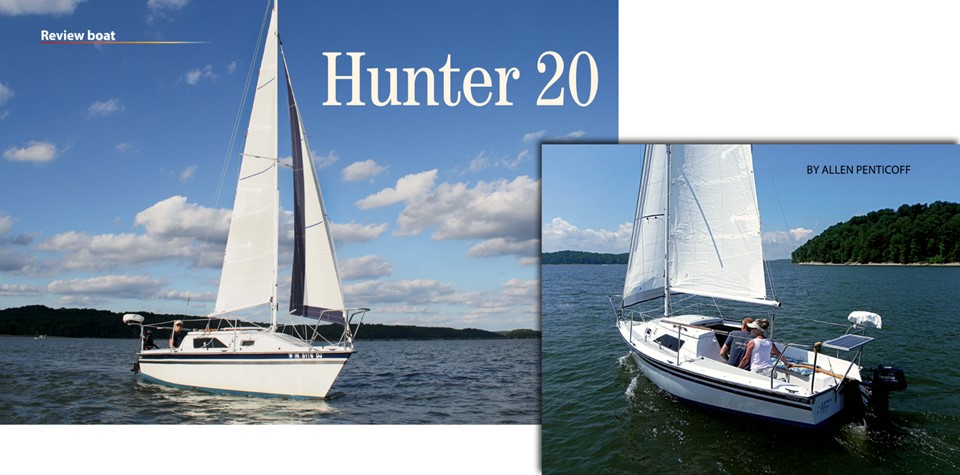
A handy trailer-sailer that’s easy on the boating budget
Issue 112: Jan/Feb 2017
Boats to review often come to me via interesting paths. In response to a request by Good Old Boat editor Karen Larson for photos of readers’ boat barns, Sam Ault of Seymour, Indiana, sent in his submission, along with a note to say he has to temporarily put smaller wheels on the trailer to get his boat and trailer into his storage shed. This in turn led to Sam offering his nicely updated 1983 Hunter 20 for review. He sent excellent photos to show why it deserved a review (Sam is an aerial photographer). We accepted his offer.
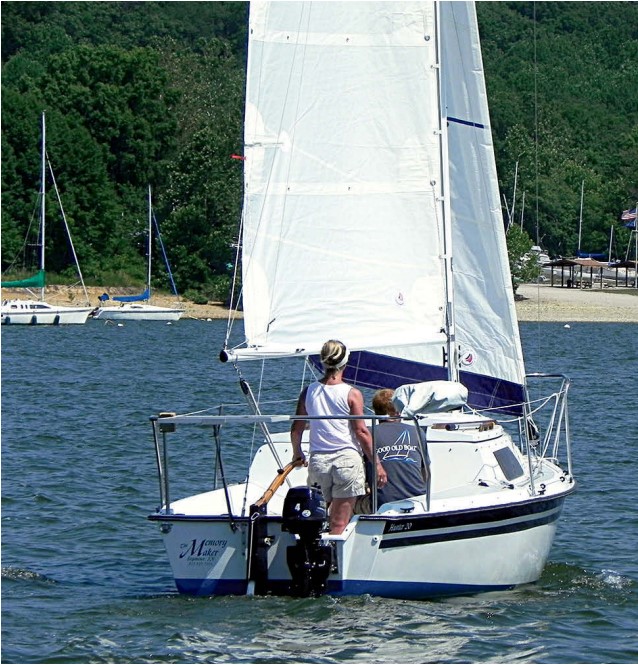
I took a trip to Lake Monroe, near Bloomington, Indiana, in June 2016. Sam had by then moved his Hunter 20, Memory Maker, to a slip in the state park marina where he and his fiancée, Cindy, had been teaching themselves to sail. Cindy was on Memory Maker’s helm during the photo shoot.
The breeze on the day of the test sail was light and our photo boat was not readily at hand, so I hailed a passing Hunter 23. Owners Bob and Cathy agreed to provide the photo platform. I never got their last name, but am indebted to them for this service.
Memory Maker is a good name for this Hunter 20, as Sam and Cindy were married in July 2016 on the beach in Empire, Michigan, and took this handy trailerable boat on their honeymoon trip to Michigan’s Lake Charlevoix and on to explore Canada’s North Channel of Lake Huron.
Sam is very handy and inventive. One of the many improvements and updates he’s made to Memory Maker was to completely repaint her. She looks like new.
History
Hunter Marine founder, Warren Luhrs, began building Luhrs and Silverton Sea Skiff powerboats in 1969 with his father, Henry, and brother John. The first sailboat he built on a production basis was his 1972 Hunter 25 “box top” model. Hunter Marine went on to build vast numbers of sailboats made affordable by streamlined production methods.
Reviewing the boats built by Hunter Marine on Sailboatdata.com involves a tedious counting of models ranging from 14 feet 6 inches (Hunter 145) to the oceangoing Hunter 50s. A total of 94 models spans 1972 to the present. The Hunter 20 was the 11th design.
Cortland Steck was the lead naval architect. Hunter only built this model in 1983 and 1984 and production numbers for it are not known, but it’s safe to assume plenty are available on the used-sailboat market. Hunter Marine was sold to David E. Marlow of Marlow Yachts in 2012. Models since that date bear the Marlow-Hunter name.
Design and construction
When I sailed with Sam and Cindy, they were already talking about purchasing a larger boat. “You can have more comfort,” I argued, “but you won’t have better sailing than this 20-foot Hunter.”
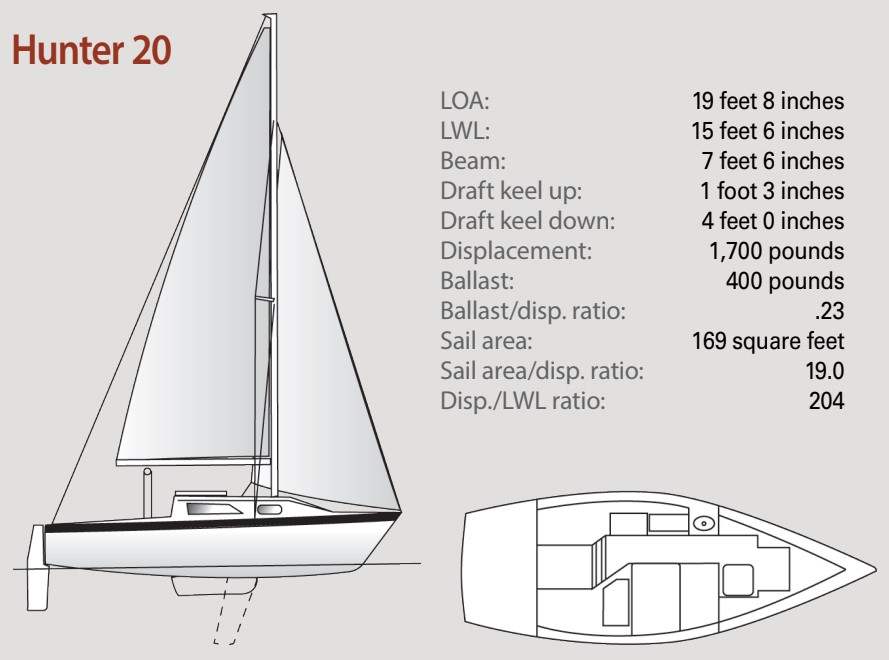
The Hunter 20 has a sleek underbody, and 400 pounds of its 1,700-pound displacement is in the cast-iron swing keel, which does not intrude into the cabin. The draft is 4 feet with the swing keel down and 1 foot 3 inches with it up. Much of the keel remains exposed below the hull when retracted, which might create a problem in a hard grounding. There is considerable overhang to the straight raked bow, while the transom is vertical to make the most of the boat’s length. The sheer is relatively flat.
The sail area/displacement ratio is a lively, but not overly so, 19. A PHRF of 274 to 285 (depending on fleet) compares favorably against the Aquarius 21 and a swing-keel Balboa 20 with essentially the same numbers.
The boat’s construction is standard: single-skin hand-laid fiberglass hull and deck, the latter stiffened with squares of 3/8-inch plywood. An aluminum rubrail covers the screwed-together hull-to-deck joint. One owner says he reinforced the transom in way of the rudder pintles, and the keel trunk where it had become worn from raising and lowering the swing keel.
Rig
The Hunter 20 is a 7/8 fractionally rigged sloop with single spreaders and single lower shrouds. It has boom-end sheeting for the mainsail, but the boom is quite short, so the sheet tackle is attached to the cockpit sole, where it’s handy to the helmsman. I suggested Sam look into repositioning the cam cleat to be “up” for releasing the sheet. In my experience, this renders it easier to make speedy trim adjustments.
No winches are fitted on the Hunter 20. The halyards secure to horn cleats on the mast. This is acceptable on a 20-foot boat, but it does require a hard pull on the halyard to obtain good sail shape, particularly on the main. Sam replaced the original sails with Precision sails, including a 122-percent genoa on a CDI Flexible Furler.
Deck
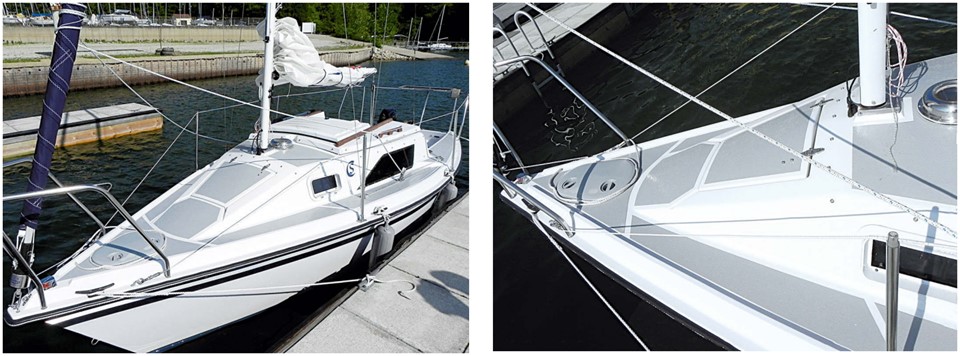
The most obvious deck detail I noted was the pop-top above the cabin that gives standing headroom below. Fitted with a nice cover, this adds much to the comfort of the small living quarters. A small-boat pop-top also provides a nice place to stand and watch the world sail by while under way.
When Sam repainted Memory Maker, he added considerable non-skid grit to the paint he used on the narrow sidedecks. Because the inboard-mounted shrouds are in the way on the sidedecks, the usual path to the roomy foredeck is to hop on top of the cabin and go forward inside the shrouds. Teak cabintop handrails aid in staying aboard. Using a kayak hatch, Sam innovated an anchor locker in the foredeck where none previously existed.
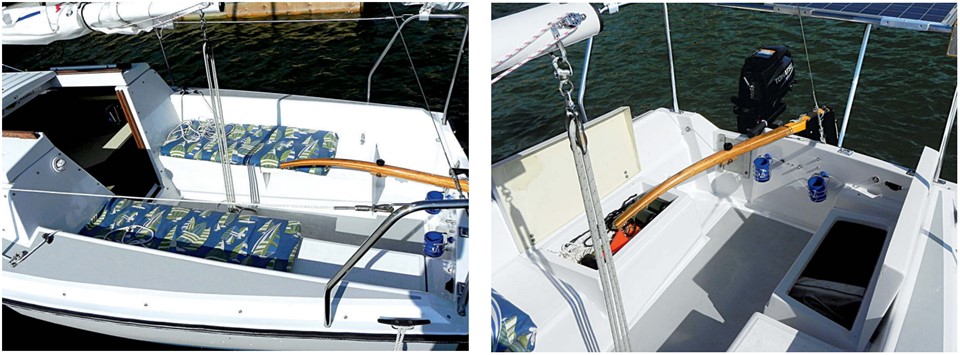
This Hunter 20 is equipped with tall bow and stern pulpits with single lifelines, but they appear to be optional. Aft, a notch built into the transom accommodates a small outboard motor. The cockpit is plenty wide and roomy for several people, but four is probably the limit. I give it a PNI (Penticoff Napability Index) of 3.5 to 4 on a scale of 1 to 5. The port seat is adequate but the starboard seat is a bit short in the absence of an extension to cover the space for the fuel tank. There are shallow lockers beneath each seat. The seatbacks are comfortable when the boat is upright. Although the cockpit is self-draining, the outlet may need to be plugged while under sail if too much weight is aft.
The bridge deck is low, making cabin access easy. Three dropboards in teak guides close off the companionway.
Cabin
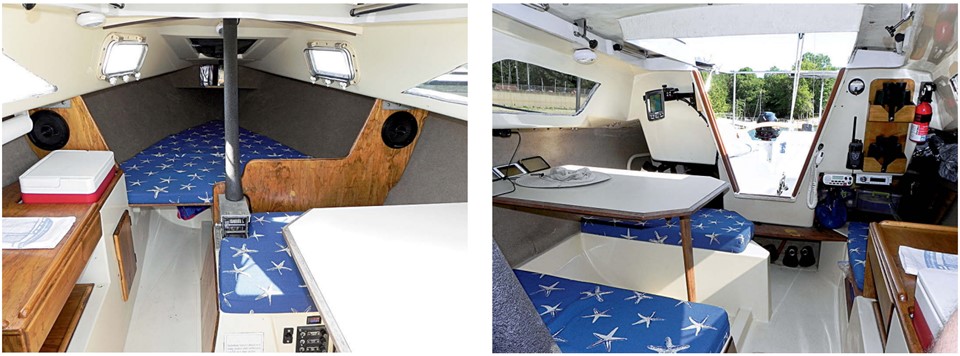
Two fixed windows, two opening portlights, and a forward hatch make the Hunter 20’s cabin light and airy even when the pop-top is down. The V-berth is roomy enough that the newlyweds share this space. Raising a cushion reveals the portable toilet tucked under the V-berth. Two small quarter berths extend under the cockpit.
The dinette can accommodate four, while the table drops to form another berth, but five people sleeping in a 20-foot boat is a crowd. Sam has replaced the countertop and the plywood bulkhead and relocated the sink to where the cooler had been. He reports that the stock sink needed a stopper to prevent water from backing up through the drain while heeled.
An aluminum compression post is something to hang onto while below. Sam covered it with PVC foam to avoid banged noggins. In addition to many storage cubbies in the cabin, there is storage aft under the cockpit footwell. A soft gray fabric helps soften the shiny white gelcoat of the furniture pan and the overhead. Cindy fabricated attractive and colorful cabin cushions with a starfish theme.
As previously mentioned, the swing keel does not intrude into the cabin space, but the winch for raising it is located on the bottom of the mast compression post. Below and to starboard is the electrical panel, upgraded by Sam to include a solar controller. Speaking of electronics, I noticed a tablet computer mounted above the foot of the V-berth on the aft face of the anchor locker so Sam and Cindy can watch movies while in bed — a nice touch. Sam has added a lot of natural-finished wood to the cabin, making it feel warm and comfy.
Under way
I found no surprises under power as we departed from the Lake Monroe Sailing Association dock. While we had light and variable winds, some of the occasional puffs were strong enough to initiate a little weather helm and demonstrate that you can’t just let go of the tiller and expect the Hunter to track straight. A reef in the main would have helped if the puffs had been more frequent. The transom-hung kick-up rudder blade has no balance area so, although quite effective, it feels a bit heavy on the helm. Sam reports the rudder can lose authority at high heel angles and cause the boat to round up. This is typical among smaller trailerable boats and points again to the need to reef early.
The location of the tiller allows the helmsman to stand up when conditions permit — or to lean against the stern pulpit and have a grand view all around. Visibility forward is not obstructed from a normal seated position. The cockpit seats are well spaced for bracing while heeled, but the coaming edge can dig into your back. Maneuvering around the mainsheet is easy.
Although the Hunter 20 points as well as your average little sloop, coming about was not quite as quick as I’d have expected in a boat of this length — not slow, just not dinghy-quick. We encountered no conditions in which to judge what the boat might be like in bigger waves but, going by its weight and ballast, it should do well in winds under 20 knots and seas of 2 to 3 feet. All in all, it is a very enjoyable boat to sail, with no surprises.
Conclusion
Trailerable boats of this size and age vary considerably in condition, so prices range from a steal at a few hundred dollars to a bargain at a few thousand for one like Memory Maker. The average price is about $2,500. Sam readily admits he has far more in Memory Maker than she’s worth on the market but he’s enjoyed working on this fine little boat.
Small Hunters in general are not overbuilt. As inland trailerable boats, they are not expected to sail offshore, and the scantlings and hardware reflect this. Nevertheless, they are affordable boats that deliver good value for a particular size. They are sort of the “Chevy” of sailboats. No one can deny that, by providing affordable means for people to access sailing, Hunter boats, new and used, have helped keep the sailboat industry afloat.
I would expect leaks in windows, gelcoat issues, and possibly damaged rigging on a small boat like this. But with some TLC such as Sam and Cindy Ault gave Memory Maker, these boats surely qualify as good old boats.
Resources
Don’t expect Marlow-Hunter to have parts for this vintage boat, but much of the hardware is easily found at any chandlery or salvage yard.
Plenty of support is available through the network of Hunter owners and several Hunter groups on the internet, including: http://hunter.sailboatowners.com
Allen Penticoff, a Good Old Boat contributing editor, is a freelance writer, sailor, and longtime aviator. He has trailer-sailed on every Great Lake and on many inland waters and has had keelboat adventures on fresh and salt water. He owns an American 14.5, a MacGregor 26D, and a 1955 Beister 42-foot steel cutter that he stores as a “someday project.”
Thank you to Sailrite Enterprises, Inc., for providing free access to back issues of Good Old Boat through intellectual property rights. Sailrite.com