*With apologies and gratitude to A.A. Milne.

Issue 23 : Mar/Apr 2002
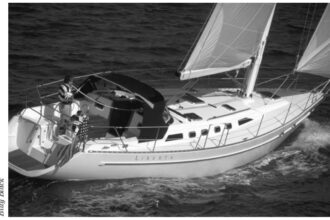
Jerry and I sat contentedly in the cockpit on one recent vacation in one of nature’s purest places: Isle Royale National Park. It was evening. The water around Mystic was pure glass. There was not another boat in sight. This is the sort of place where wildlife abounds. On that trip we’d already seen otters, moose, and a fox. We’d also seen bald eagles, osprey, and loons by the score. There are wolves there, too, although we’ve never seen one. Not during any visit to Isle Royale. But you never know. Magic can happen. It helps to have an active imagination.
We were dreamily watching dozens of nature’s feathered dandelions, ordinary herring gulls, do extraordinary flight maneuvers as they soared and swooped and scooped insects from the surface of the mirror on which we were floating. Suddenly I noticed a patch of water that was not smooth. The wind had rippled it . . . or something else had.
My attention turned toward that point, and sure enough, I saw in the dim light the shape of a moose wading in the water at the edge of a nearby island. I pointed the moose out excitedly to Jerry and went below for our binoculars. No matter how often we get to see moose it’s always a thrill . . . particularly if we’re in the safety of our sailboat and not vulnerable and low in the water in our kayak (say upstream of a moose who has just arrived to browse in the stream, effectively creating a brand-new and wholly intimidating roadblock).
By the time I returned with the binoculars, Jerry had decided that it was not one, but more likely two moose, probably a cow and a calf. However the binoculars told the sad story: our active imaginations had done it again.
In a Canadian provincial park not so far away from Isle Royale, we’ve been known to stealthily sneak up on a brown spot on a hillside thinking we were getting an opportunity to see our first caribou . . . only to discover that we were stalking a large rusting oil drum.
This time we were excited by moose-shaped dark rocks at the water’s edge. This explains why they were strangely quiet. Moose are seldom that quiet. Their massive heads splash to the surface with great mouthfuls of underwater vegetation, all of which drips and splashes. Nor are they soundless as they move those large bodies through dense forest undergrowth. They’re not usually difficult to spot. They need not tiptoe. There is nothing that can stop them, with the exception of the occasional wolf. And even a wolf is no threat unless they are very old, very young, very sick, or very injured.
Sometimes, to keep things lively, I try to find or suggest that I have spotted lions, tigers, or bears. Even heffalumps or woozles. In a magical forest that is already full of nature’s wild creatures, who’s to say I couldn’t find a heffalump or woozle sometime? Or a wolf, for that matter? Once we thought we heard one howl at a distance. We treasured that moment although we wondered if perhaps we hadn’t really heard an eerie loon’s wail from such a distance that we were, perhaps, both taken in by it.
A few days later we were in the ranger station and asked the ranger if there had been any reports of the wolves howling a couple of nights earlier. She said that she hadn’t heard any such reports but concluded, “If you think you heard a wolf, then you did.”
Just my kind of park ranger.
Thank you to Sailrite Enterprises, Inc., for providing free access to back issues of Good Old Boat through intellectual property rights. Sailrite.com