A useful technique for recovering a fancy hat — or a crewmember overboard
Issue 28 : Jan/Feb 2003
In my local waters I cannot remember the last time I saw a yacht hove to. Conversation with sailors confirms that few know how it is done and many believe it means simply slacking off all sheets.
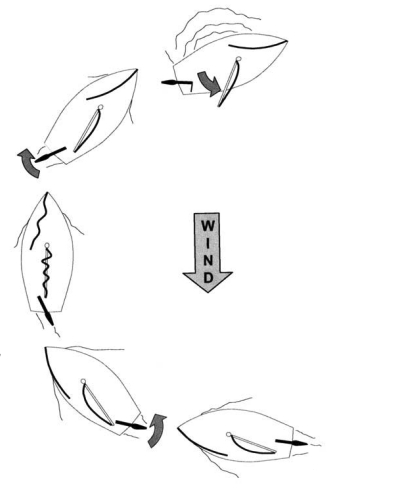
Readers of Good Old Boat will know that heaving to in a sloop will conventionally involve putting the yacht on the wind, slacking off the mainsheet, and hauling the foresail to weather so that it fills aback. With the helm down or left to its own devices, depending on one’s boat’s preference, the vessel will then, it is hoped, lie quietly while forereaching a little.
A kinder method of carrying out this evolution is to bring the yacht up into and through the wind, exactly the same as going about when tacking except that after she comes through the wind the foresail is left sheeted out to weather and naturally fills aback, after which the helm is put smartly down. Then the mainsheet is eased.
It works because the backed foresail denies the mainsail much wind. If the bows begin to fall to leeward, the mainsail fills a little, drives the ship forward, and the rudder brings her up into the wind again. She may actually do this once or twice but then she will get the idea and steady down into a state of equilibrium — provided she is the kind of yacht that will heave to.
Some modern light-displacement yachts with shorter keel profiles may not heave to very well. The time to try the technique would be in calmer conditions, ideally a fairly stiff breeze with little sea running and sufficient sea room to avoid accidents if the evolution does not go to plan.
Heaving to permits quiet time for a breather, a moment to solve problems, to go below and catch up on the chartwork, to brew up tea, tidy up, or secure the ship for heavy weather. By heaving to on the starboard tack one virtually ensures that according to the International Regulations for the Prevention of Collision at Sea the yacht has right of way. This is, I suppose, clever but is no substitute for keeping a proper lookout at all times.
Weather foresheet
When you are ready to get the boat underway again, it is simply a matter of letting fly the weather foresheet so the foresail crosses to leeward; then you trim the sails and helm. It is important to ensure that there is sufficient sea room. An alternative may be to put the helm up and turn her off downwind, but this may provoke an unwanted jibe and is not so controllable.
While heaving to may not be the best course of action in really heavy weather on the open ocean — when options such as lying ahull or using drogues are preferred by many skippers — in moderately severe conditions the heavy, or relatively heavy, displacement yacht may lie surprisingly steadily hove to while one takes stock.
On some boats, including mine which is apt to roll somewhat, it is the best preparation for tucking a reef into the mainsail, which will be lying docile in the lee of the foresail, while the deck is as steady as it may be. Similarly, it may be useful to heave to in order to furl the mainsail.
On those occasions when the direction of the wind permits my sailing onto my mooring, I usually sail just past the entrance to the little creek where my vessel berths to where there is a pool in the main estuary. Here I spin her around and heave to while I drop and secure the mainsail. Then I let draw the jib and make the last few yards to the mooring. The pool is not large enough for any other maneuver that would hold the yacht to the wind long enough to do this.
Heaving to also has its uses in slowing the ship while maneuvering. Once the skipper knows from experience how his boat will forereach, he can position the craft strategically before heaving to and then trudge very steadily up to, for example the mooring buoy, with little danger of overshooting.
Inanimate objects
By extension, I imagine the technique might be used in a crew-overboard emergency. I have not, thank God, put this to the test on anything but inanimate objects that have fallen overboard. On those occasions, once or twice in very windy conditions, the technique was useful.
Once, when a friend was crewing for me and his rather ritzy white yachting cap blew over the rail, I immediately put the helm up and jibed, leaving the jib aback but with some wind in the main. In a controlled manner, driven by the mainsail and damped by the jib, the boat returned obediently to the spot.
I must say that it was not an entirely happy ending. I could just make out the pale form sinking fast. This was no time for indecision. I hurled the boathook after it as though I were hunting the great white whale. The heavy galvanized double-hook, on a stout ash pole secured by a lanyard, harpooned its target, and I could have sworn I heard — even from the deck — the underwater impact as that club-head thudded into the cap, turning it inside out. I hauled on the lanyard, and the cherished headgear came back aboard.
Such had been the impact that the blunt head had stretched the flimsy wet material into an immense cone. We decided to make a gift of it to our local Bobby . . . on undercover missions he could wear it over his helmet. Heaving to yields many advantages.
Thank you to Sailrite Enterprises, Inc., for providing free access to back issues of Good Old Boat through intellectual property rights. Sailrite.com