The ClampTite alternative is more effective and less injurious
Issue 127: July/Aug 2019
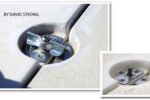
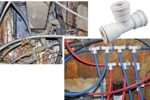
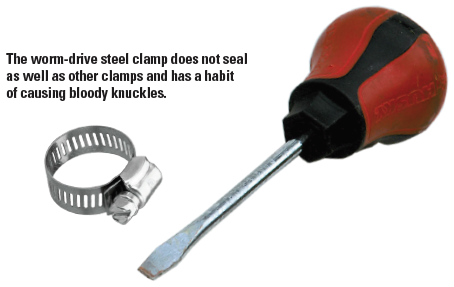
When most sailors think of hose clamps they think of the ubiquitous worm-drive steel clamp. Worm-drive clamps are easy to use, remove, and reuse but they don’t seal as well as other clamps, in part because of the hard spot created under the screw housing, which can only conform to one radius. Another reason I dislike worm-drive clamps is that I would need to carry a stock of them in several sizes to be able to replace the variously sized clamps on my boat. And . . . whenever I put my hand into a confined space full of those clamps, it almost always comes out bloody.
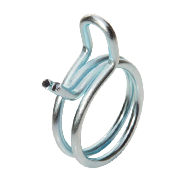
There are other types of hose clamp. OEM engines and other manufactured devices tend to use simpler, cheaper wire clamps that work well but cannot be easily removed or reused and are not adjustable. T-bolt clamps are robust and don’t suffer some of the shortcomings of worm-drive clamps, but they are expensive and their adjustment range is narrow.
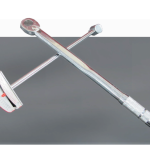
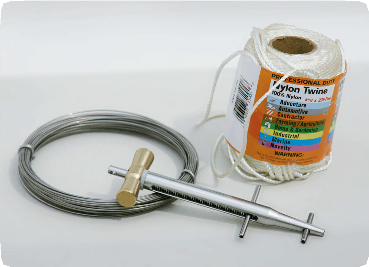
ClampTite sells a tool for making clamps out of wire. I’m of the opinion that every boat whose crew has plans to go out of sight of their mooring should have a ClampTite tool on board. I own one and think that, in most cases, the clamp it makes is much better than a worm-drive clamp. But I’ve found another way to use the ClampTite tool.
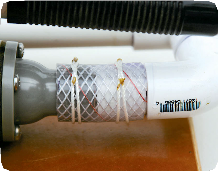
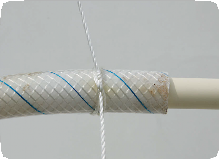
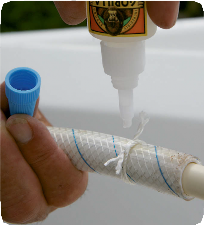
For years I’ve made very reliable well-sealing clamps out of the kind of nylon seine twine that can be found in almost every hardware store. I do so by tying a constrictor knot in the twine and tightening it around the hose with a ClampTite tool.
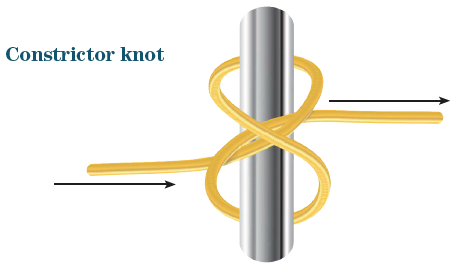 The constrictor knot is useful but not well known. Most knots can be tied and then untied, but the only way to remove the constrictor knot is to cut it — it gets that tight. Of the many ways to make a constrictor knot, the easiest is to start with a clove hitch and then make one last pass, as in the illustration below.
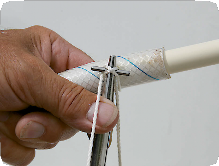
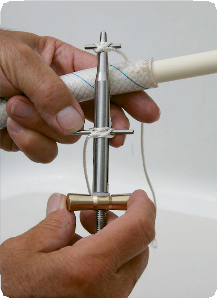
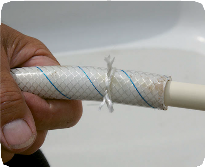
 Once I’ve tied the basic constrictor knot around the hose, I attach the ends of the twine to the ClampTite tool with several cleat hitches, one on top of the other, at each end of the tool, then tighten it using the nut on the tool. To finish it, I simply trim the ends of the resulting clamp with a sharp knife or scissors.
My seine twine (and wire) clamps offer a significant advantage over worm-drive clamps in that they apply fairly uniform pressure all the way around the clamped surface. I’ve used seine twine clamps to fix leaky connections that resulted from using worm-drive clamps.
One clamp or two?
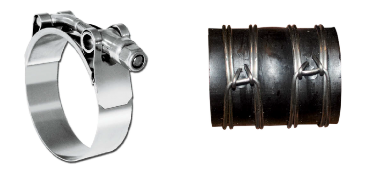
Exhaust-hose connections and fuel- fill-hose connections should have two clamps, per a respected authority used as a reference by many surveyors. These fittings normally have room for two clamps. Other fittings might not, and one of the advantages of clamps made with a ClampTite tool is that they are much smaller than worm-drive clamps and two of them will fit more easily on the clamped joint.
In any case, for most connections, the philosophy that if one clamp is good, two clamps are better, does not apply, no matter the kind of clamp. In fact, installing a second clamp where there is not adequate space for it on the barb or pipe can cause serious problems. In the event of having to please some authoritarian double-clamp-type person, put on the second clamp (of whatever type) loosely. If using worm- drive clamps, think of the second one as a spare.
ClampTite considerations
In most cases, twine will make a nice low-cost clamp that is easy on the hands and will not suffer the corrosion that can beset metal clamps. Of course, these seine-twine clamps have limitations.
- Using a ClampTite tool requires some operating room. There may be situations where a worm-drive clamp can be fitted but there is not enough space around the fitting to make a ClampTite clamp.
- The only way to remove a ClampTite clamp is to cut the wire or the twine. When securing a hose that must be removed often, it would be better to use a clamp of another type.
- With the ClampTite tool, it’s easy to make a clamp that is too tight, so watch the effect that the twine or wire is having on the hose. A benefit of being able to make a very tight clamp (far tighter than a worm-drive clamp) is that it’s possible, using wire, to effectively clamp a broken tiller or hammer handle.
- Be aware that a constrictor knot will not work at all if the body of the knot is not pressing down on the hose — it just won’t lock. The clamped surface must be round and fairly regular. In cases where it’s not, make the standard ClampTite clamp with wire.
- Where heavy-wall hard-to-com- press hoses are involved, or extremely tight clamps are needed, use wire.
Tips for Using Worm-Drive Clamps
If using a worm-drive clamp, use the smallest clamp with the narrowest band available. The larger the clamp, the larger the non-conforming hard spot under the worm-drive housing, and the greater the chance of this causing a leak.
It’s OK to keep cheap plated-steel worm-drive clamps in a spares kit. Simply spray them with WD-40 and store them in a sealed plastic bag. But, at the earliest opportunity after using one, make sure to replace it with a quality stainless steel clamp. The plated clamps won’t fail right away, but they will eventually fail from corrosion. For permanent repairs, use only high-quality clamps with all parts of the clamp made from stainless steel. The cheaper stainless steel clamps have stainless steel bands but the screws are not stainless steel.
Joints mating hose with tubes or pipes vary in their characteristics. If the hose fits tightly over the tube and there is a large overlap, all the clamp has to do is retain the tube so it does not slide off. If the hose fits loosely on the pipe, the clamp must squeeze the hose down evenly on the tube to prevent leaks. The wider the band on a worm-drive clamp, the harder it is to squeeze a loose-fitting hose and make a seal. Some tubes will be metric, some will be made to inch measurements. Some hoses will be made to a fixed outside diameter and some will be made to a fixed inside diameter. Metal pipe and tubing is usually made to a fixed metric or inch outside diameter.
Resources
Tying the constrictor knot:
Teresa and Ben Carey offer a simple method on how to tie a constrictor knot. YouTube.com/watch?v=2GxOVLuxP-M
This method uses the “under the X” method, which ties the same knot but is more difficult for people to learn. animatedknots.com/constrictorend/index.php
In “The Jug Sling or Hackamore,” in the May 2007 issue, Geoffrey Toye describes how the hackamore knot can substitute as an emergency hose clamp.
Jerry Powlas and his wife, Karen Larson, the founders of Good Old Boat, have been sailing their C&C 30, Mystic, on Lake Superior for more than 20 years. Since retiring in 2017, they have been learning the very different sailing characteristics of their trailerable C&C Mega 30, Sunflower.
Thank you to Sailrite Enterprises, Inc., for providing free access to back issues of Good Old Boat through intellectual property rights. Sailrite.com