Objets d’art emerge from an off-season pastime
Issue 117: Nov/Dec 2017
When my boat is under wraps for the winter, I seek outlets that help me preserve my sailing sanity. One of my off-season pastimes is building yacht half models. When a sailing buddy mentioned that his collection of half models did not include his old Chesapeake 32, I saw the chance to build a beautiful Phil Rhodes design. Unlike modern boats, this classic is all shape, and no one drew a sheer as sweetly as Phil Rhodes.
I prefer to give models a bright finish, and not only because wood is beautiful. Frankly, I have tried, and failed, to master the art of painting to perfection. Perhaps the nicest wood to work with is mahogany. The premium Honduras variety is scarce and expensive, but the nearly-as-nice African mahogany is affordable and does the trick. It has a pretty wild grain pattern and is a bit harder to work than Honduras mahogany, but the end result is stunning. Best of all, like any wood species finished bright, it just gets better with age.
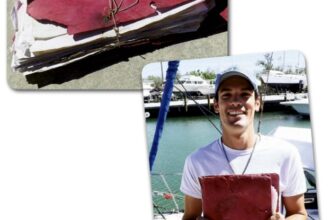
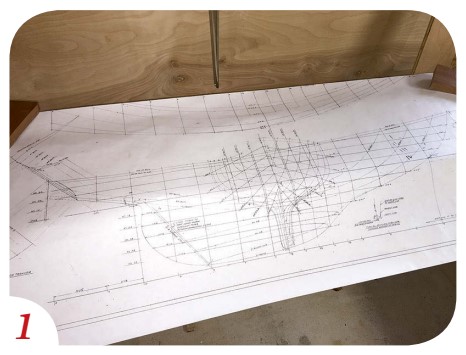
Having the boat’s plans is key to creating an accurate finished product. Fortunately, plans from the Rhodes collection are available from Mystic Seaport in Connecticut. I like to have two sets, one to cut up for patterns and the other to hang on the shop wall for reference. Accurate plans drawn to a fairly large scale are essential. The plans for the Chesapeake 32 are to the scale of 1 inch to 1 foot, so the model is quite large. A 3⁄4-inch-to-the foot model is a nice size, if the plans are available at that scale. (Photo 1)
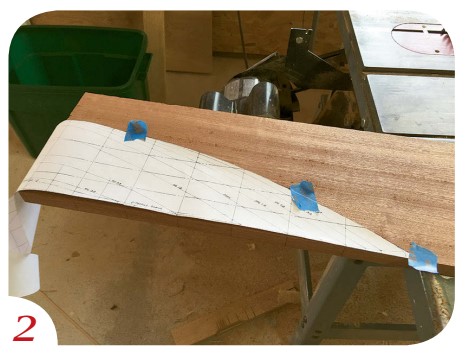
I sacrificed one copy of the drawing to cut up and use for patterns. The waterline spacing on the plans is 9 inches, which scales to 3⁄4 inch on the model, so standard 1x dimension lumber was perfect for the lifts, the layers of wood that make up the model. I traced around the patterns as accurately as I could onto the mahogany boards, and cut about 1⁄16 inch outside the lines to make the lifts. (Photo 2)
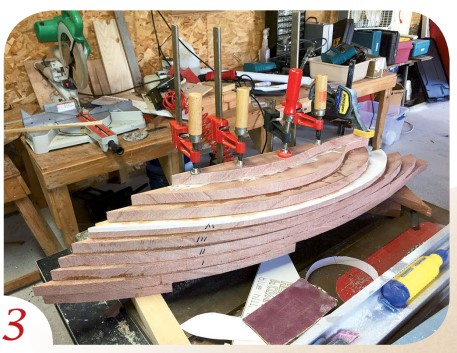
As with building any boat, building a model requires a lot of clamps. Tight glue joints make for a seamless job. For the boot stripe, I added a band of lighter-colored poplar of appropriate thickness to one of the lifts. (Photo 3)
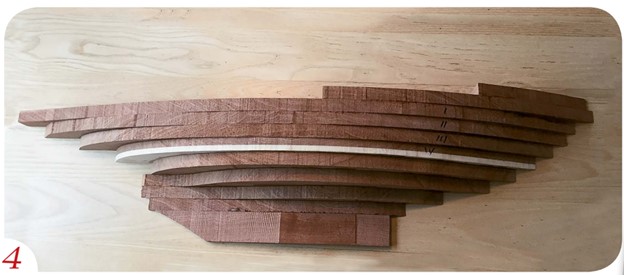
Somewhere hiding in the glue-up is a Chesapeake 32. When clamping all the lifts together, I take great pains to line up the stations. Because the glue makes the lifts want to skate around, I shoot finishing brads into them to hold them in position, taking care not to set a brad where I will later want to remove material. At this point, I draw the profile of the boat on the back of the assembled lifts. (Photo 4)
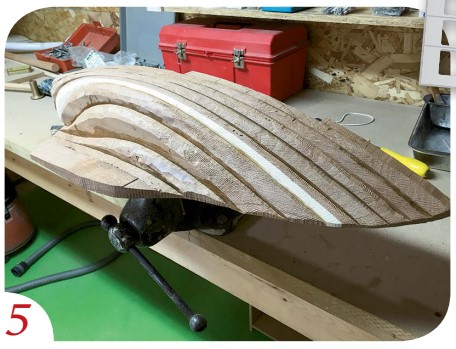
I can now begin to remove material and make the stack of lifts look like a boat. I start roughing out the shape with chisels and my favorite rasp, a Nicholson No. 49 cabinetmaker’s rasp. (Photo 5)
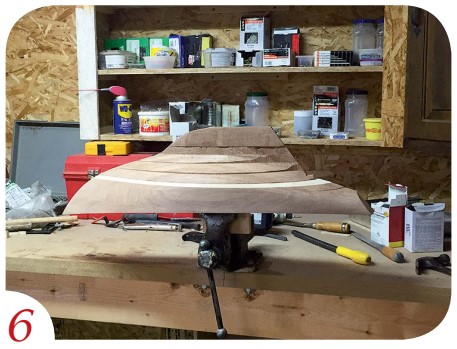
The sheerline, especially a sweeping one that rises up in the stern, can make or break a project. I rip a small batten, plot the points off the drawing onto the front of the assembled lifts, and have a helper draw the line while I hold the batten in place. I then carefully make the cut with a sharp blade in my band saw. (Photo 6)
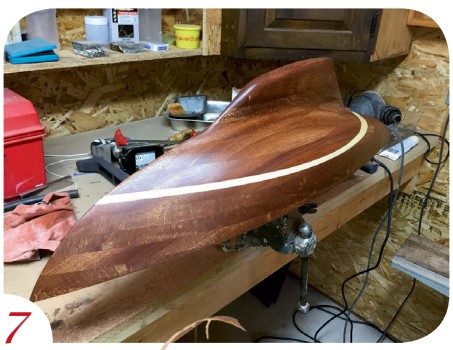
When I’m close to finishing, I like to splash a little thinner on the wood just so I can look for imperfections — and admire that gorgeous mahogany. (Photo 7)
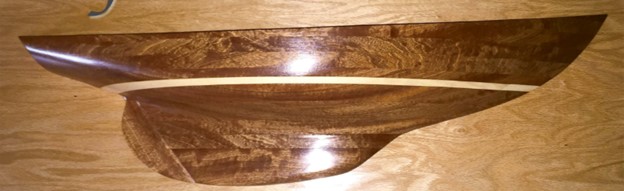
After a final fine sanding and the application of four or five coats of satin varnish, the model is ready for mounting on the wall.
Tools
Essential:
- Chisel
- Cabinetmaker’s rasp
- Coarse and fine sandpaper
- Stanley 21-297 Surform round file (great for the turn of the bilge)
- Bandsaw
- Patience and perseverance
Optional:
- Pneumatic 18 gauge finish nailer
- Multi-tool with triangular carbide grit rasp (fast material removal)
Glossary
Profile: the side-on outline of the hull, including the sheerline, stem, underbody, and transom
Sheerline: the line from the tip of the bow to the outboard corner of the transom
Waterline: a horizontal cross section through the hull. The shape of each lift is defined by the waterline at its top.
Stations: equally spaced lines drawn perpendicular to the waterlines in the profile view and at which (cross)sections are drawn
Lift: a board shaped to a waterline and of a thickness equal to the vertical distance between waterlines
Art Hall and his wife, Sandy, can be found sailing their 1965 Allied Seabreeze 35, Secret Water, on Penobscot Bay, Maine. Art says it’s still quite easy to find new places to go. Occasionally, they’ll push way Down East for some solitude. Art enjoys the challenge of keeping a good old boat going strong, season to season, decade to decade.
Thank you to Sailrite Enterprises, Inc., for providing free access to back issues of Good Old Boat through intellectual property rights. Sailrite.com