Suffering’s for singing the blues, not sailing. Here’s how to stay pain-free on the water.
Issue 129: Nov/Dec 2019
When I was in my 20s, a long breezy day on my beach cat invariably resulted in a grim collection of bruises, pulled muscles, scrapes, and bone-deep exhaustion. I progressed through a series of larger boats, and though standing instead of crawling, vigorous conditions still meant exhaustion and strain.
And then one day, well into my 50s, I noticed that sailing had become easy. Even on my 24-foot trimaran, sailing just as fast as I ever did, I wasn’t getting banged up or tired anymore. This wasn’t because I had discovered the fountain of youth, as witnessed by my departed hair and thinning joint cartilage. It was because I was sailing smarter.
Sailing smarter happens on many levels, from how you prepare your body to how you prepare your boat. Following are some easy suggestions for each.
Easy Does It
It’s not about reefing early or staying home when it blows; it’s about preparation, minimizing mistakes, and doing things the easy way. Most of what I’ve learned about avoiding injury came from singlehanding larger boats, where muscling through problems doesn’t work. Instead, I plan every action, at least in the general sense.
- A procedure for everything. There is a best way to do everything, specific to every boat. I’ve learned the procedures that work on my boat.
- Think ahead. After each tack, I prepare the lines for the next tack. A half-mile from the anchorage, I remove any securing lines from the anchor and get the bridle and snubber ready. I keep reefing ties handy so that when it’s time to reef, it’s quick and easy.
- Don’t fight the elements. I furl headsails when sailing downwind, so that they are blanketed behind the main- sail. I reef the main on a close reach with the jib in tight; the backwind keeps the main loose in the mast track. I limit slack in sheets when tacking and furling to reduce tangles. I motor up to the anchor, and I balance the sails rather than fight the helm.
- Good body position. I take a few seconds to brace myself properly before grinding or pulling. I sit instead of stoop; what does a wet bottom matter?
- One trip. When going forward, I first think of everything I’ll need. I fetch the tool box from the cabin, not just one wrench — and I keep a few tools in or near the cockpit. I pass things up through a bow hatch rather than carry them around the sidedeck.
- Reliable equipment. I keep the fuel clean, the steering system strong, line friction low, and the winches, stoppers, and cam cleats working smoothly. I regularly clean the sail tracks by hauling a solvent-soaked section of bolt rope up and down, and I lube the sliders with Sailkote. I feel I can deal with most anything if the basic gear functions properly.

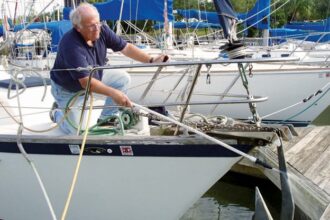
By rigging a block and tackle and snugging the boat closer to the dock, loading gear and people becomes much easier and safer.
Ergonomics
Every boat I’ve owned has benefited from changes that made it fit better — not comfort upgrades for cruising, but modifi- cations that make working the boat safer and healthier.
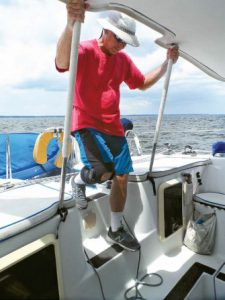
- Boarding. Even the most agile sailors struggle when their arms are full. Rig a block and tackle to pull the boat tight to the dock while loading. I recommend a step if the deck is more than 10 inches above or below the dock. Reinforce lifeline gate stanchions so that they can be pulled on. Sugar-scoop transoms make getting on and off a boat a breeze.
- Non-skid. Add aggressive non-skid strips to the edges of steps, in the cockpit, and below. Wet feet and undersized treads are a dangerous combination.
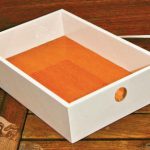
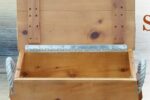
- Tall steps. The land-based building code says steps 7 ½ inches tall are best, with up to 8 ½ inches acceptable, yet every boat I have owned has included a few steps of 16 to 24 inches tall. Even young legs tire. Rebuild the compan- ionway ladder, add a step, or even a stool; a low wooden box makes a stable runt step (“A Step Above (Or below),” September 2019).
- Helm. Lower is better; elevated helm stations often whip side-to-side in beam waves, real torture for those with back problems. If the boat is tiller-steered, can you rotate your sitting position enough that your neck or back arenot constantly twisted? Is your wrist, elbow, and shoulderin a relaxed position? A tiller extension can help if you must sit forward.
- Handholds. Wet stainless is slippery, andmost handholds and handrails are only 1 inch in diameter.OSHA standard railings, hammers, and even baseball bats are closer to 1¼ inch, for good reason. Wrap vertical holds with leather or small line. Add railings anyplace you feel exposed; more handholds mean a more relaxed posture.
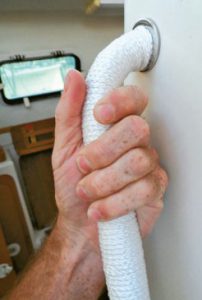
Wrapping a stainless steel handhold with thin line gives you much firmer grip. - Skinny lines. Larger lines may not be the best answer if you’re looking for better grip, because if they’re even slightly too big for the blocks they dramatically increase friction. Instead, consider smaller lines and better gloves.
- Bigger winches. Replace 8-inch handles with 10-inch handles. Self-tailing and two-speed winches can make a difference. But the biggest improvements are often better technique. If your timing is sharp when tacking, you can hand-haul the sheet in with a single turn on the winch, adding turns and grinding for only the last foot or so. Hoisting sails is mostly about reducing friction and body position. Unless the sail is heavier than you, you should be able to get gravity to do most of the work; I like sails that hoist from the mast.
- Windlass. If your boat is over 30 feet, your anchor is more than 20 pounds, or you have all-chain rode, seriously consider a windlass. At the very least, install a chain stopper so that you can take a break. If you are hauling by hand, find a comfortable sitting position, with a cleat between your knees making it easier to take a breather.
- Downsize. Smaller boats have smaller sails and lower sheet loads. Maintenance is physically less demanding. Some will argue that the quicker motion of small boats is hard for older people, but I have not found that to be the case. They should interview the old salts sailing Flying Scots out of my marina; they make it look like dancing.
- Sail smaller waters. Magazines (other than Good Old Boat) endlessly promote epic crossings and blue lagoons, because they feed our Walter Mitty fantasies and sell bigger boats. Ask yourself if you really need a big cruising boat, and if your boat fits the sailing you actually do the most. I stay in the Chesapeake Bay now and love it, and my boat suits those waters and the sailing I do.
Protective Gear
America’s Cup sailors are pretty kitted-up these days, but they’re approaching 50-knot speeds. Still, some parts of the human body can use a little reinforcement, even at 6 knots.
- Shoes. Barefoot is fine for hanging out in the cockpit at anchor, but no matter how hot it gets, you will never find me sailing without shoes. It’s too easy to step on a pad-eye, kick a genoa block, or even slip overboard. I also find most deck shoes too floppy for older feet, so I live in sneakers.
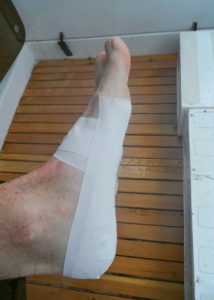
- Orthotics. If your feet or knees get tired, chances are good that your feet are over-pronating (rolling inwards) and that custom orthotics, or at least high-quality supports, will help. Additional control of the arch during sharp twisting movements and long walks ashore is best provided by direct application of tape. Many athletes and mountain climbers swear by low-dye strapping, named for podiatrist Ralph Dye.
- Gloves. Good gloves increase grip and protect tendons from bruising. I like Ronstan Sticky Race gloves, but it comes down to fit. Try pulling on a rope. Get the long finger version and don’t look at the price tag (and I’m a cheapskate).
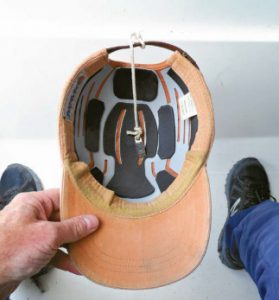
The Skullerz liner doubles the utility of an ordinary ballcap, which not only shields Drew from the sun but also protects his noggin from dings and cuts. - Head coverings. You can wear a ball cap for sun protection, but a few decades ago, I discovered my hair was gone and that everytime I bumped the companionway or overhead I got a bruise or cut. A few years later I discovered bump cap inserts for ball caps.They slip inside your favorite cap, and properly padded, the only thing I notice is that my hat stays on better.Sailing helmets are rapidly catching on in high-performance classes and youth sailing. They’ve always made sense for certain high- risk activities, such as climbing the mast underway, and assisting with man-overboard recovery alongside the boat. Solo sailors might consider that a whomp on the head leaves them more vulner- able to being thrown overboard. And as much as we resist safety rules, I don’t actually notice a hard hat on my head at work, a helmet on my head biking, or a sailing helmet when I am gear testing. In the winter, with a balaclava under it, they are actually warm and comfortable. Only the slimmest (Zhik H1, Forward Prowip) work with hoods, and most add a little to wind noise.
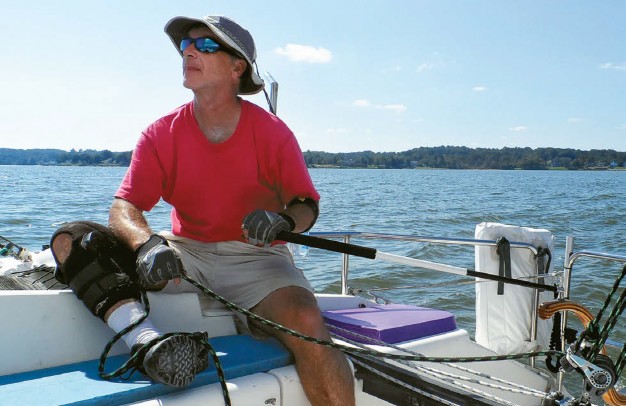
- Braces. I’m a little sensitive on this subject, the result of a shattered kneecap suffered in a college bike race and a torn meniscus sustained helping my daughter move into college.
- Elbow braces. Tendonitis is common enough. Although it’s a little counterintuitive, a tightband that presses on the tendons just below the elbow helps. It also helps me while sleeping,by preventing me from tucking an arm tightly under my head, further irritating the tendons overnight.
- Knee braces. A quality brace can prevent excessive bending and reduce impact and twisting forces. But instead of shopping at the local drug store, go to online specialty stores, such as betterbraces.com or donjoyperformance.com. My personal preference is the DonJoy Playmaker II; it is somewhat cumbersome, but I’ve had knee surgery and don’t have a lot of cartilage left. Don’t skimp; the most expensive brace is much cheaper than surgery.
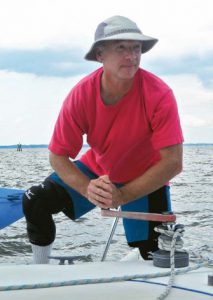
Well-positioned to grind the winch, Drew gets extra help from the pads, which save his knees from grinding into the deck.
In the Boatyard
Cleaning, repairs, and boatyard work exact a toll. Knees take a beating on decks and gravel, and elbows and sides get bruised by boat yoga, down below.
Volleyball knee pads are the choice for most on-deck and cabin chores; I like the Mizuno LR6 — it’s long and stays in place well. It’s also good for sailing in some classes. Hard-cap knee pads are great for gravel; I like the Husky Hard Cap Swivel — comfort- able as a feather pillow, and yet agile and durable.
Stash a section of ½-inch interlocking foam flooring near the engine and batteries. You’ll check the oil and water levels more often.
When you’re going to start working below, crawling and contorting into all the crazy small spaces (boat yoga), warm up first and take a few steps to make your work- space safe. This includes clearing the work area and padding hard spots with layers of folded-up towels. Volleyball knee pads are good for elbows too, since they can slide over a sweater.
At some age moving always hurts, and yet every bit of science and philosophy tells us to either move it or lose it. Some tasks are just bad; scraping the bottom sucks when you’re young and makes no sense with chronic upper skeletal problems. Sub it out. You don’t really need to polish the topsides, do you?
By sailing smart and taking care of yourself, sailing doesn’t need to hurt. For the aches you can’t avoid, attitude matters: “Pain is inevitable. Suffering is optional.” (Haruki Murakami). Above all, a day on the water will do you good.
The Human Factor
No matter how many great hacks you come up with on your boat to make sailing painless, keeping the human machine primed, flexible, and fit is equally critical to this goal. To help avoid injury, I maintain a base of fitness through activities that use the whole body. I walk and cycle (easier on old knees), but these activities work only the legs, so I mix in some swimming or kayaking. I pursue activities that encourage stretching and balance. Most back and shoulder problems result from the limited range of motion used in front of the computer and even in most trades. We work in a box, without reaching or twisting. Play with the kids on the floor. Stretch for a high shelf. Climb trees! Even boat maintenance helps, so long as you stretch first.
I supplement with a daily PT regimen, targeted at specific weaknesses. It needn’t be vigorous, and you can run through it while watching your evening movie. Warm up first. In general, strength exercises should include about two sets of 20 done at a relatively slow rate; there should be some burn. Stretches should be gradual, only a little uncomfortable, and held for 30 seconds.You should not be sore the next day.Yes, much of this comes from yoga and is thousands of years old.
Knees
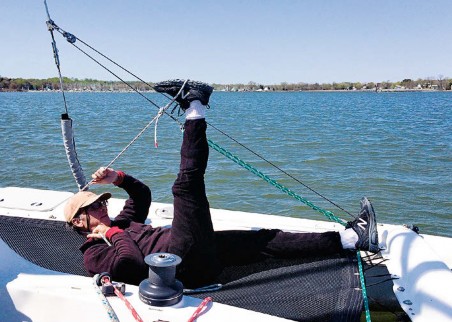
- Hamstring stretches. Lie on your back, extend one leg, and keep your knee straight. Flex your foot, loop a sail tie over your instep and gently pull your leg upwards.These also help stretch your back. Repeat several times a day.
- Straight knee raises. Sitting on a bench, hang a weight across your ankle (some chain wrapped in a towel?), and lift your foot until your knee is straight. Instead of using heavy weights, go very slowly, taking about 20 seconds per cycle.
- Air bench. Lean against a wall with your heels about 16 inches from the baseboard and lower yourself into a sitting position by sliding down the wall. Hold this unsupported sitting position for 30 to 90 seconds.
Core
- Cat and Camel. Crouching on your hands and knees, alternately arch, then flatten, your back. A good warm-up.
- Back stretch. Lie flat on your back and bring your knees to your chest, spreading them so that they pass on either side of your chest. Keep the base of your spine tight to the floor. This can also be done by kneeling and allowing your body to settle as far forward as possible (Child’s Pose).
- Pelvic tilt. Lie on your back, with your knees bent, as though you were going to do sit-ups. Instead of doing sit-ups, inhale, then exhale and tighten your lowest groin muscles and tilt your lower pelvis slightly upward, while keeping your middle back on the floor.This is a small motion, but you should feel the stretch in your lower back.
- Upward Facing Dog. Start by lying on your stomach, legs straight out and the tops of your feet on the floor, elbows bent and palms flat on the ground next to your chest. Pushing gradually against the floor with your hands, slowly raise your shoulders and chest upwards, arching the back. If you can only raise to your elbows, that’s OK. The important thing is thatyour arms and elbows are behind your shoulders so that they stretch your body forwards as you rise. Breathing deeply also helps stretch the gut.
- Sweeps (more advanced). Start by lying on your back. Lift your feet slightly (higher is easier) off the ground. Keeping the knees straight, swing your feet very slowly to your right hand, back to center, and to your left hand.
- Planks (more advanced). Assume a pushup position, feet together (you can drop to your elbows to make it a little easier). Squeeze your thighs and buttocks as you hold the position while keeping your back flat and your abs sucked in. If you are doing this right, your whole body should be shaking. Hold for 30 to 60 seconds, rest, repeat.To advance to side planks, lie on your left side, lift up on your left elbow, keep your legs straight and feet stacked and raise your hips until your body is in a straight line from head down to feet. Repeat on right side.
- Bridges. Lie on your back, feet flat on the floor. Push your hips skyward and hold a few seconds, squeezing the buttocks, then lower and repeat.
- Hamstring lifts. Similar to bridge position, but a little harder. Lie on your back, but with your feet up on a bench no higher than 18 inches or so. Keeping your knees straight and your shoulders on the ground, lift your body into a straight position using your hamstrings and lower back muscles.
Hands and Fingers
- Extension stretch. Put the palms together in front of your chest and raise your elbows, keeping the fingers flat against each other (much as if you were saying namaste or using a Praying Pose).
- Rubber band extension. Put a rubber band around your fingers on the outside, and then extend the fingers, stretching the band.
Elbows
- Wrist extensions. The common problem is over development of the pulling (flexing) side, without exer- cising the opposing lifting (extension) side. Lift a partial bucket of water (pad the handle) or something similar with the forearm level and palm facing down, by extending the wrist upwards.
Shoulders
- Hanging. We’re not that far removed from apes, but life seldom asks us to reach up, to hang, or to pull down. As a result, big muscles shorten up, reducing space in the shoulder, and making the rotator cuff muscles work harder, but with less room to do so. After warming up, find some object you can hang from, even if you have to bend your knees.The goal is not to hang straight down, but rather at whatever rotation and angle applies a nice stretch to the shoulder without hurting.
- Wall clock. Standing straight, start with your hands over your head, palms facing backwards. Lower your hands with the elbows straight, like the hands of a clock.You shouldfeel a stretching in the front of the shoulder, and your chest should push forward.
Resources
Multiple internet sources can show you stretches, exercises, and techniques like low-dye strapping. Here are a few suggestions for starters:
- verywellhealth.com (Type “lower back exercises” into the search bar and off you go.)
- yogajournal.com (Follow the “poses” drop-down to search a variety of poses and how they can help specific parts of the body.)
- Search “low-dye strapping” onYouTube to find how-to videos for this technique.
Drew Frye draws on his training as a chemical engineer and pastimes of climbing and sailing to solve boat problems. He cruises Chesapeake Bay and the mid-Atlantic coast in his Corsair F-24 trimaran, Fast and Furry-ous, using its shoal draft to venture into less-explored waters. He is most recently author of Rigging Modern Anchors (2018, Seaworthy Publications).
Thank you to Sailrite Enterprises, Inc., for providing free access to back issues of Good Old Boat through intellectual property rights. Sailrite.com