Tame your mainsail with strategic bungee cords
Issue 63 : Nov/Dec 2008
Unfurling your sail may be a great joy of anticipated sailing. Or it may just be one more tedious chore when getting under way.
Furling it may be another tedious chore, the inevitable end of a day of great sailing. Or it could be a dangerous chore, if you are in a wicked blow while simultaneously engaging the iron jenny. This could be worse yet if you are plunging around in heavy seas while entertaining mal de mer. Where are those sail ties when you need them?
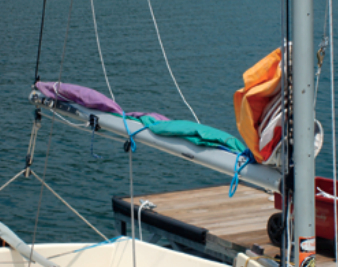
But picture this: with the breeze a bit off your starboard bow and with your mainsail lying relatively quietly in its lazy-jacks, reach your left hand under the boom at a mark. Grab a loop hanging there on the port side, raise it up, reach over the sail, and grab the loop with your right hand. Against the tension of a shock cord (a.k.a. bungee), pull the loop up and over the sail, then down, and place the shock cord over the hook on the boom’s starboard side.
“Whoa,” you say, “bungee? Not on my boat! I’ve had that stuff sun-rot the second year it supported a fender.”
Read on. There’s hope.
Depending on the size of your mainsail and the length of your boom, you may do that “cord over the hook” just once more, or perhaps several times, and then your mainsail is snugly and neatly frapped down to the boom.
No tasty sail ties in your teeth or chafing your sunburned neck. None lost overboard in that blow. None hiding in a cubby somewhere, leaving you searching when you should be furling.
This system is so simple I’m on my fourth installation. The first was on a little Montgomery 15, the next was on an elegant Cape Dory Typhoon. Then I installed the system on a Cape Cod Catboat that was just 18-feet overall but boasted 271 square feet of canvas under a solid and heavy Sitka spruce gaff. Now I’m sailing another Montgomery 15. Good old boats, one and all.
My system of frapping down the main consists of lengths of bungee tensioned along the port side of the boom and pulled over the sail to the starboard side. Lazy-jacks aren’t essential, but they sure do help.
Two small eye straps, one at each end of the boom, hold the bungee snugly against it. Larger eye straps guide a working loop as you pull it over your sail, and a fender hook holds the bungee and sail in place.
Eye straps and fender hooks are easy to find, even in my landlocked boondocks. My local Lowe’s, a big-box building supply store, carries a fair selection of the economical Atwood stainless-steel marine supplies.
However, finding a good source for marine-quality shock cord, offered in a full variety of sizes and colors and only in the needed length, was not easy until I connected with R&W Rope Warehouse (see Resources on facing page).
Installation of these goodies is fairly simple. First, determine how many cords you need. Since each cord effectively snugs the sail to the boom in two places as it is pulled over, count the number of sail ties you use now and divide by two. Odd number of straps? Just round up to the next even number.
The foot of my little Montgomery 15’s mainsail is only 7 feet 6 inches. Since I previously used just three sail ties to furl it to the 8-foot boom, now I use only two bungees. Progressively greater distances between the hooks on the starboard side and the guiding eyes on the port side gave me four angled bungees across the sail. As each one crosses over the sail from two turning points they double, and my sail is held down in four places. Great!
Longer booms will require mainsail frapping in more places, of course. Each installation is different, but not all that difficult for the average sailor who dotes on the process of continual improvement. With no furling straps to stow and fewer to fasten, you’ll love it.
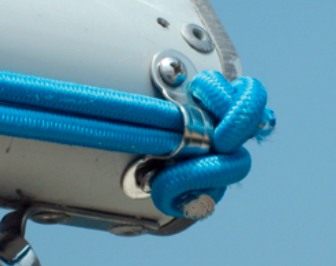
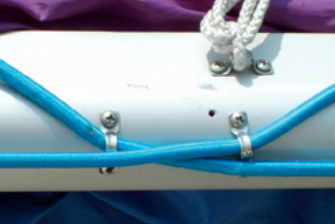
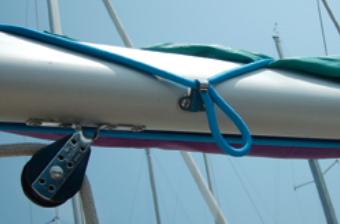
Installation notes
Cut the shock cord about 12 inches longer than your measured distance: 6 inches for the knots in each end to hold it and 6 to form a loop. Determine the best location for this loop by temporarily installing the cord, then pulling it over the sail and into the fender hook, ensuring an equal amount of tension in each direction. Mark that point and take the cord off. Back at your sewing cubicle, double the cord at the mark, then secure the sides about 3 inches from the mark. I used a needle and heavy thread.
For that final touch, mark the boom where the loop is hanging down. It won’t be opposite the hook, and black electrical tape works well.
As the initial constant tension stretches the shock cord, it will lengthen a bit. Just shorten it with a new knot at either end or both ends.
Enjoy your simplified start and finish to that fantastic day of sailing!
John Butler was a Coast Guard search-and-rescue pilot, flying amphibious helicopters and fixed-wing planes. He retired as a commander in 1974 and now lives with his wife, Mary Lu, near Beaver Lake in northwest Arkansas. He sails his 1968 Montgomery 15 sloop, Rejoyce!, whenever he is able.
Thank you to Sailrite Enterprises, Inc., for providing free access to back issues of Good Old Boat through intellectual property rights. Sailrite.com