A shoal-draft cutter for blue water
Issue 112: Jan/Feb 2017
Mike Gover, the owner of the Downeaster 38, Cabezon Café, holds a U.S. Coast Guard certification for up to 100 tons. An avid sport fisherman, he has worked professionally on fishing vessels along the West Coast from California to Alaska and is a veteran diver. Mike was a captain for Seattle’s Argosy Cruises, which plies routes between Seattle and destinations throughout Puget Sound. When he took early retirement, he began to contemplate acquiring a boat to share with his new bride, Susan. A financial analyst with a successful private consulting practice that has taken her to many parts of the world, Susan has adapted to a variety of cultures, climates, living arrangements, and lifestyles — good preparation for living on a sailboat. She is also practical, and has contributed many outfitting ideas that make Cabezon Café a better boat for the two of them. She improvises easily and has a taste for adventure.
Mike was looking for a boat with good basic performance and accommodations that could be altered to match their ideas about living aboard and to suit their likely cruising grounds, which included Canada, Alaska, and even Mexico. He was partial to the cutter rig — before becoming a professional mariner, he had built a 7-ton 34-foot pilothouse cutter and sailed it from Seattle to Mexico and back. He thought that, with a mainsail area of manageable size, a cutter would be closer-winded than a ketch or schooner and, in the words of the late Hal Roth, whom Mike much admired, there would be fewer strings to pull. He also likes a club-footed staysail that’s self-tacking and could be the last sail to come down when the wind pipes up. His previous cutter could sail to weather in winds of up to 50 knots under staysail alone.
As the search narrowed, he and Susan looked at several boats of similar size, performance, and accommodations, including a Cal 40, an Ingrid 38, a Union 36, an Ericson 41, and a couple of Downeaster (DE) 38s. Gradually, they began to lean in favor of the DE 38. Mike liked the lighter displacement, full keel, generous beam, and broad stern. The large cockpit would have advantages when entertaining at dockside. Susan was drawn to the light and spaciousness belowdecks.
They located a DE 38 in San Pedro, California. It looked good on deck and below and sailed beautifully on the trial sail, but the survey revealed a serious case of blisters.
Undeterred, the Govers found another Downeaster in California that needed more work on deck and below but was free of blisters. After settling on a price, they had the boat trucked to Port Townsend, Washington, where they began an extensive refit.
Design
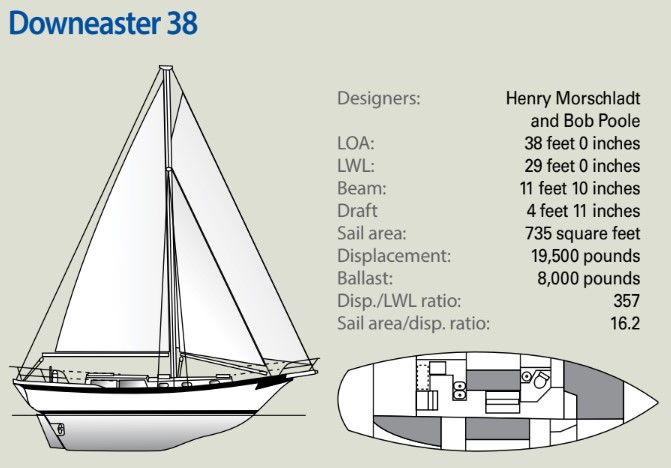
The DE 38 was conceived by Bob Poole who, when he moved to California, carried with him impressions of the traditional sailing craft he grew up with in Maine. In 1974, after a spell at Columbia Yachts, Bob co-founded Down East Yachts with Henry Morschladt, who was later one of the two original founders of Pacific Seacraft.
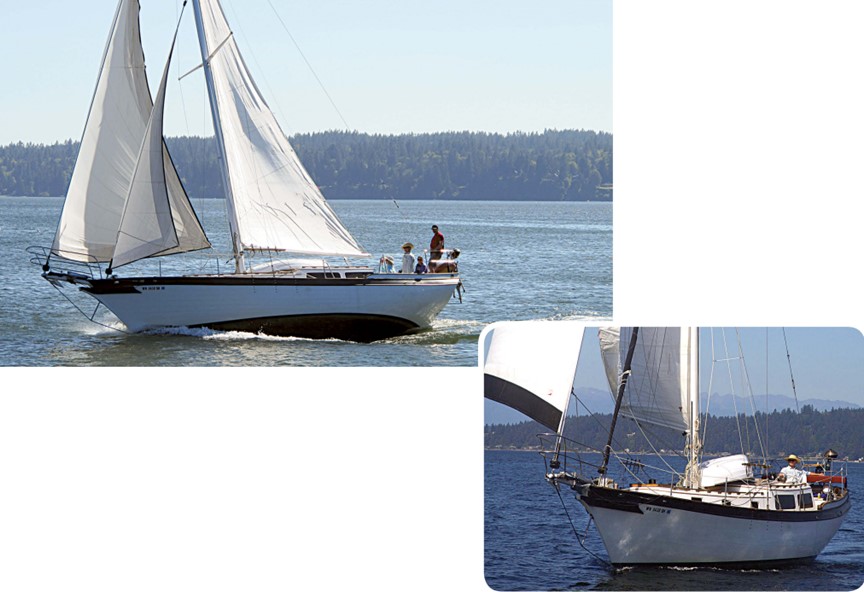
Down East Yachts built 251 DE 38s between 1974 and 1981. It also built the DE 32, the DE 45, and the pilothouse DE 41. All the Downeasters (also known as Down Easts) have a strong family resemblance, characterized by a clipper bow complete with a heavy bowsprit, trailboards, bobstay, whisker stays, and dolphin striker. The sheer sweeps gracefully from the stem to the wineglass stern, and the coachroof line follows the sheer to just aft of the mast, where it steps up. Large windows in the taller part of the cabin trunk let an abundance of light into the interior.
Construction
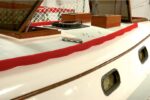
The hull of the DE 38 is a hand-laid laminate of fiberglass and polyester resin. The deck, which is for the most part cored with Airex, is solid around its perimeter. The hull-to-deck joint is formed where the deck edge lands on an inward flange molded around the hull sheer, where it’s sealed with bedding. Stainless-steel screws, driven up from below and into a heavy ironwood caprail, secure the joint, which is further reinforced with fiberglass tabbing on the inside. The caprail forms a substantial bulwark and a support for stanchions.
Mike says leaks do occur at the hull-to-deck connection as the bedding compound fails with age. The sources can be difficult to find and remedy because the fasteners are concealed.
Below the waterline, the DE38 has a full keel with attached rudder. The ballast, 8,000 pounds of lead, is set into the keel molding and sealed in place with fiberglass.
Two stainless-steel tanks within the keel cavity under the teak-and-holly cabin sole hold 100 gallons of water, and an 80-gallon fuel tank occupies a large compartment in a keel void below the galley sole. A 35-gallon holding tank is under the double berth in the forecastle.
On deck
Secure footing on the foredeck is assured by the substantial bulwarks. Movement fore and aft along the narrow sidedecks between the bulwark and the cabin trunk is largely unimpeded by chainplates, shrouds, and running rigging, which are kept well outboard of the walkway. A grit-in-paint coating provides some non-skid effect on the decks and is comfortable for bare feet, but I felt that a more aggressive surface would provide a more fitting grip for a bluewater boat.
Cabezon Café is equipped with a 35-pound CQR anchor, stowed in a roller on the starboard side of the bowsprit, and 200 feet of 3⁄8-inch chain. A second Bruce-type anchor is stowed on the port side of the bowsprit. Its rode is 80 feet of 5⁄16-inch chain and 150 feet of 3⁄4-inch nylon rode. An Ideal electric windlass with manual override does the heavy lifting.
Although the boat came equipped with davits, Mike liked neither the added complication nor the prospect of a following sea coming up against the dinghy. He prefers to carry a 9-foot Minto sailing dinghy on deck in chocks just abaft the mast, where it has little effect on the trim and can be launched quickly. He and Susan are adept at lifting the tender into and out of the water. They chose a hard dinghy for how it stands up to gravel beaches and for its fine performance under oars.
I was surprised at how little positioning the dinghy just forward of the companionway diminished the view forward, especially when compared to the effect of a dodger. A helmsman standing behind the wheel on Cabezon Café has a clear view of almost the entire horizon at all times.
DE 38s are known for the number of improvisations and improvements owners have undertaken to meet individual requirements and preferences. An example on Cabezon Café is the mainsheet, which was originally attached at the end of the boom and led to a block on the stern abaft the helm. The arrangement was awkward and unsafe, as the mainsheet interfered with the helmsman; an accidental jibe didn’t bear thinking about. To improve the setup, Mike moved the mainsheet tackle to a position on the boom forward of the helmsman and fitted a traveler forward of the wheel.
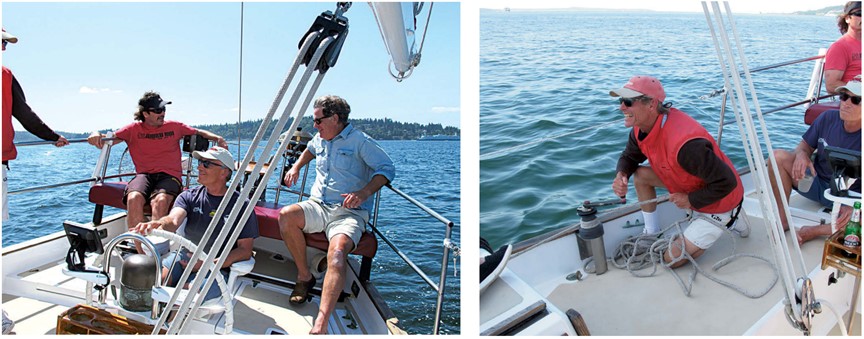
The cockpit seats, which extend from the footwell to the sides of the boat, become huge lounging spaces when in port or at anchor. A drawback to the wide seats is that they make the sheet winches difficult to reach and operate, and the footwell provides no footing to aid in serious winch work, especially on the leeward side. With this layout, singlehanding is difficult, and that difficulty is exacerbated by the wheel being so close to the seats that passing between them is almost impossible.
Mike added a removable cushioned bench that extends athwartships behind the helmsman. Although an unusual addition to a boat of this type, the bench provides seating for guests when daysailing or in harbor and looks like a useful addition to a cockpit that might easily become crowded.
Another unexpected feature in Carbezon Café’s cockpit is the helmsman’s padded and armed perch that seems lifted from a powerboat. It is exceedingly comfortable and worked admirably on the days of our sea trials.
Cockpit storage is good. There are large lazarette hatches to either side of the helm and propane is stored in a vented compartment to starboard.
The rig
Downeasters were offered as ketches or schooners, but the most popular rig was the cutter, with a roller-furling jib and a staysail on a club boom. Mike found a cutter. A large high-cut Yankee jib on a roller furler serves well in the frequent light winds of Puget Sound while allowing good visibility forward. It also helps the boat point well, while the staysail is a snug rig for work off-soundings. The mainsail is set up with jiffy reefing.
The mast is stepped on deck and supported by a large compression post located unobtrusively within the main bulkhead framing.
Belowdecks
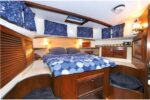
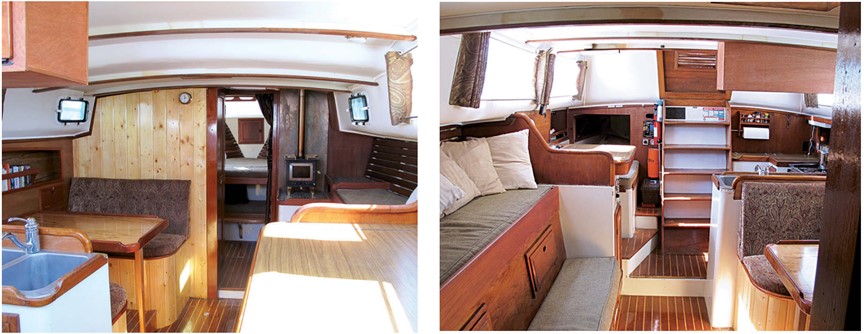
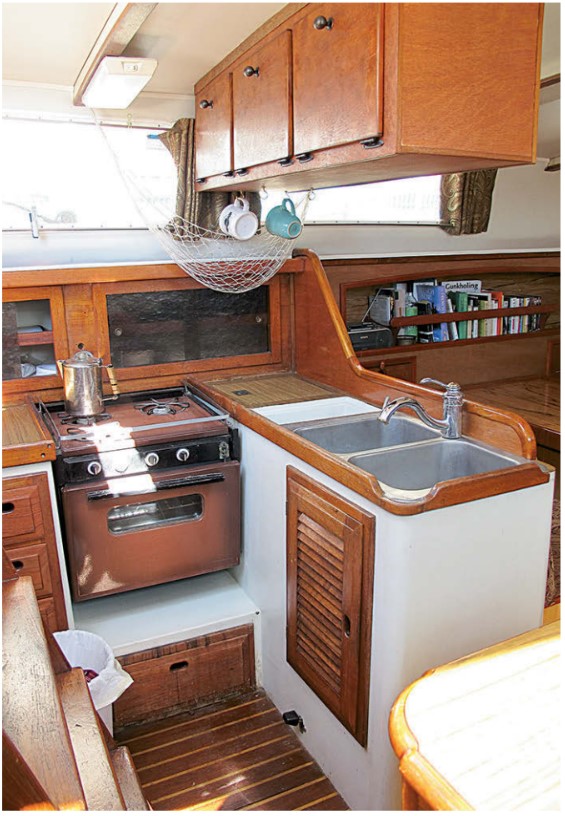
On entering the interior, the first impression is one of spaciousness, due in part to the 6-foot 4-inch headroom and the amount of light admitted by the four large windows in the raised portion of the cabin trunk. This area contains the galley, a chart table with seating at the end of the quarter berth, and part of the dining and saloon space. The nearly 12-foot beam also contributes to the spaciousness.
The DE 38 was designed with three separate iceboxes — plenty of space for general stowage and a boon for aficionados who like to maintain their wine at the proper temperature. Double sinks are located near the centerline.
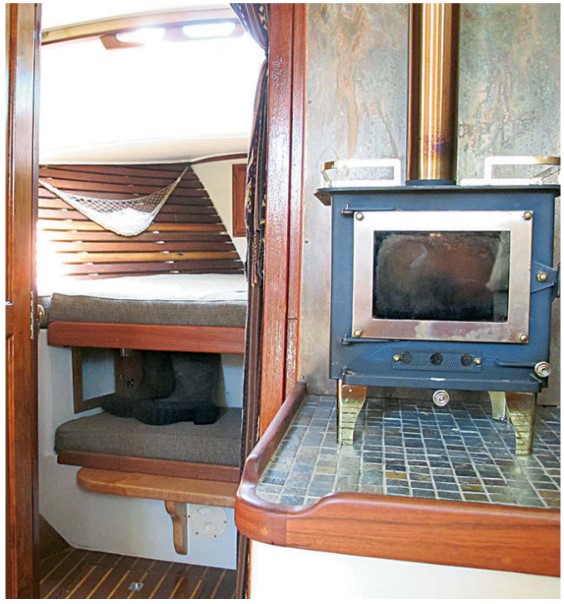
During Carbezon Café’s first winter in the marina, Mike decided to remodel the saloon. The original layout had settee berths and accompanying pilot berths on either side of a hinged table with folding leaves Mike revised this arrangement, putting a fixed dinette table on the port side opposite the single seat berth and a pilot berth to starboard. Where new cushion covers were needed, he and Susan made them with material to match the color and texture of the originals. In addition, for those cold and damp Puget Sound winter cruises, Mike installed a Cubic Mini wood stove on a small slate hearth overlooking the starboard settee. The stove’s principal fuel supply is 2- to 3-inch lengths of Presto logs that Mike pre-cuts. The original double berth in the forecabin and a quarter berth under the cockpit remain.
Mike carried out his repairs and revisions over a yearlong outfitting period. He and Susan went sailing often during this time, allowing Mike to put his ideas to the test and act on second thoughts as they arose.
All in all, the cabin is well-planned, comfortable, and tastefully outfitted with fine joinery. If it were my boat, however, I would look for places where I could add a grab bar or two strategically located to help crew moving about in a seaway.
The engine
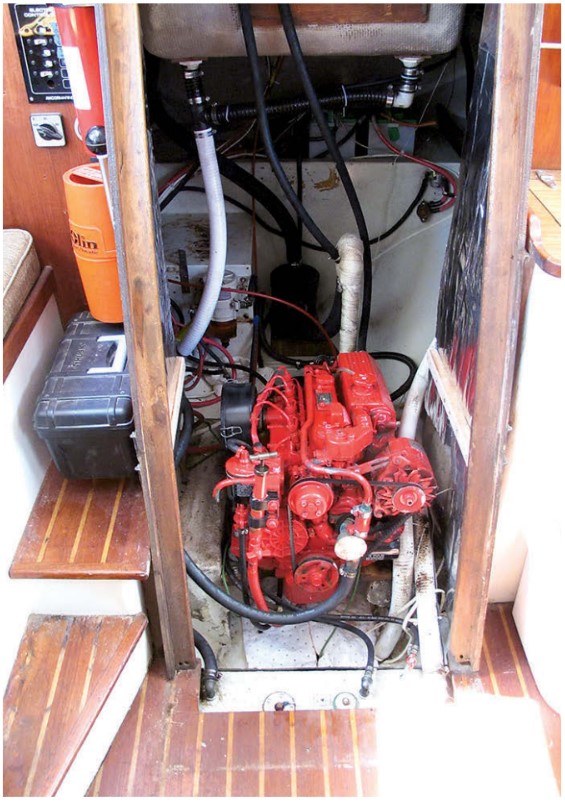
The DE 38 was originally powered by a Farymann 24-horsepower raw-water-cooled diesel with hand-cranking capability. As time wore on, many owners replaced that engine with a larger freshwater-cooled engine. Carbezon Café’s replacement engine is a 38.5-horsepower Beta. It appears to be a snug fit around the sides, but the engine is designed with most of its service points facing forward. Although the sound insulation is minimal, the engine noise on deck is quite agreeable. Mike reports an average cruising speed of 6 knots and diesel consumption of about 1⁄2 gallon per hour.
Originally, the starting and house batteries were located high in a space abaft the engine that made servicing them difficult and necessitated long cables. Mike plans to relocate them under the quarter berth, where they will be lower in the boat, easier to service, and the cables will be shorter.
Under way
As Cabezon Café moved out of her slip, the 16 x 9-inch three-blade prop got a good grip on the water. She backed predictably, and Mike was able to stop her short within the confines of the narrow waterway before we followed the Seattle ferry out of Eagle Harbor.
We made for open water smartly but lost the wind in short order. As often happens on Puget Sound, all the wind seemed to be in the harbor. Despite the DE 38’s reputation for being sluggish in light winds, we moved right along, due in part to a clean bottom, good sails well trimmed, and careful helming. She moved surely in the light air, coming about without hesitation and carrying her way in fine form.
When, on another occasion, I sailed Cabezon Café in stronger winds, she perked up and clipped along like a larger boat. She seemed smooth and steady, and was entirely dry. The roller-furling staysail and jib were safe and easy to adjust, making it easy to achieve the right balance of sail area. She made little fuss of the short chop in the 10- to 15-knot winds of the day, heeling only moderately in the gusts. Her helm was uncommonly well-balanced and she sailed herself for long periods on the wind with nothing but a light finger touch on the wheel, if anything at all. She carried very little weather helm on all points of sail.
Conclusion
The DE 38 is a good boat for a variety of coastwise conditions. It is rather shallow in draft for its size, but tough should it ground on a shoal while gunkholing. The boat is also able to perform well off-soundings when heavily laden with fuel and stores. Window protection in the form of storm shutters is essential at sea.
The large cockpit should be made to drain readily in case she takes green water on board. In fact, anyone contemplating sailing singlehanded, or couples planning passages, should take a serious look at the cockpit arrangement on the DE 38. The wheel severely restricts movement to and from the helmsman’s perch; a tiller might work better. The wide cockpit seats and their effect on winching can be accommodated when cruising near shore, but a more workable layout would better serve the offshore sailor.
A quick check on the internet turned up five used DE 38s dating from 1975 to 1979. The lowest price was about $30,000, but the highest was $74,000, suggesting that there may be some real values out there.
Richard Smith is a contributing editor emeritus with Good Old Boat. He has built, restored, and maintained a wide variety of boats and sailed them on Michigan lakes and Oregon reservoirs and from harbors and mud berths in the Irish sea. He sails Kuma, an Ericson Cruising 31, on Puget Sound.
Thank you to Sailrite Enterprises, Inc., for providing free access to back issues of Good Old Boat through intellectual property rights. Sailrite.com