The Cuban yo-yo takes up no space yet hauls in dinner
Issue 115: July/Aug 2017
I’m a fishing sailor. Fishing passes the time during periods of light winds, and there is no finer dining than on a fish that stopped flopping an hour ago. Unfortunately, ours is the typical cruising boat, crammed full of the stuff of cruising and with a cockpit that is crowded with the running and standing rigging with which the typical fishing boat doesn’t contend. Adding rods and other fishing gear that would allow us to fish as we sail isn’t reason- able, and so we’ve adopted a much simpler, more compact method.
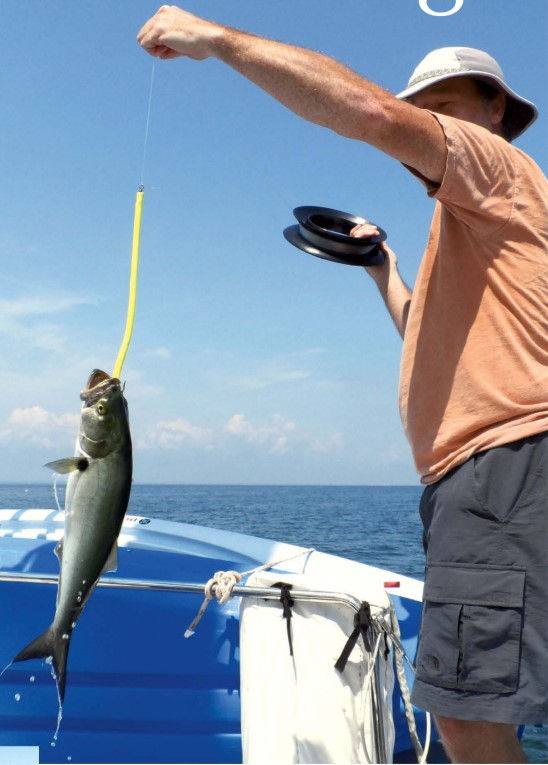
We fish with a yo-yo, actually several yo-yos. This hand-line option dispenses with rods altogether and is made practical by a simple plastic spool, the Cuban yo-yo. I discovered this device a while back on a business trip to Florida, where it’s found in every bait-and-tackle shop. Although it looks like some sort of toy to the untrained eye, I’ve landed striped bass up to 40 inches and 25 pounds with a yo-yo with no more effort than I’d need with a trolling rod.
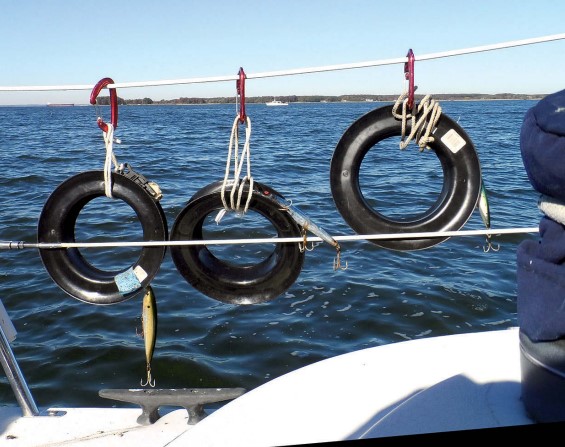
The beauty of the system is that I can keep a half-dozen yo-yos fully rigged and ready to go in a 2-gallon bucket.
Yo-yo fishing
While the Cuban yo-yo rig varies according to region and the fish being pursued, I can describe the setup that I like to use for going after bluefish and striped bass on the East Coast and Chesapeake Bay.
Size – Yo-yos come in 6-inch and 8-inch diameters. I use the 8-inch version as it works best with the heavy line and large lures I prefer for trolling.
Line – I use 150 to 250 feet of 80-pound-test monofilament and secure it to the spool with a spool knot or halyard knot. This line is strong enough for big blue- fish and striped bass and has enough stretch to manage even the most vicious strike. Some folks suggest adding a bungee cord to absorb the impact, but since the line will stretch 15 to 25 feet on a serious strike, the additional two feet of stretch afforded by a bungee doesn’t warrant the complexity it adds to the rig.
Anchoring – I attach the yo-yo to the boat with a loop tied from 4 feet of parachute cord and clipped to the stern rail with a carabiner.
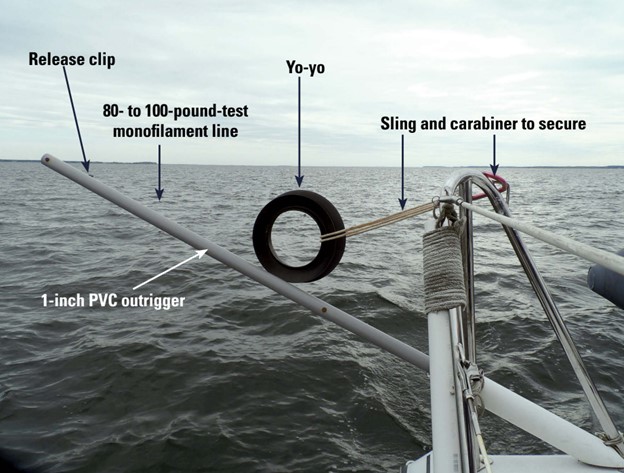
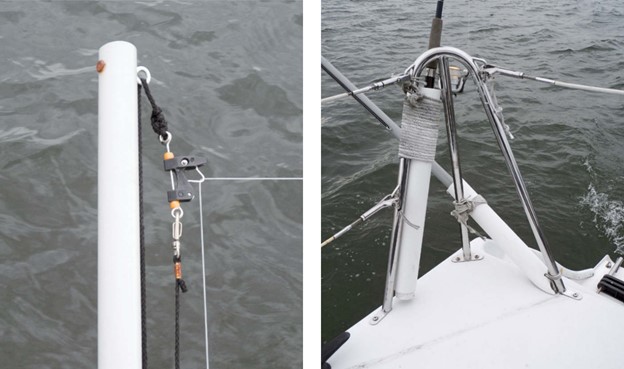
Release – To detect a strike, I like to rig the line to a flat-line release clip (like an adjustable clothespin) for the lines along the stern rail, and to outrigger clips for the lines on the outriggers. To use a flat-line clip, I pull up a loop of line and place it in the clip. I find that the loop gives a clean release. If I simply place the line in the clip, it may just slide along without releasing. When a fish strikes, there is a snap from the clip and considerable clatter as the yo-yo bangs on the rail. When using the outrigger clips, I simply lead the line through the clip.
Spacing – Rigs should be at least 6 feet apart to prevent tangling when the fish starts to zig and zag. We typically rig one on each corner of the stern. If seriously engaged in fishing, we can tow as many as five, aided by the 16-foot beam of our catamaran and our two 5-foot outriggers.
Outriggers – I use outriggers to allow me to troll with a couple of additional lines. Outriggers can be made simply with a 6-foot length of 1-inch PVC conduit and a release clip at the tip. Besides allowing me to tow additional lines, outriggers also serve to keep those lures out of the wake of the boat, which seems to help.
Sinkers – Striped bass (also known as rockfish) run a little deep, bluefish more shallow, and some game fish very near the surface. Using lead torpedo weights, I vary the weight from 1 to 5 ounces, depending on what I’m after.
Leader – I add another 15 feet of the same line between the sinker and the lure as a leader.
Lure – Of course, the lure I use depends on the fish, but spoons, jigs with soft shads (for striped bass), hose eels (for bluefish), and squid (for mahi- mahi, tuna, and the like) are popular.
Speed – I will either vary the speed depending on what I’m after, or change what I’m going after based on how fast we’re sailing. The 3- to 5-knot range is good for striped bass and 7 to 10 knots is better for fast game fish.
Where – Local knowledge rules. Drop-offs in depths from 20 to 40 feet, away from fish traps and crab pots, are a starting point.
Technique
To avoid tangles, I make long slow turns when towing more than one line. When a fish strikes, I slow the boat to 2 to 3 knots to make retrieval easier, but I do not stop the boat. Because a yo-yo doesn’t provide the perpetual tension of a bent rod, it’s prone to allowing slack in the line that may allow the fish to throw the hook. The steady forward motion of the boat keeps the line taut and is a good substitute for rod bend. Forward motion also keeps the fish straight astern, reducing the chance that it will tangle the other lines. I always wait a few minutes for a fish to tire before I begin to haul it in; an energetic fish can throw the hook.
While a net or gaff might be useful for truly spirited fish, I simply haul fish on board using the yo-yo. I use my right hand to work the yo-yo in a steady figure-eight motion, like winding in a kite, taking the full weight of the fish while I use my left hand only to guide the line. I never haul the line hand-over- hand, but let the yo-yo do the work of holding the weight. That prevents tangles, and I avoid getting a tangled mess of line in the cockpit.
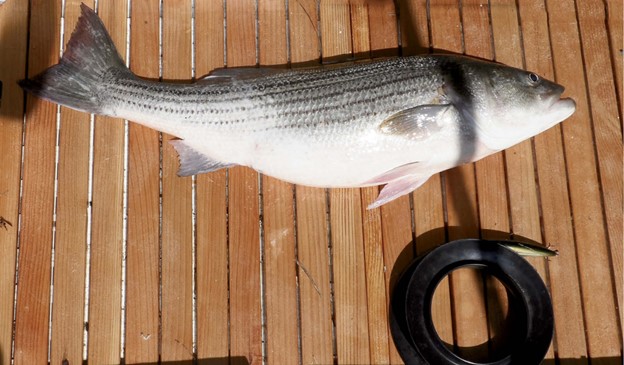
Although I nearly always wear gloves while sailing, I retrieve fish without them. Without gloves, I feel I have better control. Glove seams catch on the line and I have found there is little risk of cutting my hand, even with a large fish.
For reasons I don’t fully understand, I catch far more fish under sail than under power, something that doesn’t seem to affect most fishermen. Perhaps it’s the higher pitch of my small outboard compared to the low rumble of a big diesel running at idle. But I consider that a good thing — one more reason to sail and enjoy the quiet, while waiting for the snap and clatter that announces my Cuban yo-yo has done its job.
Fishing at Anchor
I also use the yo-yo to still fish. Still fishing is fishing reduced to its origins — me and the fish, mano-a-mano.
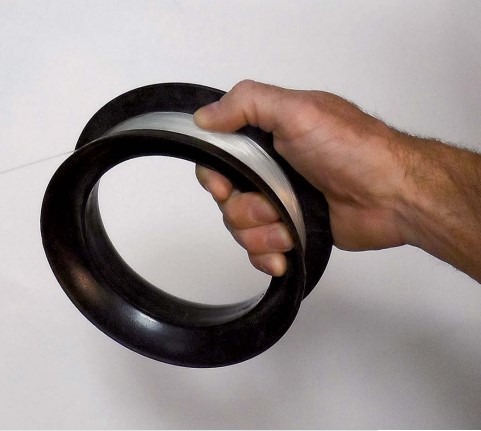
A close examination of the yo-yo reveals two vital details: the lip is lower on one side than the other and there is a ring all the way around the inside that provides a secure grip. For still fishing, I reduce the line to 25-to 40-pounds test and replace the trolling sinker and lure with any common bottom-fishing rig. To cast, I let out about 3 feet of line, pinch the line against the yo-yo with one finger, whirl it overhead like a sling shot and, at the time I release it, aim the low side of the reel at the target, just like the spool of a spinning rod. The line spirals off in the same manner. Setting the hook and fighting the fish are more delicate, as I don’t have the length of the pole working for me. I’ve done this a few times, just for the fun of it, but I also carry two light-tackle rods with 10-pound line for still fishing.
Drew Frye cruises Chesapeake Bay and the mid-Atlantic coast aboard his 34-foot catamaran Shoal Survivor, searching for out-of-the-way corners known only to locals. A chemical engineer by training, and a 40-year climber and 30-year sailor by inclina- tion, he brings a mix of experiences to solving boating problems and writing about them.
Thank you to Sailrite Enterprises, Inc., for providing free access to back issues of Good Old Boat through intellectual property rights. Sailrite.com