How you should behave in the company of whales and dolphins
Issue 21 : Nov/Dec 2001
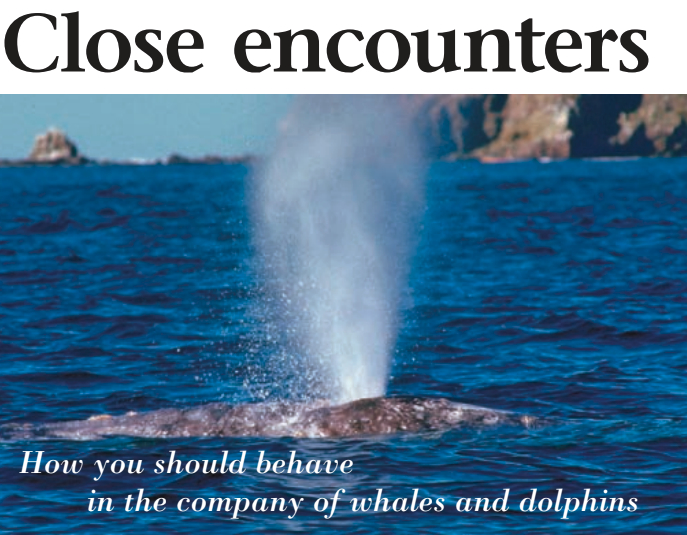
It’s a treat to have dolphins ride our bow wave as we sail along. Seeing whales from our boat makes our day. I always want to reach out, to make a connection with these amazing creatures. But my sense of self-preservation (they really are quite big . . . and wild!) and my desire for these beautiful creatures to remain wild returns. How can we safely sail through their territory without causing disruption to their lives, keep our own boats safe, and have a chance to view these amazing creatures?
As sailors, we have a responsibility to keep ourselves safe while we’re on the water. This responsibility should extend to include whales and other marine animals that come within viewing distance of our boats. The United States Marine Mammal Protection Act of 1972 (MMPA) prohibits the harassment, feeding, touching, capture, or killing of any marine mammals, with a penalty of up to $20,000 and one year in jail. Harassment is defined in the act as “any act of pursuit, torment, or annoyance which has the potential to injure a marine mammal or marine mammal stock in the wild by causing disruption of behavioral patterns, including, but not limited to, migration, breathing, nursing, breeding, feeding, or sheltering.” Some exceptions are made for authorized scientific research.
The Endangered Species Act (ESA) provides further protection to species of marine mammals that have been listed as endangered or threatened (see list of endangered mammals on Page 78). This act prohibits the “take” of species listed as endangered or threatened.
“Take” is defined as “to harass, harm, pursue, shoot, trap, collect, hunt, capture, or kill, or attempt to harass, hunt, capture, or kill any marine mammal.” It is further defined by regulation to include “feeding or attempting to feed a marine mammal in the wild.” The maximum fine for violating the ESA is $50,000 and one year in jail.
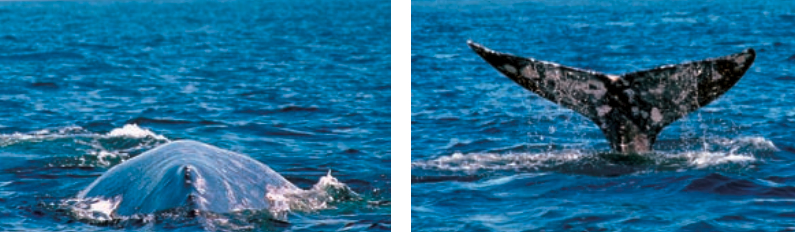
Whale-watching guidelines
Interactions with whales and dolphins are on the rise. Are we hurting them with our interest in getting close? Recent research suggests that we could be. There have been increased incidences of harm coming to cetaceans because of human and whale interactions.
Whales and dolphins need to remain wild so they can cope in their environment. Most countries have developed whale-watching guidelines for the safety of boaters and marine mammals. Cetaceans may feel threatened by boats that approach too closely. The National Marine Fisheries Service has specific whale-watching guidelines for each of our country’s main regions. The following is just an overview. For specific guidelines for your area of the country, contact your regional National Marine Fisheries Office (see list of phone numbers on Page 78).
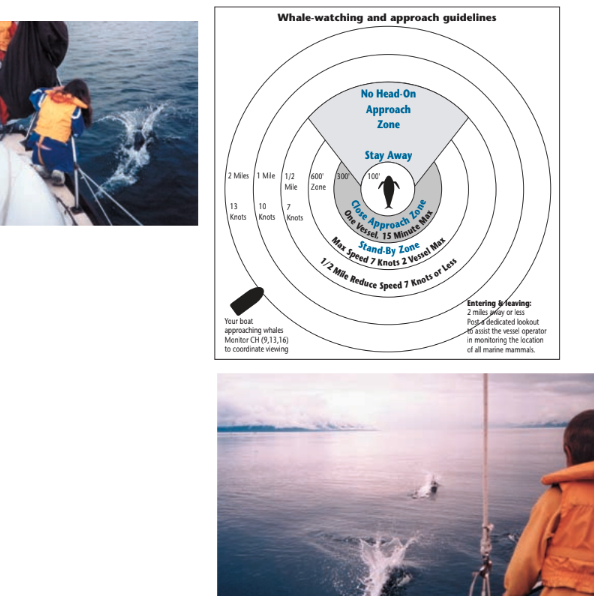
Except in the case of Northern Right whales, remain at least 100 yards (the length of a football field) away from cetaceans or other marine mammals while underway. Activities within 100 yards require caution, and approaching closer than 50 yards involves a high risk of harassing the cetacean. By federal law, no Northern Right whale can be approached closer than 500 yards. Once whales or dolphins are spotted, post a dedicated lookout. It’s not hard to get a volunteer for that! The lookout should be watching out for where the whale or dolphin resurfaces so the helmsman can avoid collision, and so the helmsman can proceed according to approach guidelines (see illustration on Page 78).
Your vessel may not be alone when encountering a whale or a pod of whales. The impact of many viewers is cumulative to whales and other marine mammals. Whales are more likely to be disturbed when there is more than one boat in the area. If other boats are nearby, communicate with those boats via radio to establish a plan to take turns approaching.
Sound travels faster and farther in water than in air and plays a major part in a marine mammal’s life. Sometimes we don’t realize how important sound is to underwater dwellers. Cetaceans use sound for communication, foraging for food, and navigation. They have a very good sense of hearing. The potential for disturbing whales with the noise of a vessel approaching is very real. Whenever you are near whales or other marine mammals, maneuver slowly and quietly. Try not to make harsh noises.
The following are guidelines the National Marine Fisheries Service has developed for whale watching:
- Never separate a group of whales.
- When you need to move your vessel, do so from behind the whale. When leaving the area, maneuver away slowly.
- Actively look for surfacing animals. Slow down and steer away from their direction of travel.
- Limit your observations to less than half an hour.
- Whales should never be encircled or trapped between boats or between boats and the shore.
- Never pursue a whale. Let the whale approach you instead. Do not attempt to touch them. These are wild animals that must be allowed to remain wild.
- Never feed or attempt to feed a marine mammal. It affects their ability to cope and live in their natural habitat.
- Do not discard fish or fish waste in the area of marine mammals.
- Avoid being directly in front of a whale.
- It is less disturbing to marine wildlife if you travel in a predictable manner. Avoid sudden changes in speed or direction.
- Boats should not be operated at a speed faster than a whale or group of whales is traveling while paralleling them within 100 yards.
- Do nothing with your boat to cause a whale to change direction.
- When in the area of a whale sighting and while sailing (without your engine running), periodically tap the side of your boat with a hard object to avoid whale and boat collisions.
- When a whale shows signs of being disturbed, leave the area.
These are the signs marine mammals exhibit when they’re disturbed:
- Increased breathing rate.
- Rapid changes in direction of movement.
- Loud blowing underwater.
- Threatening rushes at boat.
- Tail slapping or tail swishing from side to side.
Whenever we take to the water, we think of ourselves as entering a wilderness area. We wouldn’t attempt to feed a grizzly bear or a wolf while hiking in the backcountry. And we would never attempt to get very close. We try to view wildlife from afar, watching them interact naturally in their environment. If we are prudent in our observation of marine mammals, we can help keep these amazing creatures healthy, safe, and wild. When we get a chance to see their beauty and grace as they live their lives naturally, we’re glad we helped.
Theresa and Chuck Fort and children, Amie and Alex, moved aboard Lindsay Christine, a Mercator Offshore 30, in 1995. They were landbound in Florida for a period of time to accommodate their children’s orthodontic appointments, but they are underway again.
Thank you to Sailrite Enterprises, Inc., for providing free access to back issues of Good Old Boat through intellectual property rights. Sailrite.com