Could old boats be the new old cars?
Issue 112: Jan/Feb 2017
When reader George Chase offered his perspective on owning good old boats, we decided to share it with all good old boat caretakers. –Editors

I recently bought a 1971 Honda CL 100 motorcycle that I intend to (or will attempt to) restore. It runs, but just barely. I’m not a skilled mechanic, but I look forward to learning. When people hear what I’m planning, they say: “That’s great. It should be fun. Let me know how it turns out.” The general consensus is that this is a worthwhile enterprise.
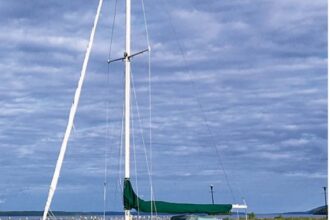
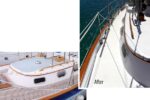
I also own a 1973 Grampian 26. The deck is wood-cored and leaks have resulted in some deck rot and soft spots. Most people said: “It’s not worth the effort to fix the deck. Just part it out and scrap the boat.” I initially accepted this view and started thinking about selling off parts.
There are subtle contradictions in these views. Why is it useful, worthwhile, and fun to restore a 1971 motorcycle but not a 1973 sailboat? There’s little monetary incentive for either project; the return cannot justify the expense and effort. What makes the sailboat “unworthy” of restoration? I recognize that an older sailboat may cost a bit more than an old motorcycle and it has ongoing costs, like moorage, but a sailboat can be bought for little more than an older second car and there are alternatives to paying yearly moorage.
I believe a sailboat is seen as useful but not valued as a classic. When its usefulness ends and it requires too much work/money to repair it, you scrap it. But the motorcycle is viewed as an antique that deserves to be restored. Maybe this has to do with a common view that the “real” classic sailboats are wooden ones, not the plastic ones that succeeded them.
We’re gradually losing good old boats, so perhaps we need to rethink how we view them. Few affordable boats are being manufactured to replace the boats we’re losing. About Classics in waiting 1,000 Grampian 26s were built. Surely no more than half are still in the water; fewer still are being actively sailed and maintained. Old cars and old motorcycles are ubiquitous; anyone who cares to restore an old car or motorcycle can easily find one.
We should view our old sailboats as “classics” worthy of restoration to be passed on to the next generation. If nearly every fiberglass sailboat under 35 feet and older than 30 years were scrapped, we’d have a strong sellers’ market for those that remained. Remember when you could buy a beat-up Volkswagen van for $800? No one ever thought they’d be highly sought-after by collectors. Our small fiberglass sailboats may be the same.
Naysayers will note that the value of a sailboat is whatever someone is willing to pay for it. That’s its present value, but what about its future value? What small sailboats might be available to the average person in 2030?
Our sailboats have inherent value because they’re declining in number and not being replaced by affordable sailboats. Boats like the Contessa 26, Alberg 30, and Westsail 32 achieved a cult following for their ocean crossings and seaworthiness. But what about the humble sailboats that were never designed or built to be ocean-crossing thoroughbreds? They represent a bygone era when smaller sailboats were within reach of the average person: big enough to vacation on and affordable for a family. That era was short: the late ’60s and early ’70s. Maybe we need to start seeing ourselves more as caretakers, rather than owners, of our good old boats.
Well-meaning surveyors tell us to purchase used boats with our heads, not our hearts, and to do a cost analysis between fixing up an older boat versus buying a newer one in good repair. I appreciate their efforts to save us from ourselves, but they’re preaching to the damned. Honestly, do any of us get into boating because we anticipate saving money or selling our boats at a profit? Unless we need a boat for transportation or in the pursuit of our work, we have no logical reason for owning a small sailboat except as a hobby or a pastime.
Obviously, when we buy a used sailboat, we try to find one that will give us the least amount of grief. I’m sure surveyors have seen their share of starry-eyed sailors who end up ritually impaling themselves on that stanchion that just won’t stop leaking no matter what they do to repair it. But in the end we never buy boats with our heads. If we listened to our heads, we would never buy them at all.
Instead, take the full cost of your boat, including upkeep and moorage, and divide it by the years you own it. If the result is equal to or less than what you would spend on a vacation and hobbies each year, you’re ahead of the game. I am presuming that you enjoy, for the most part, working on your boat. I calculated that it costs me $6 to $9 a day to own my boat. I can live with that. Many people spend much more than that every day just to park their cars.
I’m worried about whether I have the skill, the money, and the stamina to repair the deck and keep my Grampian, but I’ll give it a good try. The worst that can happen is that I’ll waste some time, effort, and money without succeeding in bringing the boat back. Wait! Isn’t that what I’m doing with my motorcycle? Besides, there’s always that leaking starboard stanchion I can use to end it all if things turn out badly.
Perhaps in my lifetime I’ll attend a floating “show and shine” with my vintage sailboat as an entry.
Thank you to Sailrite Enterprises, Inc., for providing free access to back issues of Good Old Boat through intellectual property rights. Sailrite.com