A high school sailor questions their value
Issue 124: Jan/Feb 2019
My former high school sailing-team coach was always telling us “consistency is key.” What does that even mean? What if consistency for us was last place? How is that the key to success? There are times when such clichés do apply, but that’s usually by chance.One of the rare occasions when “consistency is key” rang true to me was this past fall season, when my skipper and I were at the qualifying regatta for the Great Oaks Invitational, a national regatta for high school teams. We sailed well and raced well and consistently earned thirds and fourths in the first round. That got us into the final qualifying round, but a couple of 10ths (out of 14 boats) on Saturday and another on Sunday, prevented us from qualifying for Great Oaks. Had we consistently earned thirds and fourths, we’d have qualified. The “consistency is key” cliché didn’t help us avoid the costly bottom-of-the-fleet finishes.
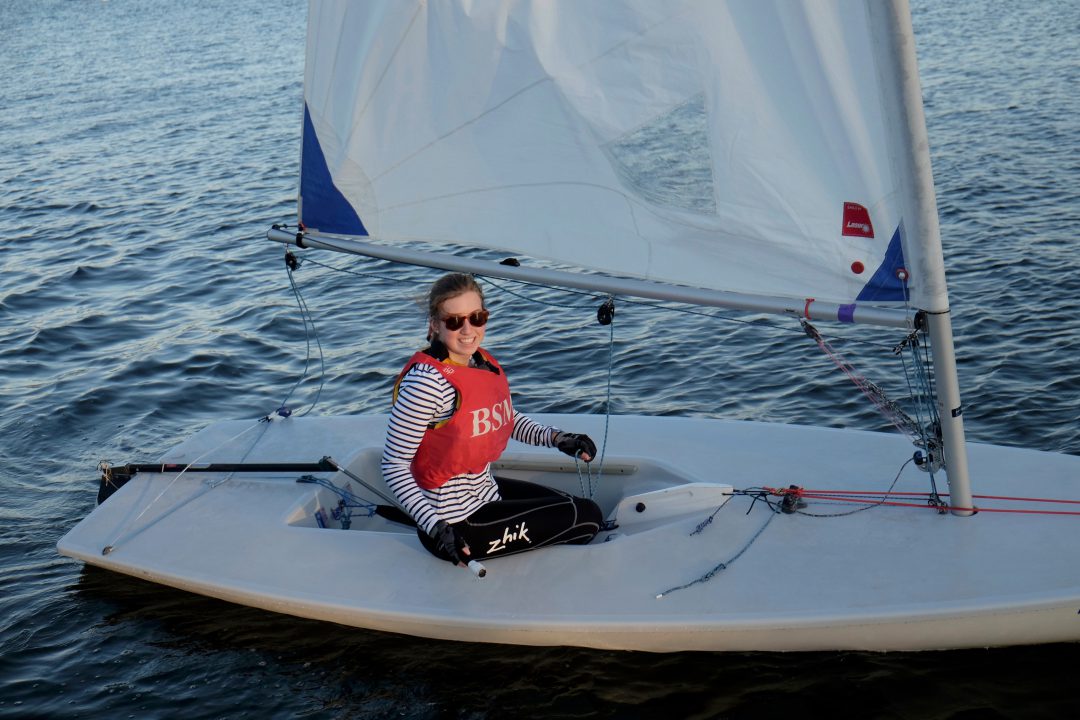
I can’t tell you how many times I’ve heard the phrase “high risk, high reward.” Another way I’ve heard coaches describe it is: “If you’re in last, and there’s even a two percent chance that a risk could pay off, take it.” This past fall I started sailing a Laser Radial. By the time the Cressy Qualifiers came, I had sailed the boat eight times. (The Cressy Trophy is awarded to the winner of the National High School Singlehanded Championship.) My goal going into this regatta was simply to not finish last. My reach goal was to get 4th from last (I’m pretty good at setting low standards for myself).
The night before the qualifiers, I was more nervous than I have ever been ahead of a regatta, but by the end of the first day, I was more confident in my skills and had already learned a lot. I was mid-fleet when I made the “high-risk, high reward” decision, based on logic and convenience, to round the right leeward mark instead of the left one, separating myself from most of the fleet. I finished the race 11th out of 25 boats. I have never been more proud of my sailing than I was after that race.
Another cliché I hear from coaches is “Your start is 90 percent of your race.” In Lake Geneva, Wisconsin, this past fall, we had more than our share of bad starts. In one race we were shut out at the line and started dead last. With nothing to lose, we took a big risk by ducking the fleet and sailing to the opposite side of the course from the other boats. The high risk didn’t lead to a high reward. We didn’t finish dead last, but we were close enough. I realized the two clichés are connected. We knew that, according to the cliché, our bad start meant a bad race, so we turned to the “high risk, high reward” cliché.
When I’m racing I have plenty to think about: Where is the wind coming from? Is the boat flat? Are we making progress toward the mark? Are we in clean air? There is a major difference between clichés and the questions I need to be focused on, the answers to which give me information I can act on right there and then. When I ignore those questions and answers and instead focus on clichés I hear so often from coaches, I’m abandoning the tactics that are key to sailing a successful race.
Clare Leeper started sailing at age 6. A high school senior, she races International and Club 420s and Lasers at regattas primarily in Minnesota, as well as sometimes in Wisconsin and Illinois. Sailing is her favorite thing to do and talk about, and she loves her sailing friends and the community within the sport. Clare’s next step is to find the perfect college with a sailing team.
Thank you to Sailrite Enterprises, Inc., for providing free access to back issues of Good Old Boat through intellectual property rights. Sailrite.com