What you see is exactly what you get
Issue 47 : Mar/Apr 2006
Why do you always seem to tack into a header? Why do iceboats always sail to windward, no matter which direction they’re going? Why is it that you need a sweater when the sailors of the boat you just met were sitting around in their shirtsleeves? The answer, in each case, is apparent wind.
“Apparent” wind sounds like something that doesn’t really exist; it just appears to. Apparent wind does exist but only on your boat and only when it’s moving. It is an invisible, ephemeral, and individual sort of reality, but it is real just the same.
What do you think of when you think of wind? It could be trees swaying or flags whipping smartly on tall flagpoles. To a meteorologist, it’s the movement of air from an area of high pressure to one of lower pressure. To a sailor, that is the “true wind.”
Imagine a totally calm day with no wind at all. Your boat sits quietly on a perfect reflection of herself. You go aboard and start the engine. As you power away you feel a breeze on your face coming from dead ahead. You know there is no wind; the breeze you feel is just the movement of the boat through the air. But from the point of view of the boat, there is a wind. It’s all in your frame of reference. Think of it as the “boat wind”: the wind you feel when you’re on a moving object.
Now let’s go sailing. With a nice (true) wind to provide the motive power, you trim your sails and the boat starts moving. As she gathers speed she also creates some wind of her own, the boat wind. This interacts with the true wind to produce another wind that is neither true wind nor boat wind, but something in between: the apparent wind. Exactly what that consists of depends entirely on the sailing characteristics of your boat. It is your own personal, private wind. No one else has one just like it.
Draw a diagram
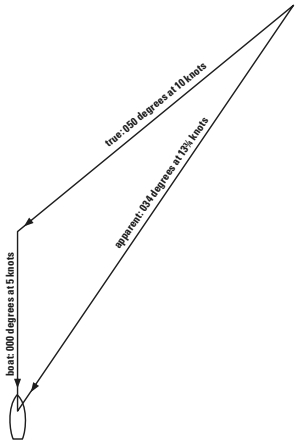
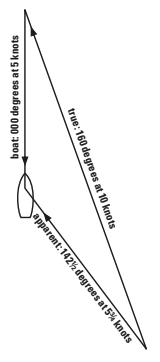
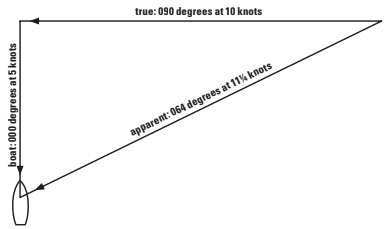
A good way to visualize what is happening is to draw a vector diagram. Draw a line to represent the true wind, in any convenient scale and from the proper direction (in the illustrations on Page 18 I use compass directions). Next, add the boat wind, in the same scale and in a direction opposite to the course of the boat (remember that the boat wind is always from dead ahead). Now add the third side of the triangle and you have both the direction and force of the apparent wind. It is possible to do all this mathematically using a calculator with trigonometric functions, but it is simpler and easier to do it graphically.
If you work out a variety of combinations, you will find that the effect of the boat’s forward motion is to move the apparent wind forward of the true wind. The true wind will always be fairer (that is, from a direction further aft) than the apparent wind. This is because, as soon as the boat starts moving, you add a forward component, the boat wind.
In addition, if the wind is from forward of the beam, the strength of the boat wind is added to the true wind so the apparent wind will be stronger. If the wind is from aft, the boat’s speed will be subtracted from the true wind speed, and apparent wind will be less that the true wind speed.
This explains why it is usually warmer running than beating. How strong these differences will be is strictly a function of how fast your boat is moving.
Vector diagrams are all very interesting in the comfort of your home, but how do you determine the apparent wind in the cockpit with one hand on the tiller and the other holding the mainsheet (or a beverage)? The reason that it is called “apparent” wind is because it is the wind that appears to the senses of the people on the boat. So what the wind indicators on your boat are showing is the apparent wind. This is equally true whether you use bits of yarn in the rigging or some sort of indicator at the masthead. If you use both, you may notice that they don’t read the same. Which is right? Both are right, as we shall see shortly.
Only one factor
So much for theory, but is it of any practical use? Most assuredly. If it is really the apparent wind that your boat is sailing in, then the true wind is just one factor in the equation (though usually the most important factor). As noted, when you are going to windward the boat speed causes the apparent wind to be stronger than the true wind. This increase in wind strength is accompanied by an increase in boat speed, which by increasing the boat wind further increases the apparent wind.
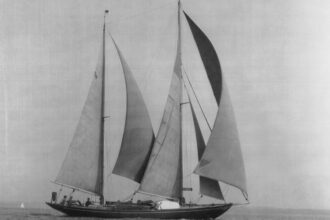
It all sounds suspiciously like a perpetual motion machine, but the boat quickly reaches equilibrium and further increases cease. Still, iceboats and some special sailboats (like proas and high-speed catamarans) sail faster than the true wind. The lesson here is not to take your cues on sail trim from the larger, faster boats you may see in your vicinity. Their personal (apparent) wind is different from yours. Trust your own telltales.
But you don’t have to be a faster-than-the-wind speedster to be affected by the fact that your apparent wind is different from the true wind. After a tack, as your boat picks up speed again, the apparent wind moves forward, just as it had already done on the other tack. The effect is to give the appearance of a heading wind shift. So if the wind always seems to head you whenever you tack, take heart. You either have a fast boat, or you are very observant.
There is something else. Wind is affected by friction with the surface of the sea. The wind at the water’s surface is slowed by this drag, but its speed increases with height. Thus the true wind blows faster at the masthead than it does on deck. But boat speed is the same everywhere on the boat. Since the true wind is a larger element at the top of the mast than at the bottom (how much depending on the height of your mast) the wind aloft is not only stronger but also fairer.
This shift in direction happens gradually with increasing height. Thus, for optimal performance the sails should twist off a bit to leeward in their upper sections. However, don’t take this too far. The difference is slight. Especially if you have a relatively short mast, the twist should be minimal.
Wind is a powerful motive force that sailors are able to capture for our use and pleasure. Therefore, no matter what seems to be happening elsewhere, trust the wind indicators on your own boat. Your telltales show the particular wind you are sailing in. When it comes to apparent wind, what you see is what you get.
Thank you to Sailrite Enterprises, Inc., for providing free access to back issues of Good Old Boat through intellectual property rights. Sailrite.com