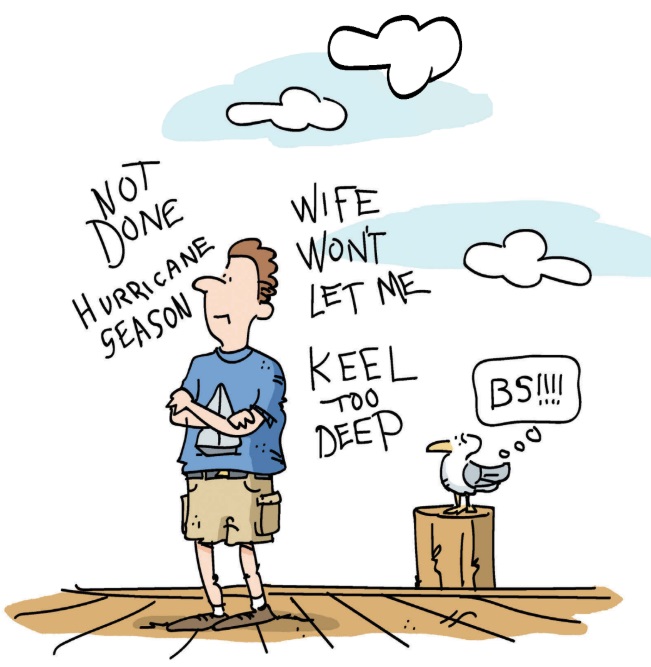
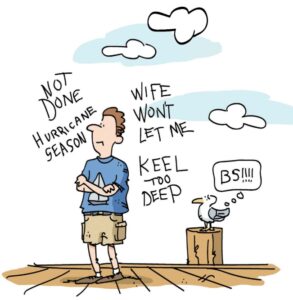
They’d set sail tomorrow if it weren’t for . . .
Issue 125: March/April 2019
We see it all the time. A boat is purchased and an announcement made, but, after some time has passed, either reality or nerves derail a bold plan to sell all and sail into the sunset. No doubt the reasons are fully rational; it matters not. Only some very fancy dancing can save the would-be voyager from humiliation. The retreat must be well reasoned, or at least artfully presented.
Some years ago I found myself at such a crossroads. I had been dreaming of passages to Bermuda and beyond. I even hinted as much to friends. But I found the cost — insurance, EPIRB, sat-phone rental — was more than I could stomach, and the emotional reward less than I’d imagined. Finding the right crew was a challenge, my back was unreliable at the time, and done right, the voyage would take me away from work longer than I could justify.
Faced with this landscape of stumbling blocks, I found myself “climbing down,” retreating to the familiarity of coastal cruising. A famous Scottish ice climber with a rapier wit, Tom Patey, wrote a penetrating article under that title some 40 years ago, describing traditional ploys used by climbers when age, situation, or infirmity prevents them from making the grade at the local crag.
Apply the following ploys as you will, either as justification for your land-based life, or to explain why your boat hasn’t left the dock for months.
1. The “Off Form” Ploy.
If you’ve not been using your boat regularly, this ploy is rooted in a bit of reality, adding instant credibility. “I haven’t been getting out enough lately to take on anything too serious. Maybe next year, after I log some more miles.” Of course, that “something serious” should be a world cruise, or at least an overnight passage.
2. The “My Boat Is Not Finished” Ploy.
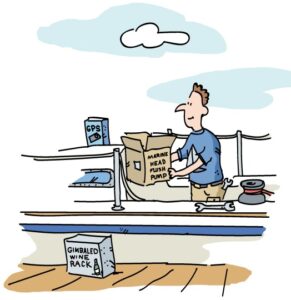
Of course it isn’t. No boat ever is. As such, this will only play for a few weeks unless generously supported with props. Leave some tools here and there. Salvage empty equipment boxes from the marina dumpster and leave them in view, making certain to rotate them from time to time. Avoid exterior projects, unless they are real.
3. The “Gunkhole” Ploy.
Guidebooks can help you righteously declare the popular places too crowded and the out-of-the-way places unworthy. (Of course, the guidebook author has never actually visited the gunkholes, having relied on the experience of another guidebook author, who in turn copied an even earlier author.)
4. The “Wrong Boat” Ploy.
Never mind that people have rowed across the Atlantic, having a smaller boat might get you out of a world cruise, but not local cruising. Or complain that your boat’s deep draft makes thin-water cruising awkward, that its heavy keel is not fun to sail in light winds. Or, taking another tack, that the weather is too strong for your more tender design. By carefully selecting a boat that makes no sense for your local cruising grounds, you can spend years protected by its shortcomings.

5. The “Secret Cove” Ploy.
Speak slowly and reluctantly, with a faraway look. “We’ve been exploring some of the old places, and we’d hate to spoil the sense of discovery for others.” Don’t maintain a blog or readers will expect to see pictures. Proclaim you leave your smart phone at home for spiritual reasons.
6. The “Solo Sailor” Ploy.
The subtlety of this ploy is that no one, other than Solo Sailor, knows where or how he spent the time once he cleared the jetty; everything that happens is a mystery. When you return, describe long, challenging passages instead of shoreside explorations.
7. The “I Have a Family at Home” Ploy.
If you happen to have a spouse and little ones at home, you can lay blame at the feet of your responsible self for not having sailed over the horizon (and hope your prevarications never get back to your partner). Many a Solo Sailor, that ploy having worn thin, has contemplated matrimony as the only honorable way out.

8. The “Game Leg” Ploy.
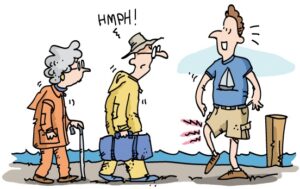
Only an obvious and permanent physical disability is of any real use; a wooden leg just adds flair. The weakness of this ploy is that people older and more disabled than you have sailed everywhere. The sailors you’ll be trying this on have just as many aches and pains as you do. All the same, it is a popular gambit.
9. The “Ill Wind” Ploy.
The standard British climbing mantra of another age was that it took more courage to retreat than to advance, and the best-loved expression was to “give the mountain best.” Hurricane season is a legitimate use of this ploy, but in the hands of a conservative old salt, the definition of “bad weather” can be expanded to include spring storms, summer squalls, fall storms, and, of course, winter storms. Too hot, too cold, and too damp can fill in the gaps. Because absolute safety can’t be planned into a cruise of any length, by combining this one with the “Blue Water” ploy, setting sail can be avoided for years.
10. The “Blue Water” Ploy.
The underlying assumption is that only ocean crossings are meaningful and that local sailing is not worth the work involved in untying the lines. Owning a heavy boat that won’t move without a small craft advisory helps sell this one. Provisioning, preparations, and planning become so involved that an afternoon sail is unthinkable. It helps if you have actually made some passages (not on a cruise ship) or are an accomplished liar.
11. The “Old Man of the Sea” Ploy.
Reaching a venerable three score and ten helps when using this ploy, but developing a proper vocabulary can substitute. Scribble down the most conservative internet wisdom from sailing forums. Read old sailing manuals; if they speak of fiberglass they are too contemporary.
Phrase — Meaning
Seamanlike — Perhaps quite cautious
Conservative — Overweight
Traditional — Obsolete
Plastic fantastic — Not wood
Classic — Pre-Nixon
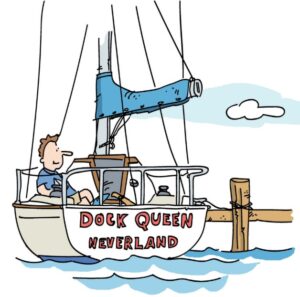
Well-maintained — Dock Queen
12. The “I Can’t Afford It” Ploy.
Since glossy mags began selling the idea that 40 feet was the new 30 feet, this one’s been easy to sell. Although it can be the plain truth if your ambitions include offshore sailing or competitive racing. (And as a semi-retired engineer getting by on a writer’s earnings, I promise you that a nest egg is good and that lack of funds is not a “fun adventure.”)
13. The “I Don’t Have Reliable Crew” Ploy.
This is the inverse of the “Solo Sailor” ploy, but you risk exposure if your mark is a singlehander. There is also the risk you might be invited along by someone else. If this is not the plan, keep the “Game Leg” ploy warmed up by staggering along the dock with a solid limp or wearing an obvious bandage on one hand.
Through skilled orchestration of these ploys, you can safely avoid sailing for many years. A depressingly common variation goes something like this. A dreamer buys his retirement boat, which needs a little work (2 and 12). Budget and physical realities are slowing the work (8 and 12). Though he sailed a little as a child, he is ill at ease (1 and 13) with the new boat, and her deep keel presents limitations (3, 4, and 10). If solutions are suggested, bad weather (9) and obscure requirements of seamanship (11) come to the rescue. On any specific day, family commitments (7) and weather (9) make venturing out inconceivable. Only another sailor experienced in the ploy game can penetrate such multi-layered obfuscation and misdirection and determine whether you had a vague dream that you are still reaching for, or that you are retreating from sailing without actually selling the boat. Perhaps you are undecided.
This is too much work for me. Instead of dreaming up fancy ploys to avoid voyaging, I just say “I don’t wanna,” and I sail where I want, when I want, the weather be damned.
I don’t climb rock as much as I used to either; I just proclaim that I’m old and lame, limiting myself to a dozen trips a year. Ice climbing, on the other hand, still holds mysteries for me, and my skills continue to improve. But the nearest mountains to me, in Virginia, are rather short on ice . . . and there I go using the “Ill Wind” ploy.
Drew Frye draws on his training as a chemical engineer and pastimes of climbing and sailing to solve boating problems. He cruises Chesapeake Bay and the mid-Atlantic coast in his Corsair F 24 trimaran, Fast and Furry-ous, using its shoal draft to venture into less-explored waters. His book, Rigging Modern Anchors, was recently published by Seaworthy Publications.
Thank you to Sailrite Enterprises, Inc., for providing free access to back issues of Good Old Boat through intellectual property rights. Sailrite.com