
Don’t let dock-hose biomass contaminate the boat’s water tanks
Issue 123: Nov/Dec 2018
Every time I take on fresh water, even in my home marina, I get an uneasy feeling. I’ve seen what lives in water hoses, and I don’t want that stuff in my water tanks. Filtration is the answer, but dockside hose filters miss the point entirely, because they can’t catch the junk growing inside the hose. End-of-hose filters may be in the right place, but they remove chlorine (we want that in the tank), reduce flow rates, and don’t last long. Both types of filter stay wet, encouraging bacteria to breed during the weeks they are not used, and while they provide reasonable flow when piped into pressurized systems, they’re useless for jerrycan transfers or rainwater collection.
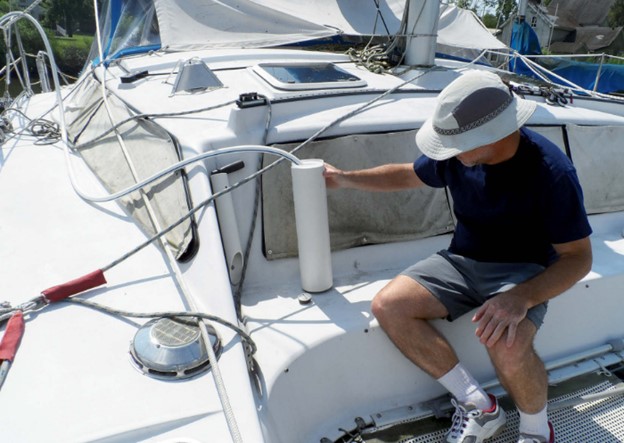
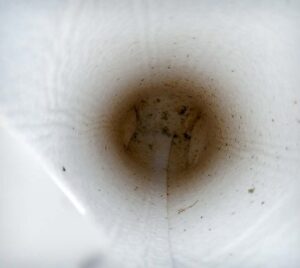
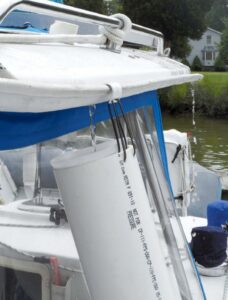
My answer was inspired by the Baja Fuel Filter revered by cruising sailors. Based on a standard industrial bag filter, my DIY water filter offers 1-micron filtration, high flow rates, visible inspection of the water, and no chlorine removal. The bag filters can be dried and even sanitized in the sun between uses, and they can be washed and reused a dozen times before losing capacity. Because my water filter is designed for gravity flow, it works with a hose, jerrycan, water from a grimy public tap, and even with rainwater-collection systems.
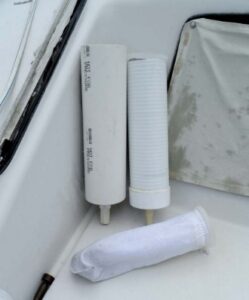
With a few scraps of 4-inch PVC pipe, simple tools, and common skills, a 4- x 14-inch 1-micron bag filter becomes a multipurpose water filter, perfect for the sailor faced with a water supply of uncertain quality.
Filter factors
Bag filters are available in many materials, and in sizes from 4 x 8 inches through 8 x 32 inches. I’ve used all of them over the years in industry. For water filtration, polyester felt removes the particles of interest most economically and efficiently—something to do with surface charge and texture. While coarser bags flow a little faster, I like the 1-micron filtration because it removes a good portion of silt and colloidal dust, ensuring clean water and a clean tank. This size also seems to be the best compromise for the sailor: compact, able to keep up with most dockside hoses, and easily managing rainwater collection and jerrycans.
Four-inch PVC pipe is small enough to support the top ring of the filter and yet large enough to give the bag an easy fit and permit flow along the sides. Foam-cored DWV (drain, waste, and vent) pipe saves weight compared to Schedule 40 or solid DWV. I cut the pipe long enough for the bag to hang free plus about 1 inch for stretch—about 15 inches inside.
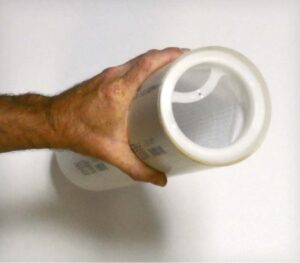
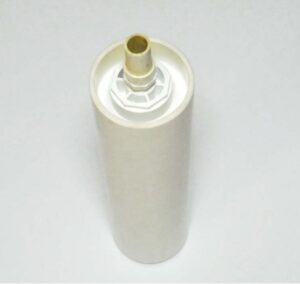
To allow the filter to sit flat over a raised deck-fill plate, I did a little non-standard fitting. I glued a 2- x 3⁄4-inch NPT bushing into a 2- x 3-inch concentric reducer with PVC cement. By grinding off the small tabs that interfered with the fit, I was able to slide the reducer inside the 4-inch pipe. Because the reducer did not fit perfectly inside the pipe, I glued it in place with polyurethane caulk (100 percent silicone caulk would work just as well). I placed a heavy bead about 2 inches from the end, slid the reducer in place, and then added a sealing bead inside and out. The end of the bushing is recessed about 1⁄2 inch inside the reducer, allowing it to straddle the deck plate without wobbling.
When filling a tank via the deck plate, I thread a 3⁄4-inch nipple into the bushing. A 3⁄4-inch pipe-to-garden-hose adapter lets me direct the water to multiple jerrycans.
I still follow safe water-management practices. I chlorinate the water to prevent growth in the tank and to eliminate off tastes caused by sulfate in the water, screen the vent (bugs can crawl in), and have an ANF 53-rated filter before the galley tap to capture chlorine-resistant cysts (cryptosporidium and giardia).
Parts and Prices
Not including the caulk, which most boat owners will have in the boat kit, the total cost to make a filter should be under $25, including the stub for filling tanks and the barb for attaching a hose.
• 1-micron polyester bag filter, seamless, trade size 4 — $7
• 3⁄4-inch NPT x 1⁄2-inch barb, nylon — $3
• 3⁄4- x 4-inch PVC nipple — $2
• 4-inch x 10-foot PVC DWV pipe — $8
• 2- x 3-inch reducer — $2
Total: $22
For a lighter version I made for some friends, I used super-lightweight drain pipe ($10 for 10 feet), matching caps, and a 5⁄8-inch through-hull mushroom fitting in place of the pipe stub and barb. It weighed 1.1 pounds vs. 2.3 pounds for the DWV version, but the flow rate was lower (4 to 5 gpm vs. 8 to 12 gpm—perfect for collecting rainwater). The flow depends on the mushroom size.
• 1-micron polyester bag filter, seamless, trade size 4 — $7
• 4-inch x 10-foot drain pipe, double wall (enough for 6 filters) — $10
• 4-inch PVC drain cap — $2
• 5⁄8-inch Perko mushroom fitting — $10
Total: $29
Both housings use the same filter, McMaster/Carr, 9316T211 (specify 1-micron). mcmaster.com/#liquid-filters
Drew Frye draws on his training as a chemical engineer and pastimes of climbing and sailing when solving boating problems. He cruises Chesapeake Bay and the mid-Atlantic coast in his Corsair F24 trimaran, using its shoal draft to venture into shallow and less-explored waters.
Thank you to Sailrite Enterprises, Inc., for providing free access to back issues of Good Old Boat through intellectual property rights. Sailrite.com