Solving a perplexing problem led to an explosive discovery
Issue 122: Sept/Oct 2018
I dialed the number and waited through several rings. A man answered, and I told him I was the most recent owner of his old sailboat. He was happy to hear about the boat, and happier yet to hear that I was fixing her up, but he stopped me when I told him about a few things that had me stumped.
“Wait a minute,” he said. “You don’t know the history of that boat?”
A wave of nausea washed over me. I thought I knew her history — the guy I was on the phone with had raced her to Bermuda a few times. “No,” I said. “I guess not.”
“You should hang up now.”
“What?”
“You don’t want to hear this. Trust me.”
My mind raced. “It’s too late.”
“I can’t believe you don’t know about that boat.”
In for a long short haul
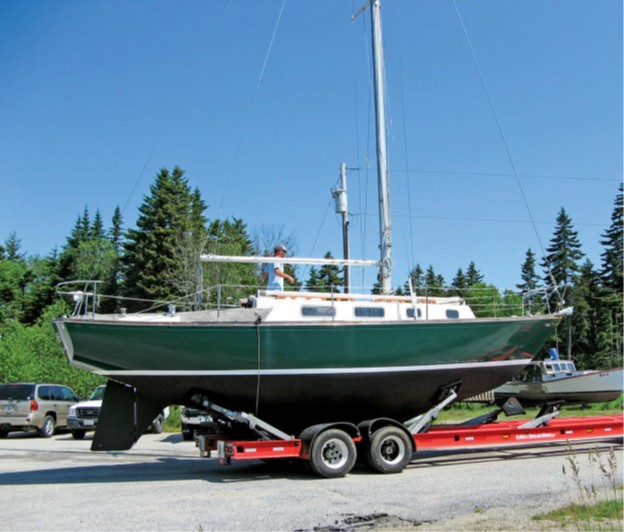
A month earlier, I’d hauled Jade, my new-to-me Tartan 34C, out of the water. The sink-drain seacock was corroded, so I thought I’d do a quick replacement before sailing the boat. As it does on old boats, one thing led to another.
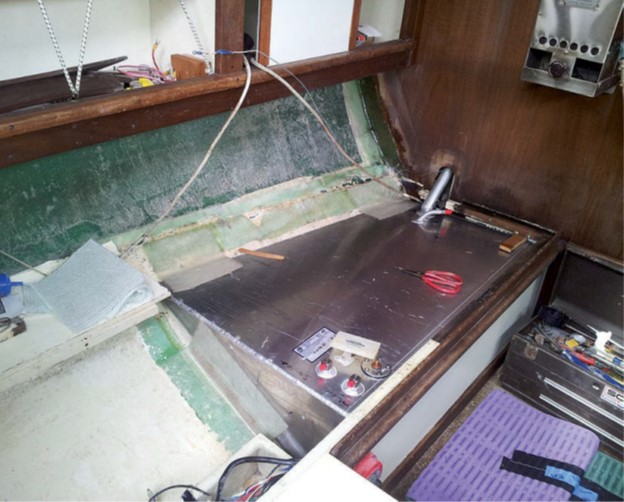
I noticed a faint smell of diesel in the cabin and traced it to a rusted-out fuel tank that had been crudely patched with fiberglass and plastic. Apparently, it only leaked if the tank was filled beyond a certain point, or when sailing and the boat heeled.
Jade was to be my home, and I couldn’t live with leaking diesel, so I cut and ground and wrestled the rusted tank out from the port settee and ordered a new aluminum one from Tartan. While awaiting the arrival of the new tank, and because the boat was already on the hard, I decided to replace the Cutless bearing and repack the stuffing box.
Because the Tartan 34C carries its engine as the centerpiece in the cabin, it’s easily accessible. I was able to free the shaft from the transmission coupling, but in doing so I noticed that two of the motor mounts were shot. Undaunted, I rigged a framework and raised the engine so I could replace the mounts.
At this point, I was in deeper than I wanted to be, but I was making progress. Realizing I wouldn’t make it back into the water for fall sailing, and with the fuel tank a week away and the motor in place but the shaft not yet aligned, I decided to tackle a project I’d planned to do sometime down the road: recoring the foredeck.
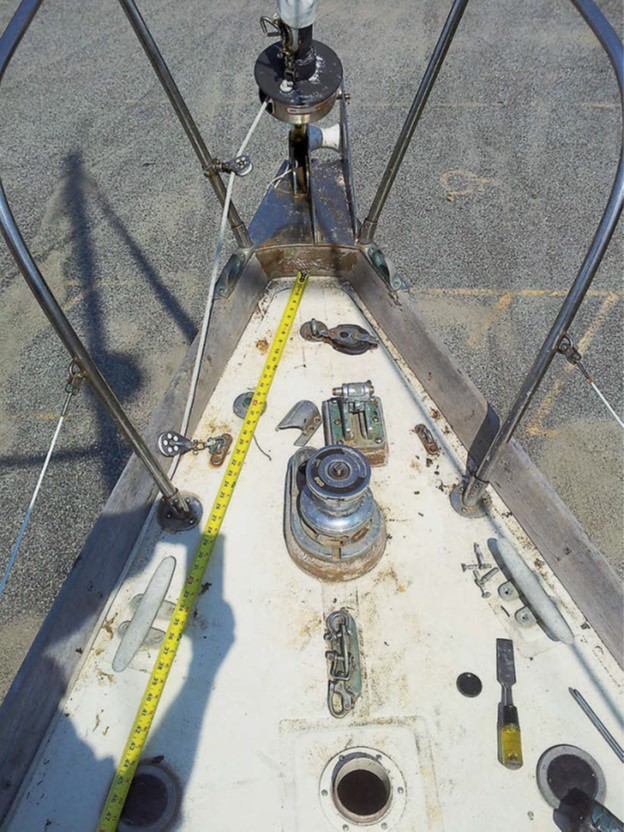
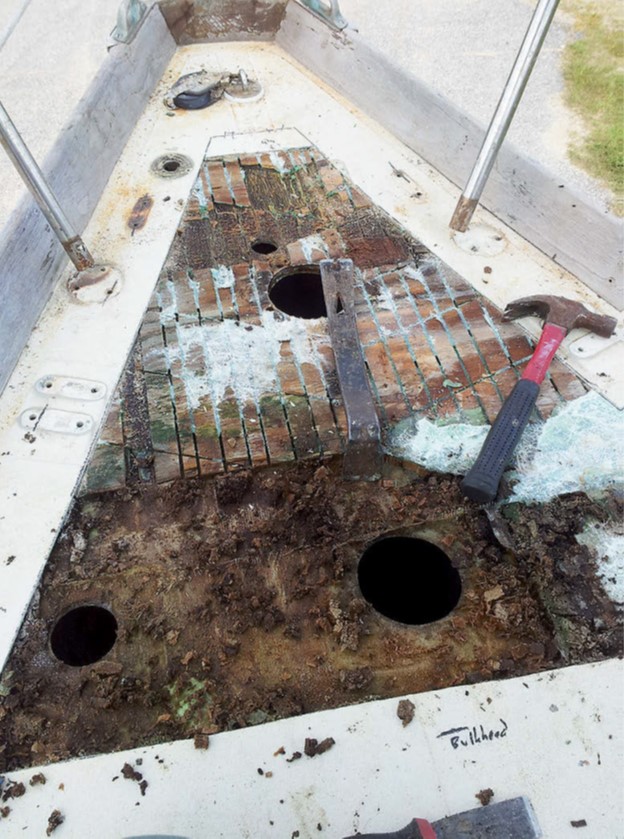
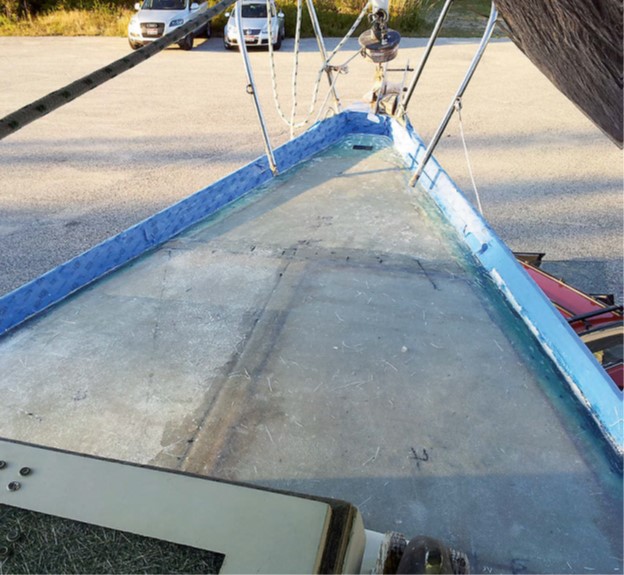
I took photos and made diagrams with measurements so I could later remount the hardware, then I tore the deck apart in stages, scooping and chipping out the rotted balsa as I went. After clearing a section, I reglassed it before moving on to the next, a method that allowed me to retain the shape and strength of the deck while I worked.
Several times, I took a stab at realigning the shaft, but I got nowhere. I wondered if something was wrong with the new motor mounts, but after careful checking I determined that couldn’t be the problem. Yet even with the motor-mount adjustments maxed out, I couldn’t get the transmission and shaft even close to aligned.
I didn’t yet know it, but I was getting in over my head.
Pressing on parts of the main cabin headliner, I felt rot, and discovered evidence of mold. So with a blend of panic and diligence, I tore out the entire headliner and discovered a leak around the diesel heater vent.
Overwhelmed by the projects I’d taken on, I abandoned the foredeck and coachroof and went back to the shaft-alignment problem, which had me stumped.
I pulled the shaft. It appeared straight to me, and when I took it to the local boat mechanic, he said it looked perfect. And then I shined a flashlight down the bronze shaft tube. I saw, plain as day, a nice smooth hook in it, just beyond my nice new Cutless bearing.
I was now daunted and frazzled. I hadn’t done anything, not worked, not exercised, not socialized, not relaxed since I’d bought Jade. My new boat, which was to be my home, was torn to pieces in the town parking lot and I was living on borrowed time in the cabin I’d been renting but was supposed to have vacated.
I’d read magazine articles in which boat owners wrote romantically about fixing up their boats, but I was finding no enjoyment whatsoever. Even the end-of-the-day beers I drank while watching the sun set over the harbor had become more a survival mechanism than a pleasure. Other boat owners let me know I wasn’t the first to experience this. One told me that he nearly went insane working on a boat, finally walking away from it and hiring out the work before his life fell apart. Another told me he stared at the boat in his driveway, aware that it would ruin him, until he forced himself to sell it.
I could empathize, but I still sought a sense of accomplishment, that warm feeling a do-it-yourselfer experiences during and after a job well done. I was in too deep to see straight, too deep to sell, and I couldn’t begin to afford to hire someone to do the labor.
My boat looking like fiberglass stir-fry, I thought back over what the guy who’d sold it to me had said about it. He told me he’d bought it from an offshore racing sailor who’d bought a new boat, and he’d neglected it since taking ownership. “Essentially, I haven’t done any maintenance at all,” he said. “I just skated for a few years on the previous owner’s diligence.” When I later called him about the leaking fuel tank, he admitted to the shoddy repair, and threw in a couple of sails to compensate me, swearing that was all he’d done.
His story didn’t add up. What in the world could have caused the shaft tube to become bent?
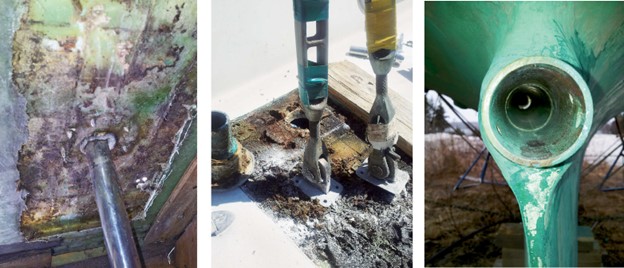
That’s when I dug through the paperwork and found the original owner’s name. He was thrilled to hear about his old boat. He’d raced Jade several times in the Bermuda Race, and he was happy to hear that I was doing so much work on her. Then I asked about the shaft tube. That’s when he said, “You don’t know the history of that boat? I stored Jade on the hard at a marina down here,” he began. “There was an ink factory nearby. It exploded.”
A state of shock
Afterward, I’d wake at night, thinking about my boat in an explosion and be unable to fall back asleep. I felt sick. I was dismayed that the guy I’d bought Jade from, a guy I’d instinctively trusted, hadn’t divulged her history, even when I’d asked. I felt like I’d wasted all my work, time, and money. I was no longer sure I was restoring a solid sailboat, one worthy of my efforts.
So I did the only thing I really knew to do: I dug in deeper. I went all in, because it was either that or walk away. I finished the foredeck, beefing it up with an extra layer of glass over a foam core, and I got rid of the troublesome windlass controls, which had caused the rot in the first place. My goal was to make Jade safe and simple — and beautiful whenever possible.
A mechanic friend stripped the windlass of its electrical parts and converted it to simpler and lighter no-fail manual operation. Down below, I removed the old head, filled the through-hull holes, and put in its place a homemade composting toilet.
All the while, I stewed over the guy I’d bought Jade from. After a month, I decided to write him a letter. I started by thanking him for the boat. I told him about all the work I was putting into her. Then I mentioned that I’d talked to the previous owner, that I’d learned about the explosion, and that I expected him to make things right.
Two weeks later, we talked on the phone. He defended the fact that he hadn’t told me, citing that every old boat has a history, perhaps hitting bottom, a drop by a travel lift, a collision with a dock or boat . . . and I could see his point. I’d been around boats enough to know that things happen.
“The word ‘explosion’ just sounds bad,” he said.
I agreed, especially when applied to my single-largest investment to date. He swore that the boat wasn’t in bad shape when he’d bought her, and that the original owner had dramatized events during our conversation. (Apparently, the boat had suffered a percussive impact, not a fire-and-fury Hollywood blast.) Then he offered to buy her back from me. But she was in pieces and I had countless hours and no small amount of cash into her.
A week later, I received a check for $1,000 from the seller. He said I could use the money for a survey if I was concerned about the soundness of the hull, though he himself did not doubt that the boat was solid. I appreciated the gesture and thought about the survey, but by then I’d had my head in every nook and cranny in the boat. I’d stripped off the bottom paint and seen the gelcoat. I’d been all over the topsides, and I was back to feeling that I did, in fact, have a solid boat, but one that needed a ton of work, most of which had nothing to do with an explosion. So I put the money into the Jade fund, where it disappeared faster than I would have thought possible.
I was a guy in a parking lot with tarps, very limited funds, and an old Subaru full of tools. But I resolved that my project was not only possible, it was worthwhile. The only downside of the affair was that, if and when I sold her, I’d have to explain to a prospective buyer everything that I had not been told, thus limiting the value of the boat — and therefore the value of my efforts. But I chose to ignore that, and pressed on as if I’d have the boat for the rest of my life.
Luckily, I knew several guys in Down East Maine who’d spent their lives in boat shops. So I gathered opinions, and a local surveyor stopped by and looked the boat over. Everyone agreed that nothing significant was wrong with the boat, she was just a bit forlorn. These guys figured separately that the fiberglass hull had flexed from the percussive impact and then returned to its original shape, a characteristic of fiberglass. But the bronze stern tube had only flexed one way. The absence of cracks or spiderwebbing in the gelcoat suggested that the flexing wasn’t major. So perhaps the guy I’d bought it from had been correct and the damage was not catastrophic.
My mechanic friend ran a 6-foot pry bar into the new Cutless bearing — which became sacrificial — and he worked from the far end while I monitored the straight line we’d rigged. Nothing happened at first, then suddenly, and with a creak like a sigh of relief, the shaft tube sprang back into position. We set the bar aside, checked the tube, and it was straight as an arrow.
Into another year
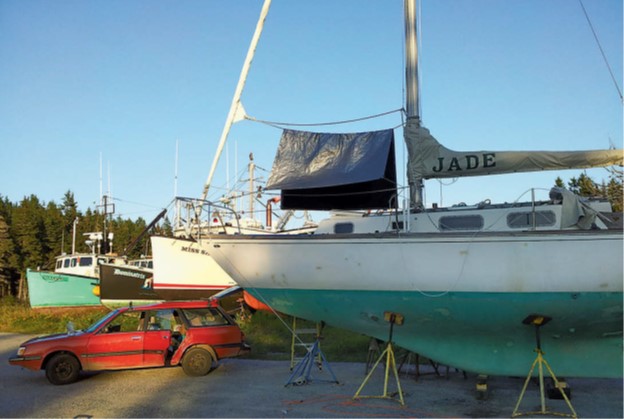
I spent winter away from the boat, but when spring came, bitter cold, I set to work on the centerboard. After researching on the internet, I shifted the blocking beneath Jade’s keel to one block just forward of the centerboard; apparently, that was the center of mass for the boat, and she’d balance there. I added another set of jack stands for safety’s sake, bringing the total number to nine. I parked my old car as close to the boat as I could, reasoning that if Jade fell, she’d crush the car and not me or a passerby.
My mechanic friend and I crawled under and chipped the still-frozen earth from beneath the keel with hammer claws. Gravel and clay spit out in small chunks until we had a trench deep enough to drop the centerboard into. It was a hard-won victory. My friend’s help reaffirmed a basic tenet of friendship: to lend a hand in executing the stupid.
I ground the board to expose the stainless steel shank, and took it to a machine shop to be rebuilt. Then I reglassed and faired the board, and had the same machine shop make me a new stainless steel pin.
While it was still too cold to paint or fiberglass, I removed the rudder heel fitting and had an insert machined and pressed into it to eliminate the small amount of slop.
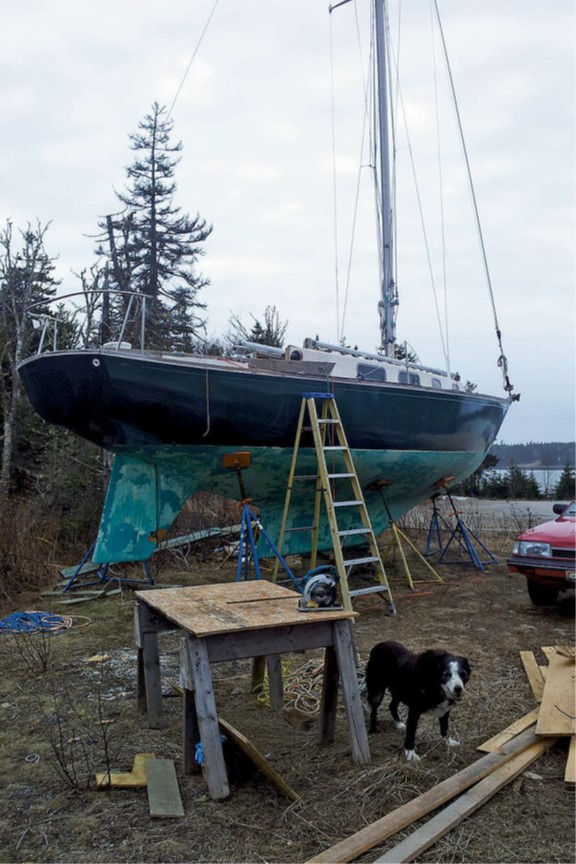
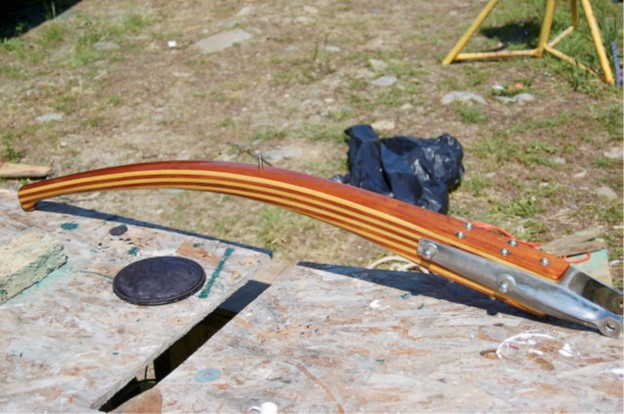
When the days warmed, I finished the foredeck, recored the cockpit sole and the areas around the chainplates, and repaired the two leaking sections of the coachroof. A woodworker neighbor, who’d taken an interest in my project while on his daily walks, made new mahogany handrails and a beautiful tiller of ash and mahogany. After installing the handrails, I replaced the old cabin headliner with varnished birch plywood. I then painted every inch of the boat, top to bottom.
Finally, Jade was safe, simple, and solid — and she looked good.
In the water
By the end of June, I was living on a borrowed mooring amid the lobster fleet with my 16-year-old border collie, Henry, whom I hadn’t expected to live long enough to have to move aboard. But like Jade, he’d defeated the odds.
Through the summer, and in between my time digging clams on the mudflats to support myself, I cruised Down East. In the fall, I headed south for Portland, where I wintered in a slip. Everything went well with the boat, but by the time I reached Portland I realized that the motor mounts I’d installed were loose in their beds; the lag bolts weren’t finding enough purchase. So, settled for the winter, I again lifted the engine out of her.
I drilled out the holes in the engine beds and filled them with epoxy, then redrilled them, making sure the motor mounts wouldn’t move. True to form, I couldn’t stop there.
Before returning the Westerbeke to its home, I painted and rewired it, pulled the transmission and had it resealed, and replaced the torsion plate, as it had been making some noise. Each morning, I had to convert my home to a shop, then at the end of the day remake it into a semblance of a home.
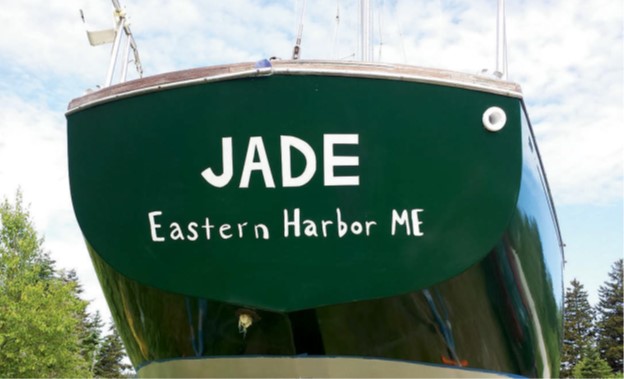
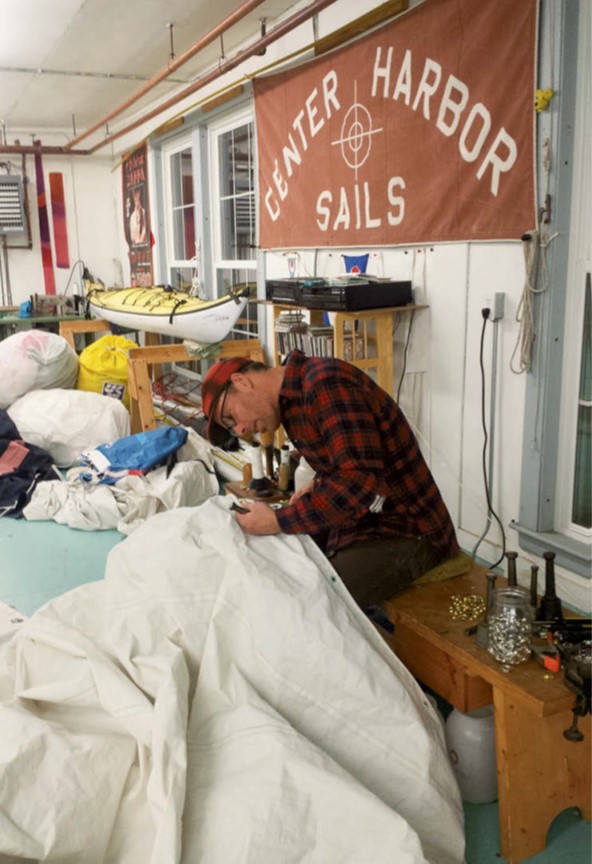
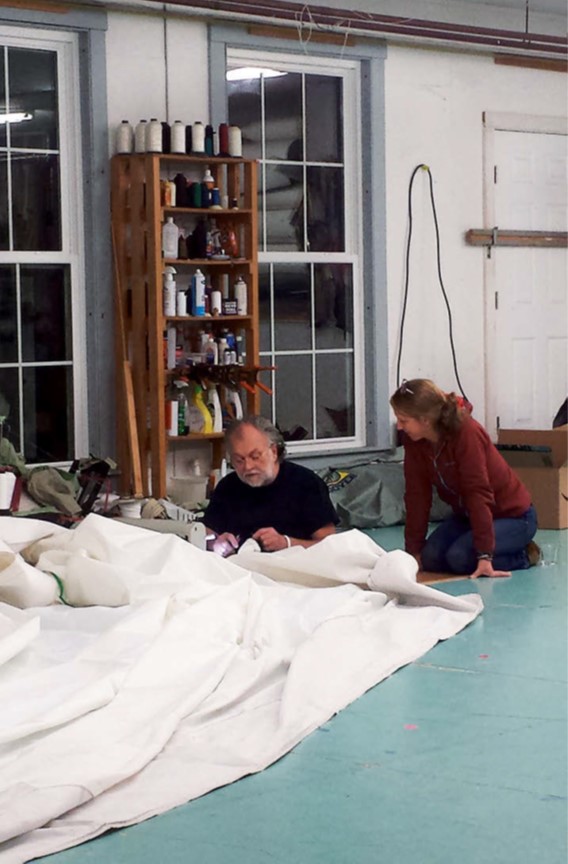
After finishing the engine, I knew that my project days were over, that I’d finally be able to sail Jade and work on her teak at my leisure, like the yachtsmen around me. But since then I’ve replaced the standing rigging and recored the last of the rotted balsa decks and completed a bunch of rewiring, which itself was a simple pleasure after dealing with epoxy and fiberglass. I met a sailmaker willing to teach me how to refurbish my sails, and I spent many evenings with him in his sail loft, resewing seams and replacing grommets while eating pizza, drinking beer, and listening to Frank Zappa.
So all is well, and I now know every inch of my boat, and with a gallon of epoxy and a toolbox (and a 6-foot pry bar) I can fix nearly anything that goes wrong with her. So the old circumnavigator friend of mine had been right when I’d asked him if I should buy a sailboat. He hadn’t said yes or no; he’d just laughed and said, “Well, you’ll learn a lot, Captain.”
Jon Keller, a writer, commercial fisherman, and former Montana guide, divides his time between his sailboat and Down East Maine cabin. His first novel, Of Sea and Cloud, was published in 2014.
Thank you to Sailrite Enterprises, Inc., for providing free access to back issues of Good Old Boat through intellectual property rights. Sailrite.com