Shedding water is the key to longevity
Issue 114: May/June 2017
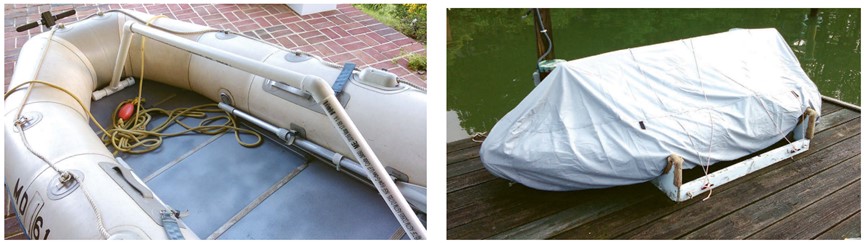
When inflatable dinghies are stored outdoors, they need protection from the sun, rain, windblown leaves, and wildlife droppings. Of the commercially available covers, some do not include a means to “tent pole” the cover so that it sheds rain and snow. Those that do rely on a single adjustable pole for support, a method that allows pockets to form in the cover where rainwater will pool. High wind and the weight of the accumulated water can unbalance and collapse a single pole. I used to rely on a single pole but, even after I added a plywood base to stabilize it, high winds and pooled water would eventually dislodge the pole.
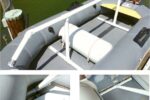
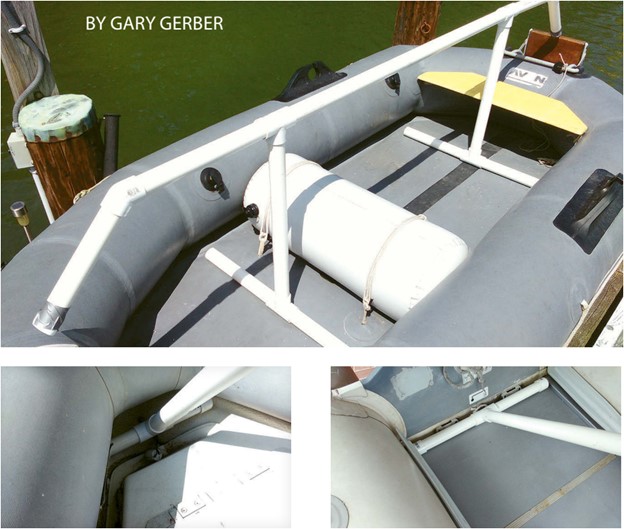
My friend John Gaston of Annapolis devised an inexpensive solution to the problem of supporting a dinghy cover. I came to appreciate his approach and today, between John, me, and my brother-in-law, we have four dinghies, each stored in a different setting, some with an outboard mounted, some without. Small tweaks to John’s approach allow it to work in all four cases.
John’s cover support is a framework assembled from 1 ¼-inch PVC pipe, assorted elbows, and PVC cement, inexpensive materials that are readily available at hardware stores. A standard 10-foot length of pipe costs in the region of $5 and can be cut with a hacksaw. I permanently joined some smaller pieces with PVC cement and left others unglued so I can disassemble the frame for storage. Gluing PVC is quick and easy, just be sure to buy PVC glue and follow the directions on the can. (Black ABS pipe is an acceptable alternative but requires an ABS glue.)
While the design can be customized to work best with any particular dinghy, a couple of design principles will apply in all cases. In short, the longitudinal ridge support should be high enough to provide adequate slope for water runoff and to shield motors and motor mounts (when installed), and it should be long enough to spread the cover over most of the length of the dinghy.
Gary Gerber, a retired industrial designer, has been sailing for more than 45 years in coastal New England, the Caribbean, and the Mediterranean. He lives in Annapolis and sails his 1970 Morgan 33 on Chesapeake Bay.
Thank you to Sailrite Enterprises, Inc., for providing free access to back issues of Good Old Boat through intellectual property rights. Sailrite.com