Night-watch ruminations lead to an unsolvable riddle
Issue 120: May/June 2018
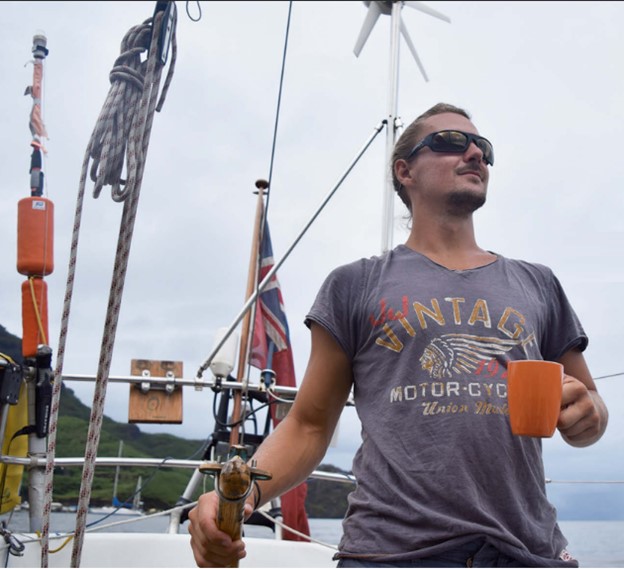
I have a confession to make. It’s been six months and 6,000 miles since my mate James and I set sail from Portland, England, on a round-the-world adventure aboard our 32-foot Nicholson, Blue Eye. That’s not the confession . . . our families do know where we are.
My confession is that I do not know what sailing is.
I was struck by this strange and discomfiting thought as we night-sailed the hundred-odd nautical miles from Bonaire to Aruba — two of the ABC Islands just off the coast of Venezuela.
Now, hear me out, because I can feel you frowning down at this imbecilic young man who has somehow drifted all the way from the UK, across Biscay, the Strait of Gibraltar, and even the Atlantic, and he now finds himself in the Caribbean Sea without an inkling as to what he’s doing. Well, let’s just back things up a bit.
I know how to get a boat to a point where it is sailing, and I know what it is to not be sailing. I know what sailing looks like, and I know what it feels like. What I do not know is at what point I am sailing.
When Blue Eye is on the desired course with the appropriate amount of sail hoisted, and we’ve trimmed her so as to be moving along at the optimal — albeit often slow — speed, she, the boat, can be said to be sailing.
But it is precisely at that point where the state of sailing is attained that I am doing nothing. I might occasionally tweak the jibsheet or slightly alter our course, but these actions take only a moment. I am not, after all, racing; I’m a liveaboard looking to do the bare minimum to sail safely from one place to another.
Indeed, we are fortunate that Blue Eye can take care of herself mostly, so long as we have balanced the sails and set up Victor the Vane correctly. (Victor is our Aries self-steering windvane, so named because he copes with adversity and because alliteration is fun.)
Anyway, given all this, it appears to me an impasse is reached. While I’m being active setting up the sails, the boat is not sailing. But from the moment the boat is sailing, I am no longer active. Do I, therefore, define sailing as the process of achieving the state of sailing? At best, this is unsatisfying; at worst, it is a fallacious circular argument.
In the case of garden croquet, played by many a Brit on a sunny summer’s day amidst a haze of Pimm’s, Wimbledon, and red trousers, the time spent setting up the lawn is not considered “croqueting.” Rather, it is the act of swinging a weighty wooden pendulum between those red trousers, in vain efforts to knock a heavy ball through a grounded hoop, that is deemed to be “croqueting.”
If you think about it, then — and apparently I have — sailing is a peculiar activity in that the physical activity of the sailor is not what it is to be sailing at all, but it is rather the act of not sailing that is thought of as sailing.
At least this is certainly the case for the lazy liveaboard such as myself. At the point that I am supposedly “sailing,” I’m doing just about anything to distract myself from that very fact. On this particular occasion, I’m considering the juxtaposition posed by the extensional and intensional definitions of what it means to be sailing.
I turned to the Oxford English Dictionary for help (and to check that my use of the long words above was vaguely correct). It defines sailing as “The action of sailing in a ship or boat.” To someone who has by this point spent a six-hour watch trying to set straight what was once so simple, this was achingly vague.
Sod it, I thought to myself, as we glided through the Caribbean waters on that moonlit night, leaving Bonaire behind us and heading to the bright lights of Aruba. What is sailing?
“It is what it is,” as a mad galley chef I once knew used to say. I gazed from the sails carrying us along beneath the stars to the illuminated waves licking at the hull to Victor the Vane doing all the hard work. It was plain sailing, I mused, whatever that might be. . .
Tom Dymond is from the southwest of England, but his nautical routes began with work aboard yachts of the rich and famous in the Mediterranean and Caribbean. He soon saw sense, and traded in a paid and comfortable position on a luxurious vessel for a berth on a creaky old Nicholson 32. He and his friend James are now on an eye-opening, adventurous, and occasionally haphazard three-year circumnavigation on Blue Eye.
Thank you to Sailrite Enterprises, Inc., for providing free access to back issues of Good Old Boat through intellectual property rights. Sailrite.com